


Padres Video
The Padres are a winning team playing losing-team baseball, at least when it comes to their swing profile.
As of early June, San Diego boasts some of the strangest plate discipline numbers in baseball. They have the second-highest chase rate in the league at 30.2% O-Swing%, meaning they swing at pitches outside the strike zone more than all but one team, the Colorado Rockies. Yet they also have the fourth-lowest Z-Swing% at 62.9%, meaning they’re letting more strikes go by than nearly anyone.
That alone is unusual, but the quirks don’t end there.
Despite those swing decisions, the Padres remain one of the league’s most contact-oriented teams. They are tied for the second-highest O-Contact% at 59.2% and rank sixth in the league in Z-Contact% at 87.2%. That gives the Padres the sixth-highest Overall Contact% at 78.7%, with the team also having one of the lowest strikeout rates in the league at 19.1%, the third-lowest in MLB.
So what happens when a team swings at bad pitches, takes good ones, and still manages to put the bat on the ball? In the Padres’ case: a lot of soft contact, opposite-field singles, and missed opportunities.
The Padres have been very good at putting the ball in play, but not very good at doing much with it. They have the second-lowest Hard-Hit% (36.6%), second-lowest Barrel% (6.7%), second-highest Groundball% (46.3%), second-lowest Flyball% (34.1%), and the highest Opposite-Field% (27.6%) in the league.
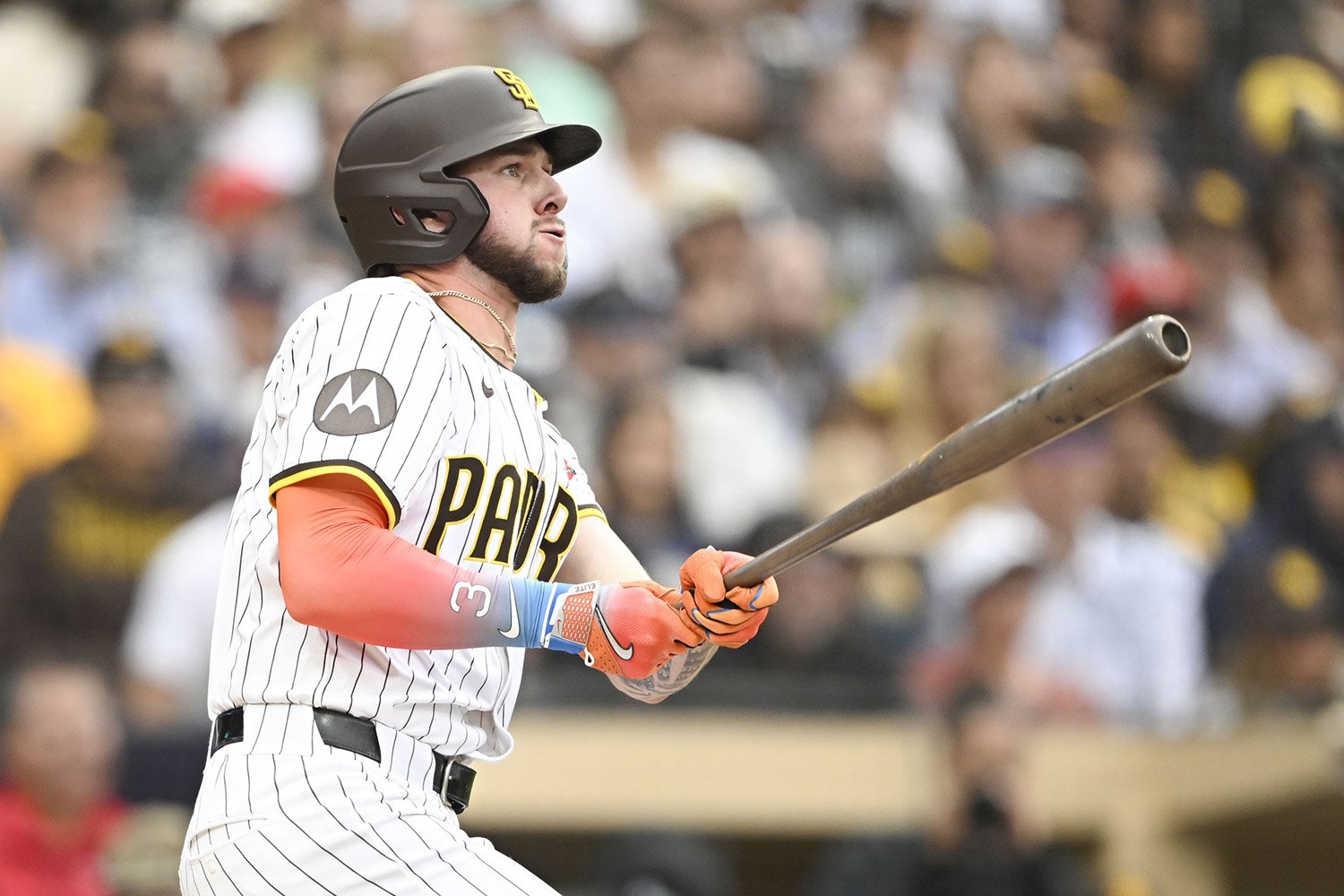
That paints the picture of a lineup that isn’t exactly hunting damage. While the contact rates are impressive on paper, most of that contact is weak, on the ground, and going the other way. For some hitters, such as Luis Arraez, that’s a feature. But for a lineup that includes Fernando Tatis Jr., Manny Machado, Jackson Merrill, et al, it feels more like a bug.
In theory, a contact-heavy offense can be effective, but it typically requires being paired with quality swings in hitters’ counts, gap power, or elite baserunning. The Padres also aren’t making up for the lack of pop with patience, as their 8.3% walk rate ranks just 20th in MLB, suggesting they’re not exactly grinding out at-bats, either. In addition, the team isn’t hitting the ball hard, which means they’re putting a lot of pressure on sequencing and timing to score runs. And it’s not that they can’t score, but they’re doing it in a way that leaves little margin for error.
This combination of high contact, low walks, and soft contact is something you might expect from a rebuilding team like the Rockies or White Sox. Not a contender built around stars and veteran bats.
To their credit, the Padres have stayed afloat in the playoff race. They’ve held their own in a top-heavy NL West, and their rotation has given them a chance most nights. But the offense feels like it's constantly walking a tightrope.
They're succeeding in ways that aren't typically sustainable, those being chasing bad pitches but still making contact, making contact but not hitting the ball hard, and putting balls in play, but not walking or slugging.
To be fair, there’s value in avoiding strikeouts, and San Diego ranks near the top of the league in that department. It’s also true that opposite-field contact can work well if it's intentional and well-executed. But when over a quarter of your batted balls go the other way, and your groundball rate is almost 50%, it suggests a team that isn’t consistently getting the swings they want.
Baseball has shown that chasing and grounding out isn’t a recipe for October. Eventually, pitchers will attack the zone more aggressively, knowing the Padres aren’t pulling the trigger on strikes, and when they do swing, they’re not doing much damage.
The bottom line is that the Padres' offense isn’t broken. But it’s undeniably strange.
They make a ton of contact, but much of it is on the pitcher’s terms. They're swinging at the wrong pitches, and taking the right ones, yet still putting the bat on the ball better than most.
Whether it's a clever new approach or just a weird statistical fluke, it’s one of the most confusing storylines of the 2025 season.
And sooner or later, something may have to give if the Padres want to compete in the second half, as we’ll find out whether this contact-first chaos can hold up, or whether the Padres are just making a lot of noise without saying much at all.





Recommended Comments
There are no comments to display.
Create an account or sign in to comment
You need to be a member in order to leave a comment
Create an account
Sign up for a new account in our community. It's easy!
Register a new accountSign in
Already have an account? Sign in here.
Sign In Now