


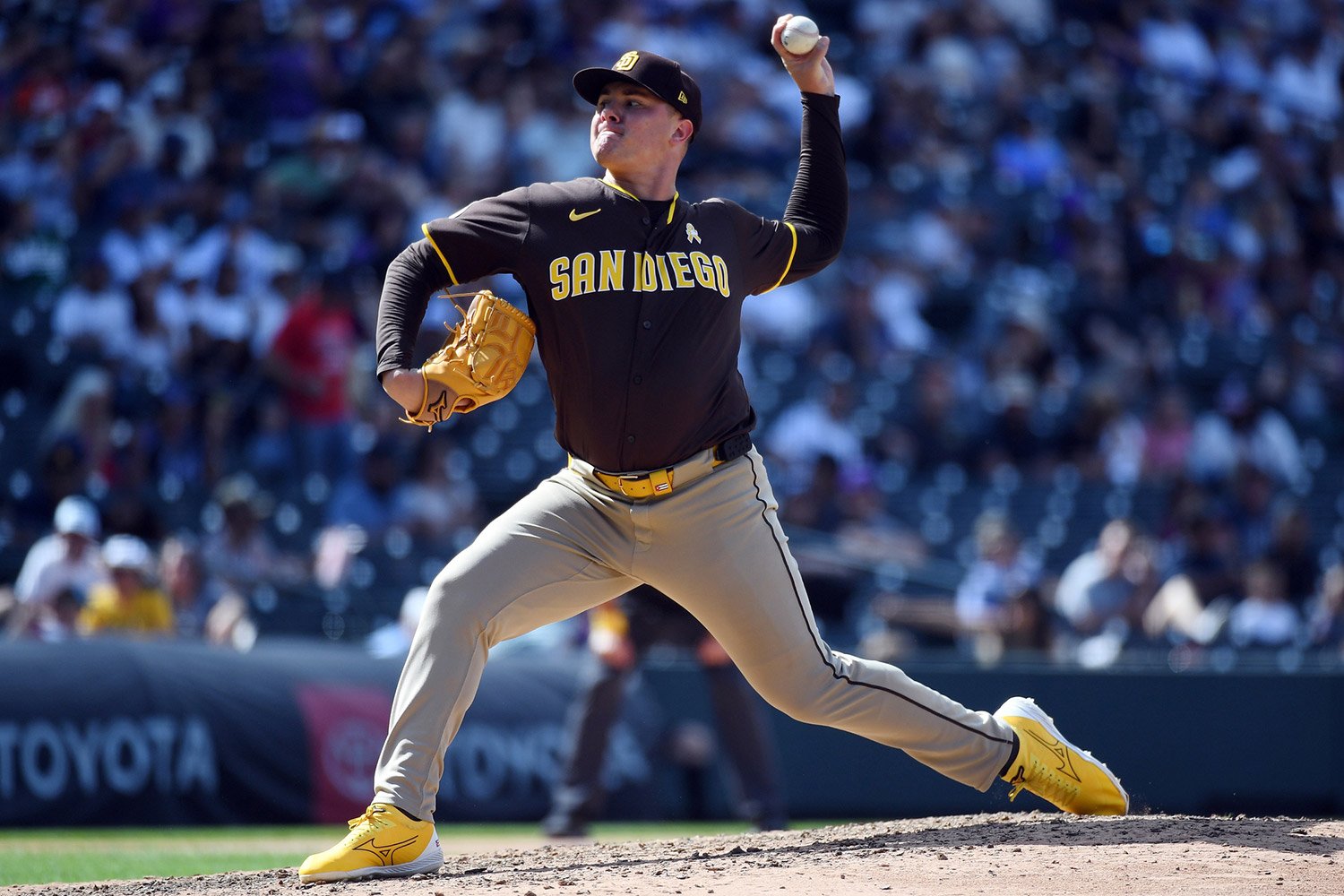
Padres Video
Considering how velocity and movement have evolved in baseball over the last handful of years, a certain archetype has emerged, predominantly in the bullpen. Two-pitch pitchers are the flavor of the day, with one of those pitches checking in as a high-velocity fastball of some sort and the other coming out of either the breaking or off-speed category. These two primary pitches collaborate in generating a high number of swinging strikes.
While this might read as something of an oversimplification, it's also something that the San Diego Padres employ in force in their own relief corps.
Robert Suarez. Mason Miller. Jeremiah Estrada. The San Diego 'pen is one that runs deep in terms of velocity, movement, and overall volume while leaning heavily on two primary pitches. And, unsurprisingly, it's been quite effective. As a collective, Padre relievers sport the fourth-highest strikeout rate in the sport (24.6 percent) and the fourth-highest whiff rate (12.7 percent). They've induced a chase rate that trails only the New York Yankees (33.4 percent). Somewhat surprising, however, is the fact that Adrian Morejon is not one of the major contributors to those specific efforts.
Don't get it twisted; Morejon has been one of the very best relief pitchers in Major League Baseball in 2025. His percentile chart would tell you as much:

Among 156 qualifying relief pitchers, Morejon ranks 16th in innings (65 1/3), fourth in ERA (1.79), fifth in FIP (2.18), and second in hard hit rate (28.5 percent). Expected metrics love him, too; his 2.17 xERA and .237 xwOBA each rank third. Given the combination of his status among his reliever comrades and where he lands on the percentile spectrum, it'd be fairly objective to note that Adrian Morejon has emerged as one of the premier bullpen arms in Major League Baseball. What's impressive, though, is that he's doing it in a sort of defiance of his archetype.
That archetype, of course, is the two-pitch, high-whiff arm that has become almost a necessity across the relief pitching landscape. It isn't a total defiance, however. For one, Morejon is a two-pitch pitcher. He's thrown his sinker about 61 percent of the time this year and his slider roughly 35 percent of the time. He's also bringing elite velocity to the table. While it isn't completely top-tier velo, a 93rd percentile fastball would still fit the bill. To say nothing of the movement he's getting from the slider (almost 37 inches of vertical drop).
Instead, we need to look to a more specific component of Morejon's game in discovering where he's actively working against the type of pitcher we might expect: the strikeouts.
As much as the top of the various leaderboards features Morejon's name fixed in a prominent position, the strikeout game is where one is required to do a bit more searching. His SwStr% comes in at just 10.5 percent (unsurprising given his 37th percentile whiff figure) and is the 110th-ranked rate among that reliever group. His strikeout percentage, meanwhile, sits only 59th (25.7 percent). Not that this is leading us to perceive Morejon as a reliever of lower quality. He's clearly one of the top arms in that role. It's more than it leads us to two specific questions.
The first of which is how he's managing to register so few punchouts against many of his counterparts with similar skill sets. The other is the manner in which he's finding success despite pitching at a lower rate, which is almost a prerequisite for success in relief at the game's current level of evolution.
Our first query is actually a fairly easy one to answer. The sinker is Morejon's primary offering. It's generally not a pitch type that's going to lead to whiffs on its own. For that, you'd need a fastball of a different variety. Instead, a sinker is almost designed to generate contact rather than avoid it. Morejon wants you to swing at — and hit — his sinker. The result is a swing-and-miss percentage lingering around just 15 percent, but getting the ball on the ground about 56 percent of the time. When that's the pitch you're throwing at as high a volume as Morejon is (over 60 percent of the time), it's quite reasonable not to expect to see too much on the strikeout side. Those that he does register are wrought by the slider, with which he's garnering a whiff rate (39.4 percent) and a strikeout rate (36.4 percent) more than and nearly double the sinker, respectively.
But even sans strikeouts, his deployment of the sinker at a high volume is leading to its own brand of success. Morejon has a 56.3 percent groundball rate and a Pull AIR% of only 5.9 percent with the sinker. His overall figure in the latter category is a third-ranked 7.0 percent, which means that the sinker is doing a healthy part of the work toward keeping the ball on the ground.
It's a number of factors to stack. He's getting the minimal barrel output from opposing hitters. He's getting the ball on the ground and avoiding the pull-air combination that has allowed so many hitters to thrive in 2025. The slider is there when he needs the whiff, but the contact game is where Morejon is making his bones this year. Velocity, sure. Movement, yes. But the true driver is location:

The above visual represents the work Morejon has done with his sinker, specifically. That's a whole lot of gray, representing an out in the field. Factor in the strikeouts, and there's a whole lot of good being done against the little bit of production you see on the part of opposing hitters.
Morejon's development has been a key factor in the San Diego bullpen's success this year. The possibility exists that he returns to his starting roots at some point. The form his usage takes at that point will be fascinating. In the meantime, it's important to acknowledge that despite fitting the profile of many of his relief counterparts across the realm of Major League Baseball, Morejon is finding his success in a way that stands quite opposed. He's not any worse for it, either. If anything, it's an example of a player executing exactly what works for his own success in trying too hard to pursue the punchout side of things.





Recommended Comments
There are no comments to display.
Create an account or sign in to comment
You need to be a member in order to leave a comment
Create an account
Sign up for a new account in our community. It's easy!
Register a new accountSign in
Already have an account? Sign in here.
Sign In Now