


Padres Video
Despite their loudest trade deadline move being an addition to an area of strength in Mason Miller, A.J. Preller and the San Diego Padres spent the bulk of their time ahead of July 31 putting the focus where it was most warranted: on the offense. In the weeks since, it's transpired just about as well as one might've hoped.
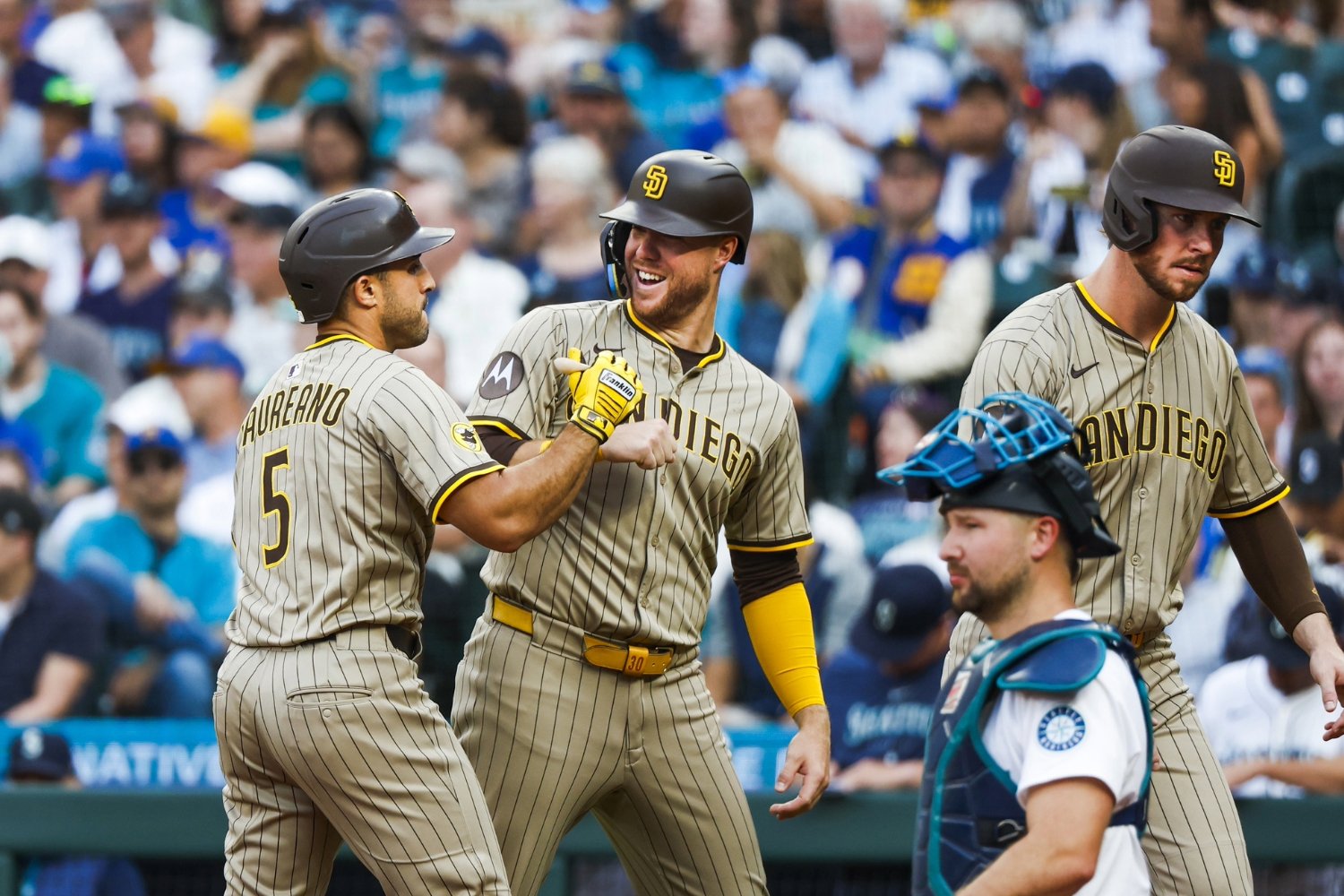
Ramón Laureano has been a genuine difference-maker in his first 100 plate appearances with the team (174 wRC+), while each of Ryan O'Hearn and Freddy Fermin have provided a boost relative to where they were most needed (corner infield power and competence behind the plate, respectively). That trio of acquisitions initially left very little time for one Gavin Sheets.
One of the team's more important bats, particularly during the rough offensive stretches of June and July, Sheets didn't appear in a game post-deadline until August 4. It was another week before he drew another start on August 11. The week after that brought a pair of pinch-hit appearances and a single start. All told, Sheets had made just three starts through August 18, with three pinch-hit appearances. He certainly bore the mark of someone who was set to serve as a situational player more than one with everyday merits to his name.
A combination of factors, however, have led to a renewed role in the San Diego lineup for Sheets. Most notably, that's been the injury to Jackson Merrill. Sheets has subsequently been thrust into regular work in left field, including a string of nine consecutive starts on the outfield grass. Defensive concerns notwithstanding, his bat has brought a welcome presence back into the lineup.
That didn't seem like it would always be the case, however.
The nature of playing for the current iteration of the Chicago White Sox is that you're easily going to be hit with the change-of-scenery label upon your departure. Sheets looked the part for the first two months of the year. Working his way into more playing time, his 130 wRC+ in April and May trailed only Manny Machado and Fernando Tatis Jr. among Padres regulars. He was striking out far too much (24.1 percent), but supplying much of the power that the collective had to offer (.229 ISO). Then, the calendar hit June.
In each of June and July, Sheets' production tailed off considerably. His wRC+ fell to 102 in June and just 65 in July. His power output dissolved, going from a .149 ISO to a .086 mark between the two months. Weirdly, he struck out only 15.9 percent of the time and was still walking at a decent clip (8.8 percent), but the batted ball results weren't promising.
There was a luck component involved, including a .219 BABIP in July, but the remainder of the explanation for Sheets' struggle is fairly unclear. He didn't feature any strange distribution in pitch types nor did pitchers overly adjust to his early-season production. There was a bat speed spike in July, but nothing else unusual mechanically. Perhaps this is a scenario where we can actually call the luck factor a factor. Because, since working his way back into regular work, it's one working well within his favor.
Since the start of August, Sheets' line checks in at .350/.409/.725, with a .375 ISO and a 214 wRC+. There's obviously a sample component to such gaudy numbers, but within that, Sheets' BABIP is at .379. So, the luck has returned, in addition to the power.
Perhaps more impressive than the numbers themselves is that Sheets is doing this while being more aggressive than he has at any point during the season. His Swing% this month is at 46.7 percent. That comes in just higher than his rate during the first month of the year and comfortably ahead of any month since. His chase rate is not quite his highest, but still abnormal at roughly 31 percent. Yet, this is also a notable trend within his overall plate discipline:

Even when Sheets was going well early in the year, his chase and miss habits were cause for concern. That's reflected in the ballooned strikeout rate and a roughly 75 percent contact rate that was one of the 60 lowest in the league (among 169 qualifiers) in those first two months. Essentially, Sheets was giving the perception of a power-or-nothing type bat. He then reined it in and upped the contact rate to almost 80 percent, but was confronted with some brutal luck along the way.
But now, we're looking at a more complete hitter in the form of Gavin Sheets. There's the aggression, but he's finding far more contact as a hitter than he was even at his early-season best. As of this writing, Sheets is making contact at a 82.1 percent rate and adding the elevation that hadn't been present when his struggles began (his 46.6 percent fly ball rate is his highest of the year in a given month).
It's not particularly deep, either. We're not necessarily looking at a player who overhauled his mechanics or completely renewed his approach. He simply needed to make more contact and he did. The organic process of batted ball luck was the only thing standing in front of him realizing the value of that increased contact. The result is a version of Sheets that's going to continue to find his way into the lineup, even when the group is back to full health.





Recommended Comments
There are no comments to display.
Create an account or sign in to comment
You need to be a member in order to leave a comment
Create an account
Sign up for a new account in our community. It's easy!
Register a new accountSign in
Already have an account? Sign in here.
Sign In Now