


Padres Video
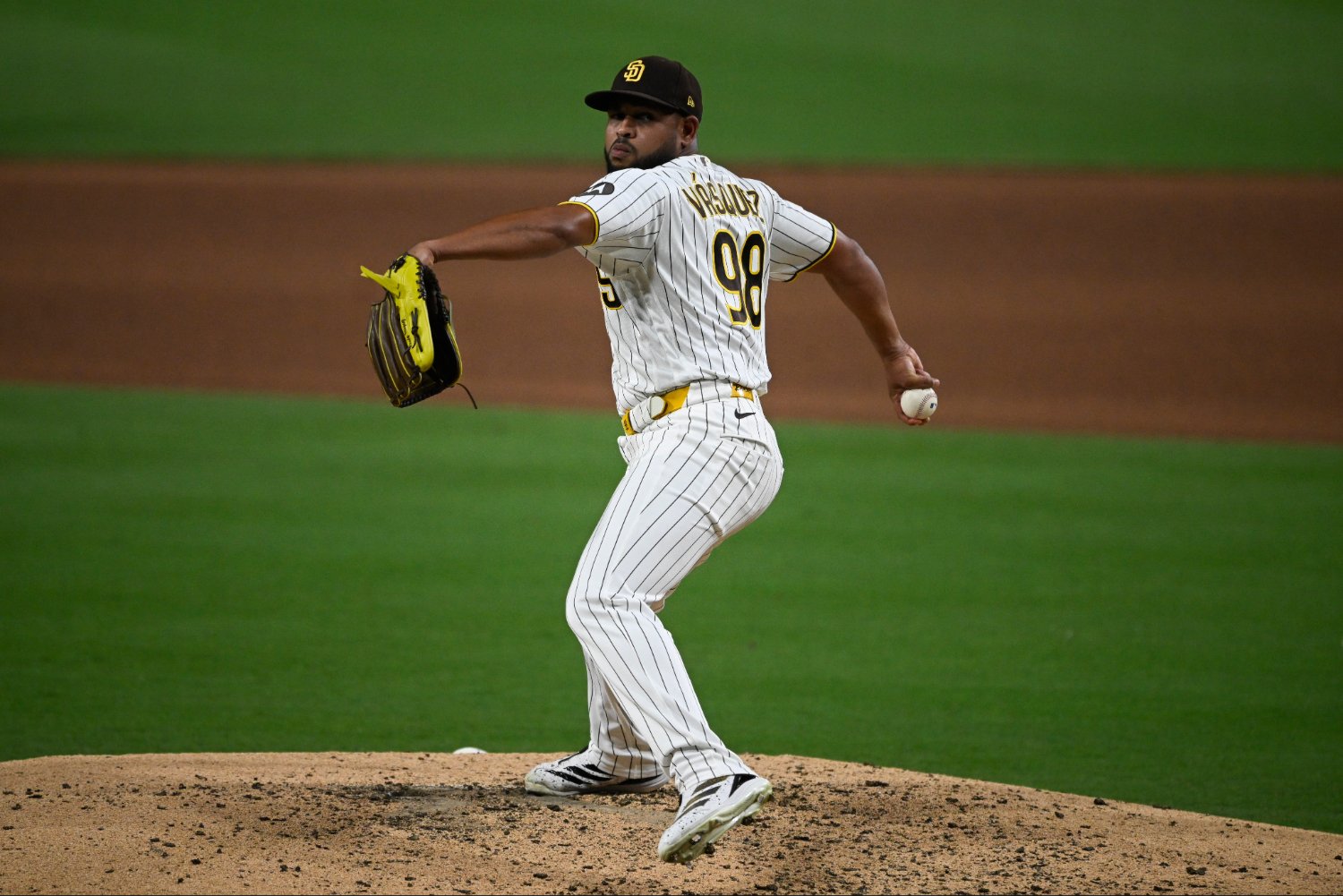
For a pitcher, problems are not always just in the execution of his pitches. San Diego Padres right-hander Randy Vásquez embodies that truth. He seems like he can exhibit a more dominant version of himself at times, and then you get periods of collapse like he had at the end of May. After beating the Seattle Mariners with six scoreless innings and just four hits allowed in a 2-0 victory on May 15, he could not secure at least six innings again in his next 12 appearances, four of them as a reliever. The Padres decided to remove him from the starting rotation and Vásquez entered one of the worst stretches of his career. In his 11 outings from May 20 through July 25, he went 1-5, 7.20 ERA, 6.72 FIP with 10 home runs allowed and a 1.12 K/BB rate.
When we analyze his repertoire, his curveball was the most vulnerable pitch. Between April and July, batters hit .309 xBA with .440 xSLG. The story repeated itself, as in 2025 Vásquez allowed a .497 xSLG and .486 in 2024 when he threw his curveball. By gaining almost 3 mph of velocity in 2026, from 81.2 to 84.0 mph, his curve lost vertical drop, going from 48.1 to 41.8 inches. That evolution did not favor Vásquez, who depended too much on his most vulnerable pitch.
Then, the Padres fixed it. In the most recent stretch, since July 30, Vásquez has made 10 outings. He returned to the starting rotation and is 4-0, 2.76 ERA, 3.40 FIP and has accumulated a hold. He has allowed only two home runs against 162 opponents and his K/BB rose to 2.5, surpassing his career average (1.88).
The key was in the utilization of his repertoire. He began throwing fewer curveballs and more sinkers in pressure counts. Against left-handed hitters, with the batter ahead in the count, he eliminated the curveball and increased his attack with the sinker from 4% to 36%. When the at-bat reaches the finish in two strikes, he still uses the curveball against left-handed hitters, but dropped from 33% to 8%, and has placed more of his trust in the sinker, from 5% to 28%.
Now comes the most interesting part of that new strategy: the batters, who had hit .385 in the first stretch between May 20 and July 25, saw their average against the sinker fall from .385 to .200 and their slugging from .539 to .255. Vásquez was throwing the sinker in fewer favorable counts, but even though the samples were small, there are considerable differences in terms of dominance.

In the graph on the left, which corresponds to the first period we have analyzed here, Vásquez was hit through the middle vertical part of the zone, but in the second period his sinker has done more damage against the opposition. He is still in danger when he stays high in the strike zone, but in the middle and on the outside corner it has been lethal against left-handed hitters, achieving the effect that the curveball had not been able to.
Another one of the adjustments within Vásquez’s mix is in his use of the cutter, which he is now using more frequently to open the count against right-handed hitters, going from 30% to 45%. It took away prominence from the fastball and the cutter has also improved in the decisions of the at-bats. In the first stretch, the cutter allowed a .405 average and .905 slugging, but Vásquez has limited hitters since, leaving them at marks of just .130 and .217, respectively. He has also turned it into a more effective weapon for generating swings and misses, improving almost twice as much in whiffs%, from 13.0% to 24.6%.
| Pitch Type | 05/20/2026 to 07/25/2026 | 07/30/2026 to 09/15/2026 | ||||||
|---|---|---|---|---|---|---|---|---|
| BAA | SLG | Whiff/Swing | GB/BIP | BAA | SLG | Whiff/Swing | GB/BIP | |
| Four-seam | .289 | .444 | 18.4 | 20.5 | .158 | .290 | 17.2 | 30.3 |
| Sinker | .385 | .539 | 9.3 | 43.5 | .200 | .255 | 6.9 | 51.0 |
| Change | .333 | .444 | 7.7 | 33.3 | .211 | .316 | 26.7 | 75.0 |
| Slider | .444 | .889 | 13.3 | 14.3 | .500 | 1.000 | 0.0 | 33.3 |
| Curve | .378 | .600 | 13.8 | 50.0 | .083 | .083 | 17.4 | 70.0 |
| Cutter | .405 | .905 | 13.0 | 23.8 | .130 | .217 | 24.6 | 44.4 |
Here is Randy Vásquez’s recent improvement, summarized in two key changes: fewer hard-hit balls and home runs allowed. He has limited contact and the adjustment in his pitch mix is giving him the possibility of generating more swings and misses. He is also increasing his ground-ball rate with all his pitches, another turning point in his favor as he continues to recover his ability to strike hitters out.
All these adjustments by Vásquez have come at a key moment of the season, while the Padres continue to wait for the consistency and durability of Casey Mize and Robbie Ray, who have not found their best form after joining the team at the trade deadline. If this continues, we could see Vásquez handle some extremely important innings in October, either as a starter or reliever.





Recommended Comments
There are no comments to display.
Create an account or sign in to comment
You need to be a member in order to leave a comment
Create an account
Sign up for a new account in our community. It's easy!
Register a new accountSign in
Already have an account? Sign in here.
Sign In Now