


Padres Video
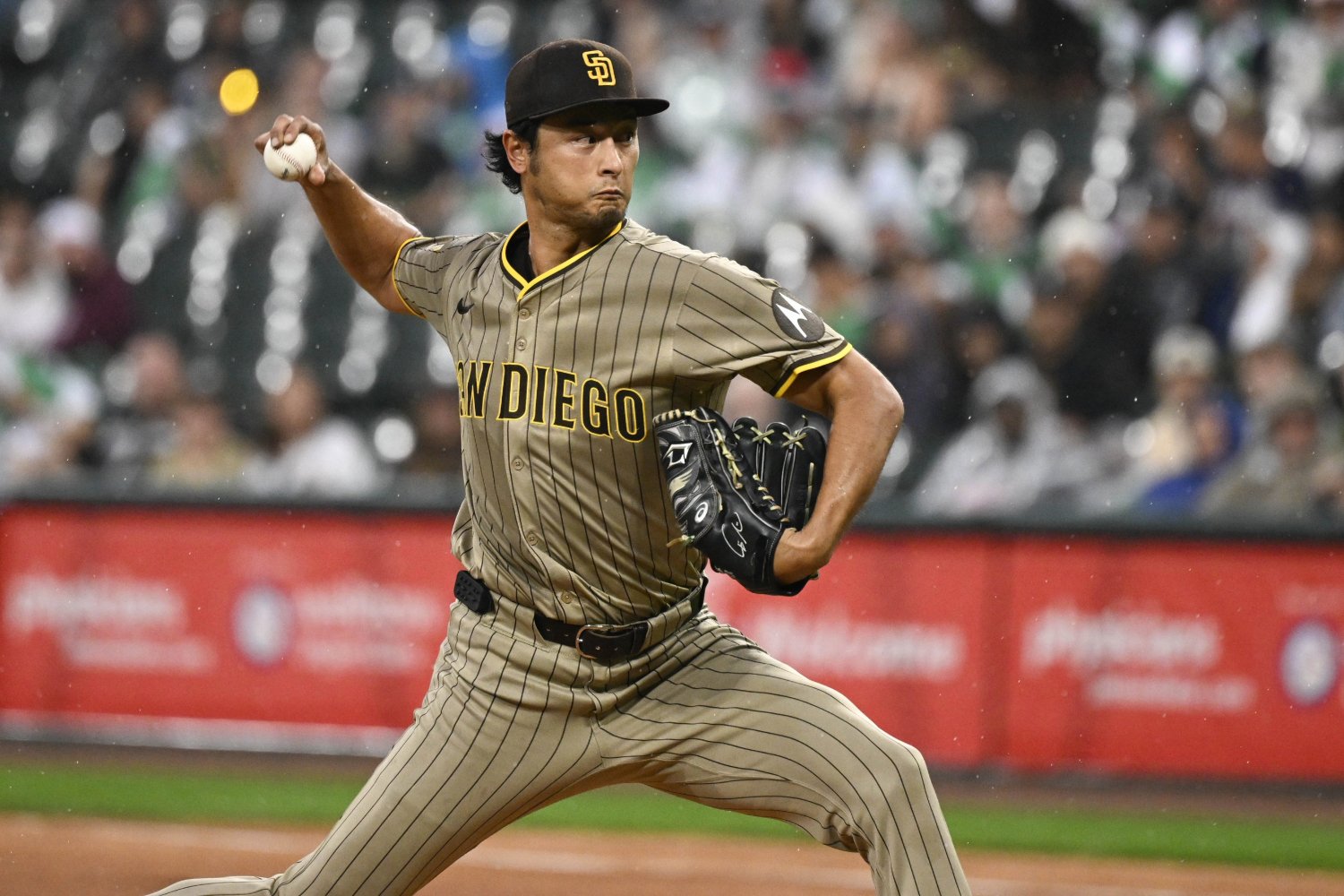
Yu Darvish is one of the last vestiges of the "workhorse" starter, an archetype that has been slowly dying out over the last 20 years. He's completed 175 or more innings five times in his career, though only once since arriving in San Diego prior to the 2021 campaign.
Despite being 39 years old, Darvish remains effective and one of the most unique pitchers in the league. His arsenal goes eight pitches deep according to Baseball Savant, with no offering being featured more than 21% of the time (his sinker leads the pack). His expected stats also remain favorable, with a 3.29 xERA, 94th-percentile average exit velocity allowed (86.7 mph), and a scant walk rate (6.2%) highlighting his ageless abilities. Even if he can't push his fastball into the upper-90s or fan 30% of hitters like he used to a decade ago, Darvish continues to be a solid anchor in the Padres' rotation.
The issue is, recently, Darvish hasn't looked much like himself. His 5.51 ERA on the season is disappointing, but again, his expected metrics paint a far rosier picture of his abilities. Over the last month and change, though? Father Time appears to be closing in on its next victim.
Darvish got off to a slow start this season, only making his debut in July after missing the first three months of the campaign with elbow inflammation. Things hit a nadir on July 24 when he allowed eight runs in 3 1/3 innings to the St. Louis Cardinals, though he quickly righted the ship, allowing just four earned runs over his next 17 innings.
Unfortunately, it's been downhill ever since. Beginning with his next start after that good stretch of pitching (an Aug. 17 loss to the Dodgers), Darvish has surrendered the following: a 5.40 ERA, a .240/.296/.464 batting line (.328 wOBA), a 5.07 FIP, and, most disastrously, 2.2 home runs per nine innings. He's also going less than five innings per start despite throwing an average of 80 pitches in each appearance. His efficiency his waning, and hitters are clearly catching onto his guise.
Now, there are some encouraging metrics -- his 25.7% strikeout rate and 4.4% walk rate remain elite for a starter -- but typical indicators of positive regression aren't on his side. His .265 BABIP allowed is already slightly better than average, as is his 66.0% left-on-base rate. Generating a few more groundballs would surely help his cause (and eliminate some of those pesky home runs), but the fact is hitters are pulling the ball more than 53% of the time against Darvish during this stretch. Even if he can still fool them often enough to generate a bundle of strikeouts, the power numbers (eight home runs allowed in last seven starts) won't creep down without a systematic change to his approach.
That change could actually exist within his famously diverse arsenal; a simplification of it has always seemed like heresy, but it's clear that some offerings are now plainly more effective than others in Darvish's advanced age. Let's compare some of his similar pitches to get a sense of what we're looking at:
- Fastball: 93.4 mph, .365 SLG (.284 xSLG), .313 wOBA (.277 xwOBA)
- Sinker: 93.9 mph, .361 SLG (.316 xSLG), .262 wOBA (.233 xwOBA)
- Sweeper: 36.4% whiff rate, .333 BA (.276 xBA), .556 wOBA (.465 xwOBA)
- Curveball: 34.2% whiff rate, .133 BA (.155 xBA), .201 wOBA (.204 xwOBA)
Again, part of what makes Darvish so effective is his ability to pull any of his many tricks out of his hat in any given moment or situation. The solution here isn't as simple as just "eliminate the sinker and slider", because then the fastball and curveball don't work as well. The movement profiles alone are different enough to justify their inclusion, not to mention the fact that Darvish can throw variants of his different pitches to further mess with a hitter's eye level or timing.
Still, when some offerings are so clearly more effective than others, there comes a point at which you have to tighten the leash on freedom and creativity. With Michael King back in the rotation, the need for Darvish to be a bona fide No. 3 is no longer as pressing; it's entirely likely that King, Nick Pivetta, Dylan Cease, and Randy Vásquez make up the Padres' playoff quartet of starters, assuming they even escape the best-of-three Wild Card Round.
Nevertheless, Darvish is still a weapon, even if it's as a long reliever out of the bullpen. Don't forget, this is a guy with a 2.56 ERA in six playoff starts (38 2/3 innings) for the Padres over the last three years. If he can make the necessary changes to keep hitters off balance more often, he could be Mike Shildt's X-factor in the playoffs.





Recommended Comments
There are no comments to display.
Create an account or sign in to comment
You need to be a member in order to leave a comment
Create an account
Sign up for a new account in our community. It's easy!
Register a new accountSign in
Already have an account? Sign in here.
Sign In Now