


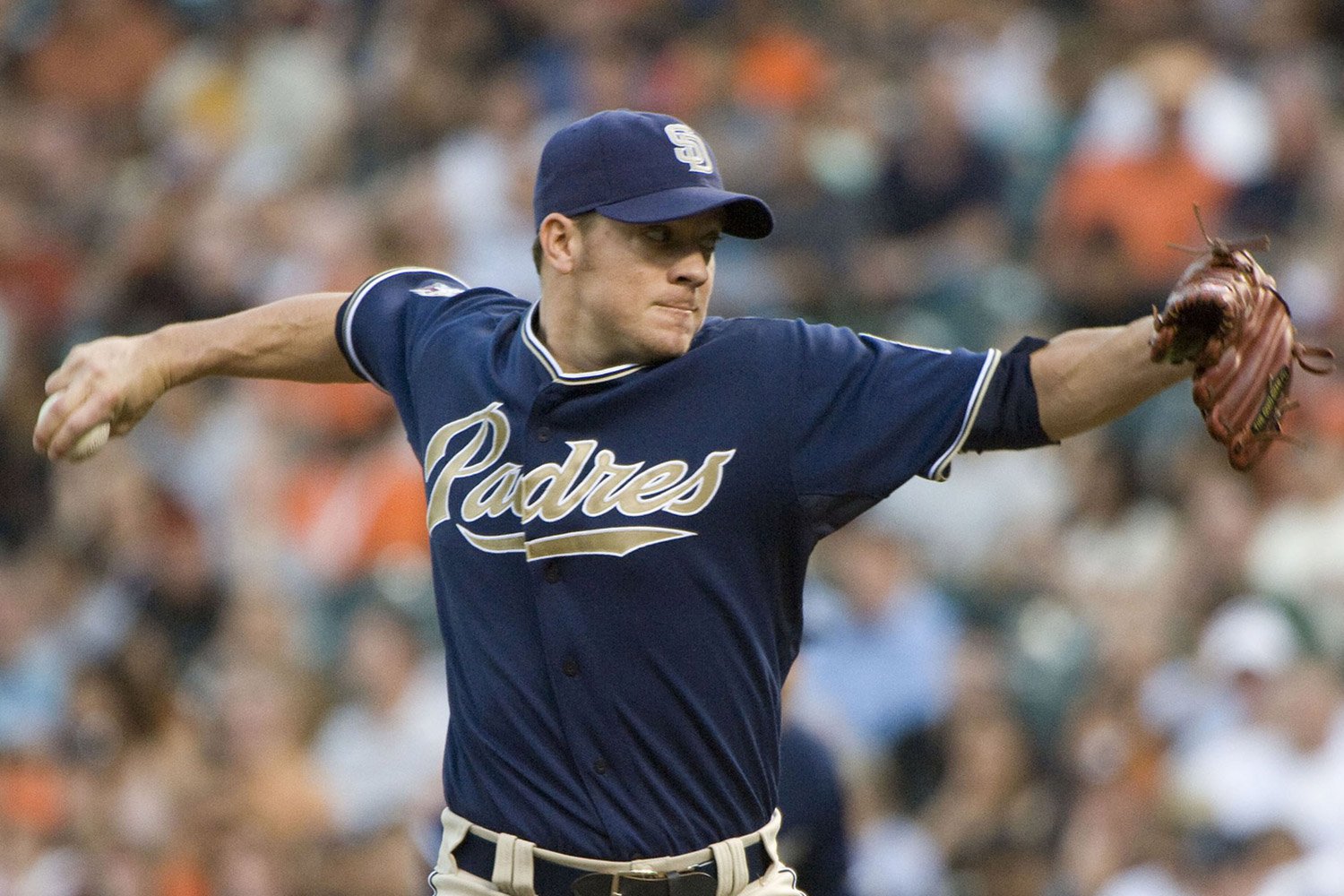
Padres Video
Before diving into this article, we recommend reading previous entries in this series, along with an introduction in part one. With that said, let's look at the gold standard Padres, starting rotation.
Part one: Gold Standard Padres, Infield Edition
Part two: Gold Standard Padres, Outfield Edition
Part three: Gold Standard Padres, Bench Edition
The Starting Rotation: The Masters of the Hill
The architects of the rubber. These arms took the ball every fifth day, carrying the hopes of the city for nine innings at a time. Through heat, movement, control, deception, and sheer will, they turned the mound into a sanctuary and defined the different eras of Padres baseball.
Kevin Brown "Brownie" "The Hired Gun" 1998 (8.6 WAR) The Sinkerball Assassin
W-L: 18-7 | ERA: 2.38 | FIP: 2.23 | SIERA: 2.71 | SO: 257 | IP: 257.0 | CG: 7 | SHO: 3 | WHIP: 1.07 | K/BB: 5.24 | K%: 24.9% | K-BB%: 20.2% | ERA+ 164
NL All-Star (1998) | NL Player of the Week (Aug 16 & Sept 20, 1998) | Clyde McCullough Pitcher of the Year Award (1998) | Padres Chairman's Award (1998)
The Five Pillars of Brownie
Innovation: Brown was the architect of the modern "power sinker," a pitch that defied the laws of physics in the late 90s. While most sinkerballers of the era sat in the high 80s, Brown’s clocked in at a staggering 96-98 MPH with a violent, late horizontal run. Under the specific guidance of pitching coach Dave Stewart in 1998, Brown perfected a devastating split-finger fastball that mimicked the exact arm speed and tunnel of his sinker before falling off a table. This two-pitch tunnel made it impossible for hitters to distinguish between a ball breaking into their hands or one diving into the dirt. He effectively weaponized the ground ball and the strikeout simultaneously in a feat rarely seen before the Statcast era—a combination of power and precision that paved the way for the high-velocity, high-spin specialists of today's game.
Impact: Kevin Brown’s presence changed the entire culture of the 1998 clubhouse. His "bulldog tenacity" was contagious, leading the staff to an imposing identity. In the playoffs, he famously outdueled Randy Johnson in Game 1 of the NLDS with 16 strikeouts—setting a franchise postseason record and the tone to upset the 102-win Astros. He followed that by silencing the 106-win Braves in the NLCS, throwing a three-hit, 11-strikeout complete game shutout in Atlanta that gave San Diego a commanding 2-0 series lead. During the regular season, he led the National League with 8.6 WAR and set a Padres franchise record with 257 strikeouts, a mark that still stands today. He finished the year with 7 complete games and 3 shutouts, while leading all of Major League Baseball with a microscopic 0.3 HR/9.
Legend: Kevin Brown's 1998 season is widely regarded by historians as the most dominant single-season pitching performance in San Diego history. Beyond the record-breaking stats, he provided the psychological edge the franchise needed to transition from a divisional contender into a legitimate national juggernaut. He remains the only pitcher in club history to anchor a World Series run while simultaneously leading the entire Major Leagues in overall value with an 8.6 WAR. Brown arrived as the ultimate "hired gun," and though his tenure lasted only one summer, he established an impossible standard of excellence that remains the benchmark for every San Diego ace who has followed. His 1998 campaign is the definitive chapter of Padres pitching lore, representing a moment when the best pitcher on the planet belonged exclusively to San Diego.
Iconic Look: Brown was the intimidating face of the Padres' 1998 "pinstripe" era in navy blue and orange. On the mound, he was a study in controlled aggression, standing 6'4" with a menacing, stoic expression and a traditional clean-shaven look that highlighted his intense, focused game face. His appearance was anchored by the team's navy blue crown cap featuring the iconic white-and-orange interlocking "SD" logo, a color scheme that became the visual hallmark of the 1998 World Series run. In an era where many pitchers were moving toward loose, baggy styles, Brown maintained a sharp, athletic appearance with high-set shoulders and a deliberate, high-leg kick. He exclusively used a dark Rawlings heart-of-the-hide pitcher’s glove with a closed web to hide his grips on his legendary sinker and split-finger pitches. The finishing touch to his look was his signature intensity; he rarely smiled, and his jersey was often stained with sweat and dirt, reflecting the grit he brought to every start.
The "Did You Know Factor": Kevin Brown’s 1998 season was so dominant that he finished in the top four of the National League in every major pitching category: Wins (18), ERA (2.38), and Strikeouts (257). He was the only pitcher in the Senior Circuit to achieve that level of "Triple Crown" consistency that year. Despite his dominance, Brown finished 3rd in the Cy Young voting behind Tom Glavine and teammate Trevor Hoffman. This created a historical rarity: Brown and Hoffman became the only pair of teammates to finish second and third in the voting while the award went to a player from a different team. Perhaps most impressively, Brown surrendered only 8 home runs across 257.0 innings; he famously struck out twice as many batters in a single playoff game (16) as he allowed home runs over the entire 162-game regular season schedule.
Randy Jones "The Junkman" "Jonesie" 1976 (7.8 WAR) The Workhorse of Mission Valley
W-L: 22-14 | ERA: 2.74 | FIP: 3.16 | SIERA: 3.42 | SO: 93 | IP: 315.1 | CG: 25 | SHO: 5 | WHIP: 1.027 | K/BB: 1.86 | K%: 7.4% | K-BB%: 3.4% | ERA+ 119
NL Cy Young Award (1976) | Sporting News NL Pitcher of the Year (1976) | Baseball Bulletin NL Pitcher of the Year (1976) | NL All-Star (1975, 1976) | NL Player of the Month (April & May 1976) | NL Player of the Week (May 22, 1976) | Padres Team MVP (1975, 1976) | Clyde McCullough Pitcher of the Year Award (1975, 1976) | Padres Chairman's Award (1975, 1976) | No. 35 Retired by Padres (1997) | Padres Hall of Fame (1999 - Inaugural Class)
The Five Pillars of Jonesie
Innovation: Jones was the master of the "sinker-slider" approach, a style of pitching that served as a radical, cerebral departure from the high-heat dominance that defined the mid-70s. Relying on impeccable control and late, biting movement rather than raw velocity, Jones innovated through a blend of psychological warfare and relentless tempo. He famously worked with a rapid-fire cadence that bordered on the obsessive, often completing nine full innings in under two hours. By weaponizing the diving action of his sinker and varying its speeds to create a "ghost" effect, he forced the opposition to play at his speed, turning aggressive swings into a record-setting parade of weak ground balls and demoralizing double plays. He proved that a pitcher could dominate the strike zone and dismantle an order without ever needing to touch 90 miles per hour on a radar gun.
Impact: He was the ultimate "workhorse" during a fragile era where the Padres franchise was still desperately fighting for respect and a foothold in the National League. In 1976, Jones got a season started that remains statistically unprecedented; he became the first pitcher in National League history to be named Player of the Month in back-to-back months (April and May). This early-season blitz anchored the entire organization, as he went on to lead the major leagues in Wins (22), Starts (40), Innings Pitched (315.1), and Complete Games (25). His efficiency was unmatched, finishing the year with a league-best 1.027 WHIP, proving he could maintain elite precision despite the massive workload. This output single-handedly preserved a thin bullpen and gave a young, often outmatched San Diego team a legitimate chance to win every fifth day.
Legend: In 1976, Randy Jones became a literal folk hero, cementing his place in San Diego lore as the first pitcher in franchise history to capture the Cy Young Award. Following a 20-win season in 1975, where he was arguably snubbed for the honor, he returned with a quiet vengeance, capturing the hearts of the city during a historic summer where "Randy Jones Day" became a mandatory local holiday. He was the first true superstar the city could claim as entirely their own—a home-grown icon who provided a symbol of hope for a young expansion franchise. His legacy is defined by his "weapon of choice"—a sinker with a distinct screwball tilt that baffled the era's greatest hitters. This unique movement, combined with a superior mental plan, allowed him to out-duel Hall of Fame flamethrowers with surgical precision.
Iconic Look: With his trademark blonde curls flowing out from beneath his cap and his classic brown and gold #35 jersey, Jones was the visual pulse of San Diego in the 70s. His calm, methodical presence on the mound provided a perfect contrast to the high-pressure situations he mastered, moving through innings with a smooth, repeatable delivery that looked effortless. He was the visual embodiment of the Swinging Friar era, frequently seen in the team’s signature brown-sleeved home whites or the solid chocolate brown road jerseys with gold sleeves. On the mound, he utilized an oversized, deep-pocketed tan glove to hide his finger grips and a short, controlled follow-through that left him in a perfect, square-ready defensive stance. His relaxed, West Coast swagger became as recognizable to fans as the Mission Valley skyline itself.
The "Did You Know Factor": Jones started the All-Star Game for the National League and earned the win, pitching three dominant innings against an American League powerhouse. This performance came on the heels of his 1975 season, where he led the league in ERA, making him the only pitcher in franchise history to win an ERA title and a Cy Young Award in back-to-back campaigns. During the 1976 season, he went 68 consecutive innings without walking a single batter, tying a 63-year-old National League record set by the legendary Christy Mathewson in 1913. Furthermore, Jones set a major league record for the most total defensive chances by a pitcher in a single season (112) without committing an error. He also entered the All-Star break with a 16-3 record, a National League mark for most wins before the break. His dominance was so total that he finished 10th in the 1976 NL MVP voting.
Dave Roberts "The Unlucky Lefty" 1971 (7.1 WAR) The Quiet Professional
W-L: 14-17 | ERA: 2.10 | FIP: 2.89 | SIERA: 3.11 | SO: 135 | IP: 269.2 | CG: 16 | SHO: 3 | WHIP: 1.050 | K/BB: 2.21 | K% 12.4% | K-BB% 6.8% | ERA+ 151
NL Cy Young - 6th Place (1971)
The Five Pillars of The Unlucky Leftie
Innovation: The tendency of the era was toward high-strikeout smoke, but Roberts operated with a surgical precision that stood in stark contrast to his peers. He innovated through the art of the calculated contact game, utilizing a heavy, bowling-ball sinker that bore in on the hands of right-handed hitters with such violent downward action that it was widely considered the most physically taxing pitch to square up in the National League. He weaponized a unique cross-fire delivery, stepping slightly toward the third-base dugout to create an angled release point that hid the ball until the last possible millisecond, thriving in the expansive, marine-layer-heavy dimensions of San Diego Stadium. By mastering tunneling—maintaining an identical arm slot for both his biting slider and his fading changeup—he dictated the pace of every at-bat, forcing hitters into late, defensive swings.
Impact: Roberts’ 1971 campaign remains the gold standard for hard luck brilliance in Major League history. Despite a losing record of 14-17, his 2.10 ERA was the second-best mark in the league, trailing only Tom Seaver, and remains a franchise record that still stands. His impact was defined by his role as the first true stabilizer for a fledgling Padres rotation; he threw nearly 270 innings and completed 16 games, single-handedly shielding a young, overmatched bullpen from exposure. His value was most visible in his 24 Quality Starts, a mark of consistency that was routinely sabotaged by a historically stagnant Padres offense that finished dead last in the NL in runs and hits. Roberts was forced to pitch with zero margin for error, as evidenced by his 11 starts in which his offense provided zero or one run of support, yet he still posted the third-highest WAR (7.1) of any pitcher in the league.
Legend: Before the arrival of Cy Young winners like Randy Jones and Gaylord Perry, Dave Roberts was the quiet foundation upon which San Diego pitching was built. He was the franchise’s first legitimate Ace, a southpaw who carried the dignity of a last-place team on some of the worst rosters in team history. His legacy is etched in the 1971 leaderboards, where he stood toe-to-toe with Hall of Fame giants, earning a 6th-place Cy Young finish that served as the first legitimate mark of excellence in Padres history. To this day, he is remembered by San Diego purists as the Unlucky Lefty—a man who once pitched 28 consecutive innings without allowing an earned run across four starts, yet failed to record a single victory during that stretch due to an utter lack of support. He didn't just play for the Padres; he validated them, proving a pitcher could achieve immortality even while pitching for a 100-loss club.
Iconic Look: Roberts was the personification of the early "Mustard and Mud" era, cutting a lean, focused figure on the mound in the Padres’ original 1971 uniforms. In contrast to the shaggier looks of the later 70s, Roberts maintained the clean-shaven, traditional appearance of a quiet professional. He wore the solid brown cap featuring the bold, gold SD logo and a gold button on top—the gritty, definitive look of the team's infancy. He donned the high-waisted, classic white flannels with the brown Padres script across the chest, often seen with his stirrups pulled high to show a flash of the white sanitary socks underneath. He used a dark, deep-pocketed Rawlings leather glove he kept tucked tight to his chest, emphasizing a windup as compact and unshakeable as his personality.
The "Did You Know Factor": On August 11, 1971, Roberts participated in arguably the greatest pitching duel in franchise history, out-dueling Tom Seaver in a 1-0 masterpiece by throwing a 12-inning complete-game shutout and allowing only 5 hits while striking out 10. During that historic season, Roberts went on an incredible tear where he made 15 consecutive starts without allowing a single home run, a stretch spanning over 93 innings that remains a franchise record that stands to this day. His mastery extended to the running game; with a lightning-quick slide step and a deceptive pickoff move, he allowed only five players to successfully steal a base against him all season. He remains the only pitcher in major league history to finish a season with an ERA at or below 2.10 while pitching at least 250 innings and still finishing with a losing record.
Jake Peavy "The Alabama Hammer" "The Gunslinger" 2007 (6.7 WAR) The Triple Crown Champion
W-L: 19-6 | ERA: 2.54 | FIP: 2.62 | SIERA: 3.01 | SO: 240 | IP: 223.1 | CG: 0 | SHO: 0 | WHIP: 1.061 | K/BB: 3.53 | K% 26.8% | K-BB% 19.2% | ERA+ 158
NL Cy Young Winner - Unanimous (2007) | Pitching Triple Crown (2007) | NL All-Star Game Starter (2007) | Padres Team MVP (2007) | Clyde McCullough Pitcher of the Year (2007)
The Five Pillars of The Gunslinger
Innovation: Peavy was a "max-effort" right-hander with a violent, cross-fire delivery. Working closely with pitching coach Darren Balsley and veteran Greg Maddux, he refined his command to the point where he could pinpoint a "nasty" two-seamer that broke late and sharp, leaving the league's best hitters flailing. He mastered pitch tunneling, ensuring his 95-mph heater and his 10-to-4 slider looked identical until the last moment for the batter. By landing his lead foot toward the third-base side, he created a horizontal angle that made his sinker effectively run away from lefties and jam righties, leading to a league-best 0.52 HR/9. This mechanical precision transformed him from a pure thrower into a tactical surgeon who could dismantle lineups without ever giving up a barrel, marking the fifth-best ERA season in franchise history.
Impact: He was the heartbeat of the mid-2000s Padres. Peavy didn't just pitch; he competed with a visible, fiery intensity that galvanized the entire stadium. His 2007 campaign kept the Padres in the hunt until the final breath of the season. Beyond his energy, he was the statistical anchor of the staff, taking the ball 34 times and leading the National League with a 1.06 WHIP. During the high-pressure stretch of September, Peavy went 4-1 with a 1.20 ERA, single-handedly carrying the rotation through a brutal race that ended in the 163rd tie-breaker game. He finished the season holding opponents to a measly .208 batting average, serving as the ultimate "stopper" every fifth day for a club that eventually fought into a 163rd tie-breaker game, providing the workhorse stability that allowed a heavy-use bullpen to survive.
Legend: In 2007, Jake Peavy reached a level of dominance rarely seen in the modern era. By leading the National League in wins, ERA, and strikeouts, he secured the only Pitching Triple Crown in Padres history. He was the unanimous choice for the Cy Young, cementing his place as the greatest homegrown arm to ever wear the jersey. His 2007 season remains a mountaintop in franchise lore, as he received all 32 first-place votes to become a unanimous selection. He is one of only two NL pitchers since 1985 to sweep all three Triple Crown categories, joining Randy Johnson in that elite tier. His transformation from a 15th-round draft pick into the undisputed premier pitcher in the world solidified his status as the most important arm developed in San Diego history.
Iconic Look: Often pitching with a face red from exertion and grit, Peavy was a blur of motion in the navy blue and sand uniforms. His jersey was usually stained with dirt and sweat by the fifth inning, a testament to his "bulldog" mentality. This high-octane visual was punctuated by a distinct, audible grunt that accompanied every single max-effort delivery, a sound that echoed through the stadium and signaled his absolute physical commitment to the pitch. His aggressive follow-through, where his flat-back finish left him staring down hitters through a sweat-streaked cap pulled low over his eyes, showcased the sheer torque of his delivery. The sight of him shouting into his glove after a massive strikeout became the definitive image of the Petco Park era, personifying a high-tension performer who exerted every ounce of physical torque into every single delivery to connect with a fan base that thrived on his gritty persona.
The "Did You Know Factor": On April 25, 2007, he struck out 16 Arizona Diamondbacks, including a stretch where he fanned nine consecutive batters—just one shy of the all-time MLB record set by Tom Seaver. By winning the ERA title in 2007, he became the youngest pitcher since Dwight Gooden to win two career ERA crowns. Further adding to his 2007 legacy, he outdueled reigning Cy Young winner Brandon Webb in that 16-K performance and tied the franchise single-game record he had previously set in 2006. In a strange statistical anomaly, he also became the first pitcher in the live-ball era to win a Pitching Triple Crown without recording a single complete game. This 2007 run also included a stretch of four consecutive games with double-digit strikeouts, one of the most dominant stretches in franchise history, highlighting his status as the most feared arm in the National League.
Gaylord Perry "The Spitter" 1978 (6.6 WAR) The Ageless Alchemist
W-L: 21-6 | ERA: 2.73 | FIP: 3.19 | SIERA: 3.82 | SO: 154 | IP: 260.2 | CG: 5 | SHO: 2 | WHIP: 1.178 | K/BB: 2.33 | K% 14.6% | K-BB% 8.3% | ERA+ 122
NL Cy Young Award (1978) | Sporting News NL Pitcher of the Year (1978) | NL Pitcher of the Month (September 1978) | Clyde McCullough Pitcher of the Year (1978)
The Five Pillars of The Spitter
Innovation: Perry was the undisputed master of psychological warfare on the mound. Whether it was the legendary "spitball" or simply the threat of one, he kept hitters completely unsettled. He was a master of gamesmanship. By turning his pre-pitch routine into a theatrical performance, he forced batters to hunt for a "wet" ball rather than focusing on his actual release point. This mental manipulation enabled him to weaponize a high-leverage pitching style that disrupted a hitter's rhythm and intent. He effectively used an agonizingly deliberate pace to make his sinking fastball and hard slider even more devastating because the batter was often mentally defeated before the ball was even released. He mastered the art of the "decoy," understanding that in the heat of a pennant race, the suspicion of a doctored baseball was just as lethal as the pitch itself, forcing hitters to fight a ghost that may or may not have been there.
Impact: His arrival provided a veteran championship pedigree that the 1978 Padres desperately needed. He gave the rotation an anchor and taught the younger staff how to "pitch with their heads," using 21 wins to lead the team to its first-ever winning season. Perry’s presence professionalized a clubhouse that had known only losing, serving as a de facto coach for young starters like Bob Shirley and Bob Owchinko. By eating 260 2/3 innings, he stabilized the rotation and protected the rest of the staff. His 21 wins accounted for 25% of the team's total victories, a workload that earned him the Cy Young over Burt Hooton and Vida Blue. This shift in culture resulted in an 84-78 finish—the first time in the franchise's 10-year history they finished above .500. His 1978 campaign wasn't just a statistical outlier; it was the blueprint that proved the Padres could compete for a pennant.
Legend: In 1978, at the age of 39, Gaylord Perry became the first pitcher in MLB history to win the Cy Young Award in both leagues, proving that "Spitter" still had plenty of magic left in his right arm when he arrived in San Diego. This achievement made him the oldest pitcher to win the award at the time, a record that stood for 26 years until Roger Clemens won it at 42. His 1978 campaign remains the gold standard for veteran acquisitions in Padres history, as he defied the physical decline expected of a player his age through intelligence and craftiness. This dominance was recognized across the league, as he was voted the NL's top starting pitcher by his peers in The Sporting News. By the time he moved on from San Diego, he had climbed to 3rd all-time on the strikeout list, trailing only Walter Johnson and Bob Gibson, cementing his status as a first-ballot Hall of Famer who used the 1978 season to prove that the "Ageless Alchemist" longevity was no fluke.
Iconic Look: With his weathered face and the 1978 home white pullover with its distinct brown sleeves, Perry looked like a veteran of a thousand battles. His left sleeve featured the 1978 All-Star Game patch, which famously introduced the "Swinging Friar" logo to the Padres' game uniform for the first time, placing him right in the center of the design. At 6'4" and 215 pounds, Perry was famous for having sweat on his forehead and neck; he used the San Diego heat to his advantage, making sure everyone saw the moisture he might be using for his spitter. It was a visual intimidation tactic that left hitters more focused on his fingers than his sinking fastball. His deliberate, methodical motion and legendary pre-pitch ritual—touching his hat, belt, and jersey—made him a fascinating spectacle that often prompted opposing managers to demand that umpires search him for hidden substances.
The "Did You Know" Factor: Perry once famously said, "I'd give them a look at the dry side, the wet side, and the side they hadn't even thought of yet." He leaned so far into this reputation that he published an autobiography in 1974 titled Me and the Spitter, in which he detailed his methods for doctoring the ball. Because of this, opposing managers often asked umpires to perform mid-game inspections. These searches included peering into his cap and feeling behind his ears and along his neck. During one famous search, an umpire even made Perry pull up his pant legs to check his knees. His Padres catcher, Gene Tenace, later joked that the ball was sometimes so greasy he couldn't even throw it back to the mound, forced instead to walk it out and hand-deliver it to Perry. When he wasn't using grease, he used a "Puffball" tactic, caking the ball in rosin so it would explode in a cloud of white dust upon release, a move that forced MLB to pass a rule in 1981 specifically banning the practice.
Blake Snell "Snellzilla" 2023 (6.0 WAR) The Cy Young Specialist
W-L: 14-9 | ERA: 2.25 | FIP: 3.44 | SIERA: 4.06 | SO: 234 | IP: 180.0 | CG: 0 | SHO: 0 | WHIP: 1.189 | K/BB: 2.36 | K% 31.5% | K-BB% 18.2% | ERA+ 182
NL Cy Young Award (2023) | All-MLB First Team (2023) | NL Pitcher of the Month (June & September 2023) | Players' Choice NL Outstanding Pitcher (2023) | Sporting News MLB Starting Pitcher of the Year (2023) | Clyde McCullough Award (2023)
The Five Pillars of Snellzilla
Innovation: Snell mastered the "tunneling" of his four-pitch mix to a degree rarely seen in the Statcast era. He utilized a high-velocity four-seam fastball with "ride" to effectively set up three distinct "out" pitches: a devastating 12-6 curveball, a sharp slider, and a fading changeup. This approach focused on mirroring his release points to ensure that no pitch was ever located over the heart of the plate, keeping hitters off balance. In a shift from traditional usage, he reduced his fastball frequency to a career-low (under 50%), instead utilizing those secondary offerings as primary weapons. While traditional pitching emphasizes pounding the strike zone, Snell and pitching coach Ruben Niebla adopted a philosophy in which walks were a calculated risk, proving that a pitcher could dominate by using the space just outside the zone.
Impact: During a season of high expectations, Snell became the ace of the Padres. He was a master of escaping jams, posting an 86.7% left-on-base rate—the seventh-highest mark by a starting pitcher in history—anchored by a Major League-best .152 opponent average with runners in scoring position. This was fueled by 234 strikeouts and a 37.3% whiff rate. He also led the majors with just 5.75 hits allowed per nine innings. This season was punctuated by an NL Pitcher of the Month performance in September—his second of the season (June and September)—where he went 3-0 with a 0.58 ERA and ended the year with 19 consecutive scoreless innings. Beyond his league-leading .181 opponent batting average, Snell also led all of Major League Baseball in opponent slugging (.286) and opponent OPS (.579).
Legend: In 2023, Blake Snell produced one of the most dominant seasons in baseball history. He became just the seventh pitcher to win a Cy Young in both leagues, joining the elite company of Gaylord Perry as the only two players to accomplish the feat while wearing a Padres uniform. This achievement placed him in a rare circle alongside icons like Randy Johnson and Pedro Martinez. For months, he was essentially a brick wall, posting a historic 1.20 ERA over his final 23 starts. In the last century of Major League history, the only pitcher to post a lower ERA over a similar span in a single season was Bob Gibson (0.85 ERA), a feat not seen since the "Year of the Pitcher." In 1968.
Iconic Look: Although he hails from the Pacific Northwest, Blake Snell brought a distinct, laid-back energy to the mound that resonated perfectly with the Friar Faithful. He became a staple of the modern Padres era, pulling off the vibrant City Connect pink and mint or the classic brown pinstripes. His signature look was defined by a loose-fitting jersey, his blingy Jaxxon gold chains, and a delivery where he holds his hands high before an explosive leg kick that hides the ball behind his frame. To complete the look, he wore custom gear that turned a childhood nickname he stole from his brother, Dru, at age eleven into a massive personal brand. This included his signature Snellzilla belt and hand-painted cleats featuring everything from Kobe Bryant tributes to The Simpsons—specifically Bart and Homer playing catch.
The "Did You Know Factor": In his 2023 Cy Young campaign, Blake Snell became the first pitcher since the ERA became an official stat in 1913 and the first in Major League history to lead all of baseball in both ERA (2.25) and walks (99) in the same season. This ability to ignore negativity was built early on. Growing up, Blake was often smaller than his peers and doubted he could keep up, but his father, Dave—a former pro in the Giants and Mariners systems—guided him through those years at their family training facility, Showcase Sports NW. Having now passed that torch by launching "Zilla National," a youth travel team in Seattle, where he personally coaches and outfits players with neon gear and custom Jaxxon jewelry. His competitive edge translates to the digital world, too—Snell is a world-class gamer who dominated the delay in a shortened 2020 COVID season by winning the inaugural MLB The Show Players League championship, sweeping the virtual World Series 3-0.





Recommended Comments
There are no comments to display.
Create an account or sign in to comment
You need to be a member in order to leave a comment
Create an account
Sign up for a new account in our community. It's easy!
Register a new accountSign in
Already have an account? Sign in here.
Sign In Now