


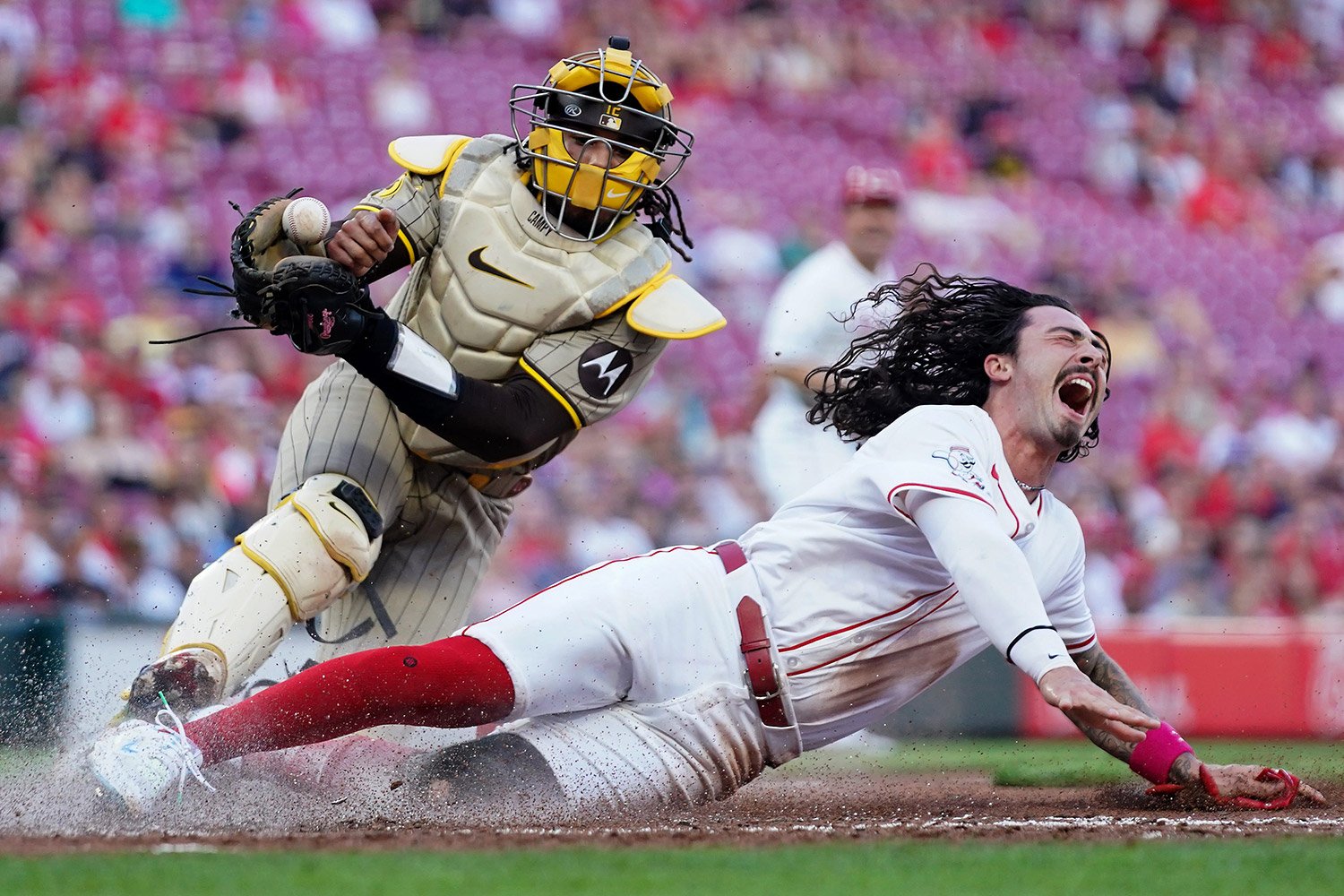
Padres Video
Last Saturday, Mariners catcher Cal Raleigh hit two home runs, positioning himself atop the home run leaderboard in 2025 and taking over the top spot from superstar Aaron Judge.
If I told you in 2018 that the player overtaking Judge for the league lead in homers was a catcher, you’d undoubtedly be shocked. The assumption in modern-day MLB is that high-level hitting comes from outfielders, first basemen, and designated hitters. There’s also a solid group of infield bats, but catchers have lowered offensive expectations. That was until recently, when catchers are cementing themselves back into the realm of normal offense.
While Raleigh’s slug is the headline of 2025’s catcher offensive surge, the group as a whole is putting together impressive production that hasn’t been seen in years. Since 2018, when the position batted to a minuscule 85 wRC+, catchers have steadily increased their output and now sit at a respectable 98 wRC+ in 2025. This change can be attributed to a variety of factors.
First, catchers have benefited from an increase in analytical tools (a.k.a. platooning) for lineup formation. One of the strongest advantages a batter can have in MLB is facing a pitcher of the opposite hand. With teams often carrying at least two catchers, we have seen platooning employed more frequently, and the results have been notable.
In 2018, of the seven lefty catchers with 100+ plate appearances against righties, just one had a wRC+ over 100. Fast forward to 2024, and the number remained at seven; however, three of these batters were able to produce a wRC+ of 100 or more. Now, we look at this season, where, once again, seven players meet the threshold (for 2025, we will use 50 plate appearances instead of 100, as we are roughly 45% through the season). Of these seven qualified lefty catchers, five are producing at a 100+ wRC+, illustrating the steady uptick in catchers’ offensive effectiveness.
A similar pattern prevails for righty catchers against lefty pitchers. Of the 20 qualified batters in 2018 (100+ PAs), 10 of them boasted a 100+ wRC+. Then, in 2024, the sample size was 20 once again, but 12 of the batters had a wRC+ of 100 or higher. In the current season, the number of qualified hitters has dropped to 16; however, nine of them have achieved a wRC+ of 100 or more, making it a very strong group of hitters.
The increased presence of platooning has certainly helped the production we see from role-playing catchers and backup players, but that alone can’t take the worst-hitting position in baseball and turn it into an offensive asset. We also have to look at the top of the ranks, where it’s clear that baseball has a dominant group of star catchers. These aren’t just one-hit wonders; these guys have been hitting for years. Now, with growth from the rest of the league's catchers, they are leading the position to glory.
Back to where we started, Cal Raleigh has established himself as not only the best catcher in the sport but also one of the best hitters in the sport. He is slashing 265/.372/.629 with 181 wRC+ as we near the halfway mark of the season. On top of his impressive line, he has a league-leading 26 home runs, which would put him on pace for over 50 on the year. The craziest thing is, with just a .271 BABIP, he may be able to keep this production up for the whole season.
There is also Will Smith, who has been one of the best catchers in MLB for years. A regular presence in the middle of the Dodgers' lineup, his consistency is rare at the position. With that said, this season may be his best. His .324/.427/.503 line is eye-popping and has led to a 164 wRC+. The foundation of Smith’s production is in his approach. With a 15.1% walk rate and just a 17.4% strikeout rate, his at-bats are incredibly efficient. The .374 BABIP will certainly decline, but the 103-point gap between his AVG and OBP should create production all year.
Finally, we have Alejandro Kirk. While many catchers are deserving of a shout-out this season, Kirk’s re-emergence as an elite catcher in 2025 has been huge for the position's success. The 2022 All-Star is returning to form and slashing .325/.367/.440. His .325 average leads catchers this year and has come as a result of his 10.1% strikeout rate, making him one of the hardest outs in baseball. Although his .341 BABIP suggests some regression potential, his history and high contact rates should keep him among the top catchers in baseball.
Along with these stars, the catcher position as a whole is in a better spot than it’s been in a long time. Looking at the catching landscape, you could argue that at least 25 out of the 30 teams are confident in their catchers' offensive production.
Fourteen teams in MLB boast a 95 or higher wRC+ from their catchers, which any organization would certainly take. In addition to these 14 squads, seven more teams have received great production from their starting catchers but have just fallen off a bit from their backups. These teams are the Red Sox (Carlos Narvaez, 125 wRC+), Rockies (Hunter Goodman, 121 wRC+), Diamondbacks (Gabriel Moreno, 113 wRC+), Guardians (Bo Naylor, 103 wRC+), Athletics (Langeliers, 102 wRC+), Orioles (Adley Rutschman, 99 wRC+) and Angels (Logan O’Hoppe, 98 wRC+).
Neither of those groups includes teams that have excellent catchers who have just started cold this season. Yainer Diaz (Astros, 90 wRC+), J.T. Realmuto (Phillies, 85 wRC+), Jonah Heim (Rangers, 82 wRC+), and Salvador Perez (Royals, 71 wRC+) will all likely finish the year better than they are hitting now.
With so many teams having excellent catcher groups, an increase in the utilization of platooning, and an emerging class of superstars behind the plate, it’s safe to say catchers have entered the middle of the lineup, and they may be here to stay.





Recommended Comments
There are no comments to display.
Create an account or sign in to comment
You need to be a member in order to leave a comment
Create an account
Sign up for a new account in our community. It's easy!
Register a new accountSign in
Already have an account? Sign in here.
Sign In Now