


Padres Video
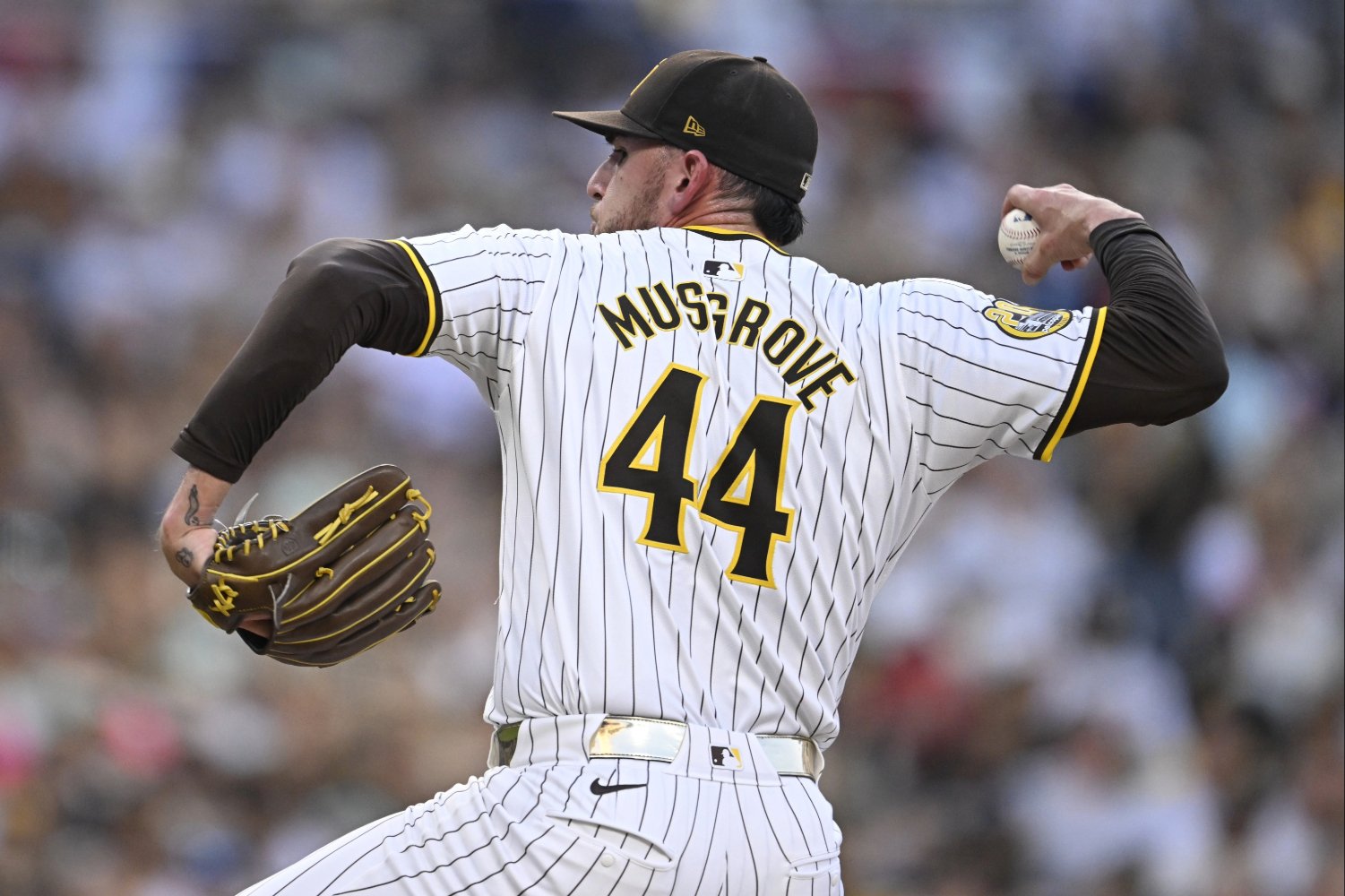
The San Diego Padres need Joe Musgrove to perform. Last year’s rotation was already an island of misfit toys, and things are only getting more complicated in 2026. Nick Pivetta will return, but can the 32-year-old breakout star be trusted to sustain his career-high output from last season? No one knows where Dylan Cease or Michael King will be pitching, but it’s unlikely San Diego keeps both. Ownership is in shambles and, unlike years past, can’t be counted on to save the day with a big signing or trade. (Yes, I’ll still be delusional and pray for Tarik Skubal like every other fanbase.)
The brightest glimmer of hope for the Padres’ staff is the return of Joe Musgrove.
He’s dealt with many injuries since 2023:
-
Spring training fractured toe
-
Shoulder capsule issue
-
Bone spur
-
Torn ulnar collateral ligament
-
Tommy John surgery
Returning to dominance won’t be easy, but with modern treatment plans and his history of success, he can still be a key piece of the rotation.
Before the injuries, he was one of the most reliable pitchers in baseball. His last two fully healthy seasons, 2021 and 2022, included more than 180 innings each. During that stretch, he logged:
-
362 2/3 IP
-
3.06 ERA
-
3.64 FIP
-
3.58 xERA
-
26% strikeout rate
-
6.5% walk rate
The most predictable drop-off will be in his workload. It’s unlikely he returns to the innings-eater he was a few seasons ago. Musgrove has already spoken about “easing” himself back into action, and that’s okay.
In 2025, only two Padres starters threw more than 140 innings (Pivetta and Cease), and only one other reached 100 (Randy Vásquez). King was injured, Darvish was injured, and the Nestor Cortes/JP Sears deadline duo was notably unproductive. Despite that, the Padres still won 90 games and fielded a respectable pitching staff.
Essentially, the bar for Musgrove to come in and be an upgrade is fairly low. The focus has to be on avoiding re-injury and making the innings he does throw as productive as possible.
So, what can we expect?
Musgrove has shown he can succeed even when he’s not fully healthy. Coming back from Tommy John surgery is a different level of adversity, but his 2023 and 2024 seasons are encouraging. Even though he never surpassed 100 innings in either year, he still produced:
-
3.47 ERA
-
3.74 FIP
-
3.69 xERA
-
24.5% strikeout rate
-
5.4% walk rate
There’s clearly reason to believe in Musgrove’s resilience.
Also, he isn’t a fastball-dependent pitcher. That’s important because many pitchers who get Tommy John struggle to survive the velocity drop. Musgrove throws his fastball just 25% of the time with an average velocity of 93 mph (1.7 mph below average). His fastball velocity hasn’t been above the 34th percentile since 2021, when it sat in the 45th. What will affect him more is a potential decline in spin rate. Musgrove has been in the 98th or 99th percentile in fastball spin since 2021.
Compare that with Jacob deGrom, who missed a similar amount of time after Tommy John surgery and has dealt with his own injury battles. DeGrom dropped about five percentiles in both velocity and spin rate, yet still had a dominant return in 2025.
Now, Musgrove isn’t deGrom, but he also isn’t as reliant on power pitching (elite velocity and high-spin off-speed pitches). Instead, he navigates lineups with a five-pitch mix and pinpoint command. Those traits don’t vanish—he’ll just need time to shake off rust.
With likely declines in fastball metrics and breaking balls posing higher injury risk, expect Musgrove to lean more on his changeup. He threw it 11.4% of the time in 2023, his highest mark since 2018, and it became his most effective pitch, yielding a 40.6% whiff rate and 22.9% putaway rate. A cutter increase should complement that. The cutter has been one of Musgrove’s most consistent pitches, never posting a negative run value on Statcast. In 2023, the same year he threw more changeups, the cutter had a run value of +7. Shifting away from a fastball/curveball vertical attack and moving toward a horizontal approach with cutters and changeups isn’t just healthier, it’s effective.
That said, he can still trust his breaking balls. Unlike fastballs, his curveball and sweeper should remain sharp. Looking at deGrom again—whose 90+ mph slider is one of the most arm-taxing pitches in baseball—he saw no drop in slider velocity or spin in 2025. In fact, he kept his RPM above 2,600, something he rarely did even in his prime. Hopefully, San Diego can use that same magic to keep Musgrove’s breaking pitches spinning. He typically throws his sweeper and curveball around 20% each.
Overall, he’ll likely see a decline in velocity that will reduce the fastball’s effectiveness. He’ll also be coming off a long injured-list stint and a difficult surgery. Protecting his health will be the priority, and spinning a heavy load of breaking balls immediately isn’t smart. Still, sports science is stronger than ever, and pitchers like deGrom have been returning from similar injuries. We also know that Musgrove plans to ease back into a full starter workload.
With that in mind, here’s my prediction:
2026 Projection
-
120 IP
-
3.75 ERA
-
3.98 FIP
-
23.8% strikeout rate
-
5.9% walk rate
Pitch Mix
-
23.5% fastball
-
18% curveball
-
22% cutter
-
20% slider/sweeper
-
15% changeup
-
1.5% other
It may not be Cy Young-level production, but this output would be a significant upgrade for a rotation in desperate need of stability.





Recommended Comments
There are no comments to display.
Create an account or sign in to comment
You need to be a member in order to leave a comment
Create an account
Sign up for a new account in our community. It's easy!
Register a new accountSign in
Already have an account? Sign in here.
Sign In Now