


Padres Video
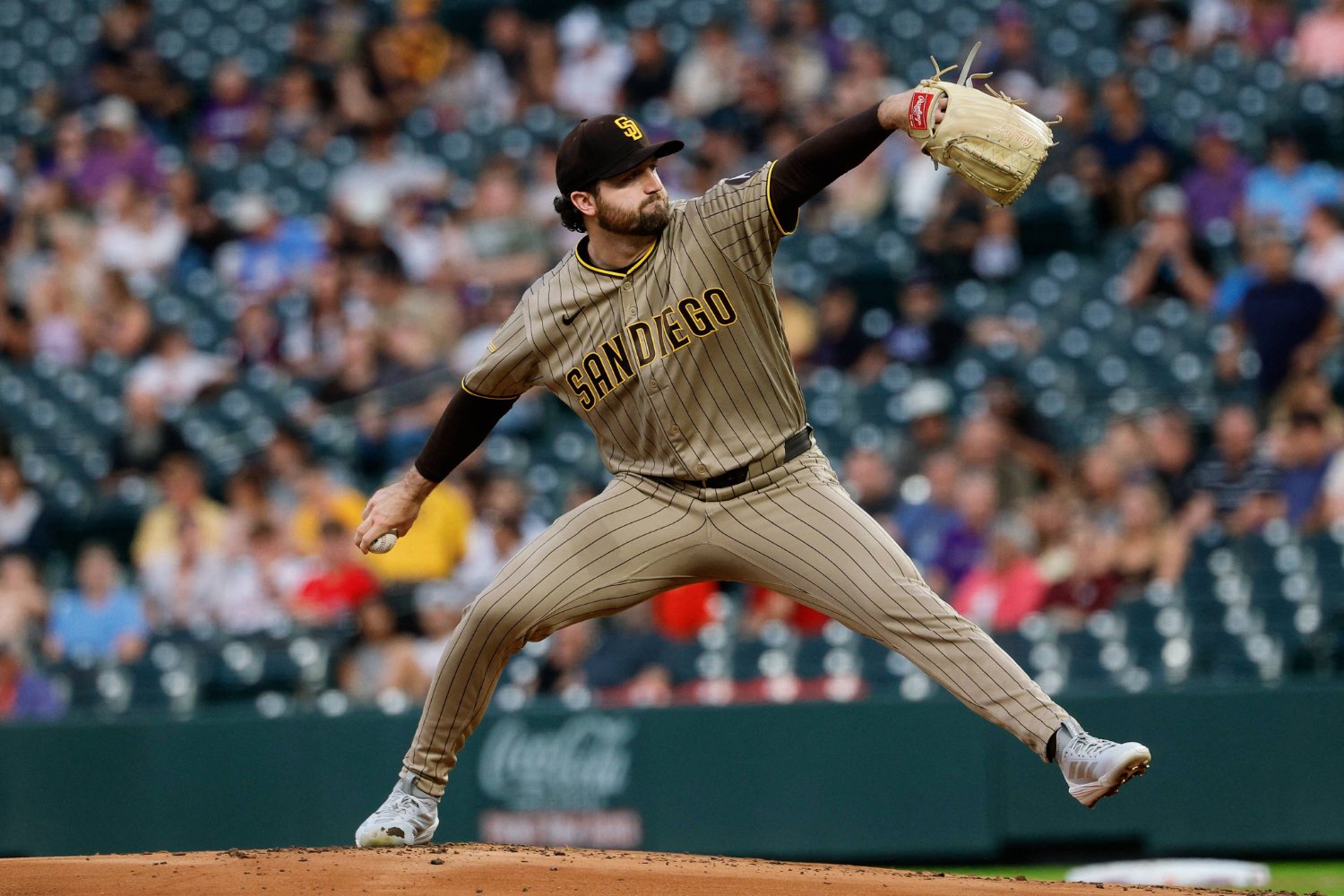
The doubts surrounding Casey Mize are impossible to hide and are generating more concerns as the postseason approaches. The pitcher who seemed like a revelation when the Detroit Tigers needed him most in the first half of the season has fallen off in this second stretch. =
The problems began right when he arrived in San Diego at the trade deadline. Since then, Mize has been unable to make the turnaround that is expected. The opposition is managing to hit his pitches inside the strike zone 10.1% more, and that impact has been key to raising the .601 OPS from the first half to a .821 OPS since the All-Star break.
The Mize of the almost unhittable arsenal with fastball, slider, slurve and split finger who moved through lineups between April and July has now seen his K/BB rate pulverized with a puzzling 11.1% drop.
Since arriving in San Diego, the Padres have modified the way he uses his repertoire depending on the hitter’s handedness and the count situation. Between June and July, Mize’s sinker and slider had a slight decline in their expected metrics, and that may have alerted the Friars' coaching staff. In a way, there have been some interesting improvements that we will explore here, even though the overall results still do not show them. The most interesting question (with the playoffs in mind) is whether the Padres really found a structure that can make the right-hander more effective.
| Situation | vs. LHH before | vs. LHH SD | vs. RHH before | vs. RHH SD |
|---|---|---|---|---|
| All counts — Splitter | 29% | 35% | 16% | 8% |
| All counts — Slider | 28% | 27% | 24% | 36% |
| All counts — Sinker | 1% | 0% | 25% | 15% |
| Two strikes — Splitter | 40% | 49% | 24% | 19% |
| Two strikes — Four-seam | 38% | 41% | 27% | 45% |
The changes show that San Diego is trying to get Mize to change the attack with his pitches depending on the matchup and the moment of the at-bat. Against left-handed hitters, Mize saw his K/9 fall in July to his worst rate of the entire season. So the splitter, with which he recorded 52% of his strikeouts, went from 29% to 35% usage. With the change, it is acquiring more importance when he has the advantage in the count, from 44% to 51% when he is ahead, and from 40% to 49% in two-strike counts.
Against right-handers, the adjustment is different. The slider went from 24% to 36% overall usage, while the sinker fell from 25% to 15%. And when he gets to two strikes, the four-seam fastball went from 27% to 45%. The splitter is where the plan with the Padres is finding the most interesting results.
| Splitter | August | September |
|---|---|---|
| BA | .333 | .176 |
| SLG | .481 | .176 |
| EV | 84.3 mph | 80.9 mph |
| Whiff | 11.1% | 38.9% |
| PutAway | 8.3% | 25.0% |
The formula is beginning to give results beyond just whiff rates. The splitter is limiting the impact on all the important indicators, and PutAway% reveals that Mize is using it in more decisive situations.
Continuing with the adjustments, the slider presents a different evolution, but also a relevant one. In August, it allowed a .412 batting average, .647 slugging and .445 wOBA. In September, those numbers have fallen to .273, .364 and .276. The whiff rate, however, barely changed: 17.1% in August versus 17.9% in September. The improvement of the slider has been reflected more against right-handers, but Mize has had inconsistencies against left-handers, allowing .539 slugging in 13 at-bats. It is a small sample that we still have to follow, because before arriving in San Diego they had hit .182 against him in 44 at-bats.
Finally, let's analyze what the four-seam fastball brings us.
| Four-seam | August | September |
|---|---|---|
| BA | .179 | .261 |
| SLG | .462 | .565 |
| EV | 93.8 mph | 95.0 mph |
| Whiffs | 5.7% | 9.5% |
| PutAway | 11.6% | 18.5% |
In this month of September, Mize has not been able to continue with the adjustments from August, but he has generated more swings-and-misses and finished at-bats with more strikeouts. For that reason, the monthly change is not enough to define it as a weak point within the new plan. The most interesting question appears when we observe what is happening according to the hitter’s handedness.
| Four-seam with Padres | LHB | RHB |
|---|---|---|
| K% | 19.4% | 21.9% |
| Whiffs | 4.7% | 11.7% |
| BAA | .209 | .138 |
| SLG | .328 | .310 |
| GB/BIP | 21.8% | 9.0% |
There are two key details here: the batting averages have gone down, but it has not been because Mize is finding more vulnerable points to generate swings and misses. In fact, if we analyze his profile overall, we can see that his Flawed Swing% with the fastball has fallen from 3% to 0% since he arrived in San Diego. Of course, he can be dominant without generating flawed swings, but when you reach the point of barely getting any, it is obvious that hitters are not feeling surprised and probably are not even concerned with the fastball or the environment in which he is throwing it.
Now, what is positive is that the dominance is coming through a reduction in contact quality. Against right-handers, the fastball is allowing just a .138 batting average, despite generating a meager 11.7% whiff rate. Against left-handers, that falls even further to 4.7%, but the ground-ball rate rises to 21.8%, an important point in Mize’s favor.
As revealing as the samples are, we still need to see many more adjustments, as Mize continues to be unable to find a consistent finish to the at-bats in his favor. The postseason is getting closer and closer, and the Padres need the dominant Mize from the first half of the season to survive a brutal National League gauntlet. It's a question of if he can put everything together in time October.





Recommended Comments
There are no comments to display.
Create an account or sign in to comment
You need to be a member in order to leave a comment
Create an account
Sign up for a new account in our community. It's easy!
Register a new accountSign in
Already have an account? Sign in here.
Sign In Now