


Padres Video
Before diving into this article, we recommend reading previous entries in this series, along with an introduction in part one. With that said, let's look at the gold standard Padres starting rotation.
Part one: Gold Standard Padres, Infield Edition
Part two: Gold Standard Padres, Outfield Edition
Part three: Gold Standard Padres, Bench Edition
Part four: Gold Standard Padres, Starting Rotation
The Bullpen: The Guardians of the Lead
This is where the game is won in the late hours. The arms that emerged from the shadows of the left-field fence to shut the door. These aren't just relievers; they are the high-leverage souls who carried the weight of the city on their shoulders when the lights were brightest.
RP Mark Davis "The Hammer" "Uncle Charlie" 1989 (4.4 WAR) The Curveball Crown
W-L: 4-3 | ERA: 1.85 | SV: 44 | G: 70 | IRS%: 78.4% | WHIP: 1.05 | IP: 92.2 | SO: 92 | K/BB: 2.97 | K%: 24.9% | K-BB%: 16.5% | ERA+: 191 | WPA: 6.1 | aLI: 2.14
NL Cy Young Award Winner | 2x NL All-Star (1988, 1989) | Padres Team MVP | Clyde McCullough Pitcher of the Year Award | NL Saves Leader | NL Rolaids Relief Man of the Year | NL Pitcher of the Month (April 1989) | NL Player of the Week (Sept 10, 1989) | Sporting News NL Pitcher of the Year
The Five Pillars of Uncle Charlie
Innovation: Davis relied on a heavy fastball that sat in the mid-90s—dominant velocity for 1989—paired with a sharp vertical snap on his breaking ball, nicknamed Uncle Charlie. That elite command of his signature pitch provided him the rare conviction to throw it for strikes in any count, including high-leverage situations. The innovation lay in the pitch's deadly movement; Davis threw his curveball with the same aggressive arm speed as his fastball. This created a tunneling effect in which the ball stayed on a fastball plane for the first 50 feet, making the two pitches indistinguishable to the hitter before the ball fell off the table in the final 10 feet. This approach kept hitters off balance, as they couldn't simply sit on his high-velocity heat in late-inning situations. By mastering this speed differential, he neutralized both left and right-handed threats.
Impact: Davis served as the ultimate safety net for the 1989 Padres, transforming late innings into a foregone conclusion. His presence allowed the starting rotation to pitch with aggression, knowing that any lead handed to "The Hammer" was essentially a guaranteed victory. The statistical weight of his impact is anchored by a then-franchise record 44 saves and an elite 78.4% Inherited Runners Stranded rate. His 6.1 Win Probability Added (WPA) led the entire National League, meaning he shifted the outcome of more games than any other pitcher in the league. This dominance is further highlighted by a 2.14 Adjusted Leverage Index (aLI), which confirms he was consistently deployed in situations more than twice as intense as the league average. By maintaining a 1.05 WHIP and a 191 ERA+, Davis performed 91% better than his peers, holding opponents to a staggering .540 OPS while allowing only 5.9 hits per nine innings (H/9).
Legend: In 1989, Mark Davis put together one of the most dominant seasons ever by a relief pitcher, becoming one of the few bullpen arms to ever win the Cy Young Award. By leading the league with 44 saves—a franchise record that stood for nine years until it was finally broken by Trevor Hoffman in 1998—he joined an elite group of only nine relief pitchers in MLB history to earn the honor. His performance was so significant that he finished 6th in the National League MVP voting, a rarity for a closer. This run began in late 1988, when he earned his first All-Star selection and recorded 28 saves, laying the foundation for his historic 1989 campaign. He led the National League with 65 games finished and posted a 1.85 ERA across 92.2 innings. His legendary status was cemented during the final month of the season, where he went a perfect 12-for-12 in save opportunities and stranded all 19 runners he inherited, transforming into the most feared arm in the game for a single, historic summer.
Iconic Look: Standing a lanky 6'4", he was most recognizable for a high leg kick that brought his lead knee nearly to his chest before he delivered from a straight over-the-top arm slot. When the bases were empty, he worked from a full, deliberate windup, but he maintained that same motion even when he had to work from the stretch with runners on. He is best remembered in this season for his signature "Uncle Charlie" curveball, which looked like it was falling off a table as it reached the plate. He anchored the bullpen in the 1989 home white jersey with brown pinstripes and the solid brown cap with the orange "SD," often wearing a dark brown leather glove that matched the team’s classic colors. The sight of his frame in those brown and orange tones, using that kick to bury the curveball which gave it its nickname, is the image that defines his 1989 Cy Young season.
The "Did You Know Factor": His 1989 season was so dominant that he captured 19 of the 24 first-place votes for the Cy Young Award, beating out legendary starters like Mike Scott and Orel Hershiser. During that campaign, he became the first pitcher in Major League history to record a save on five consecutive days, a record that stood alone for nearly a decade. While he remains the only left-handed reliever in National League history to win the award, his success also triggered a massive shift in how the league valued the closer position. Immediately following his win, he signed a landmark contract with the Kansas City Royals that briefly made him the highest-paid pitcher in baseball. This deal set a new financial ceiling for bullpen specialists, proving that a closer could command the same respect as the league’s most elite starting pitchers.
RP Trevor Hoffman "Hell’s Bells" "Hoffy" "Trevor Time" 1998 (4.1 WAR) The Changeup King
W-L: 4-2 | ERA: 1.48 | SV: 53 | G: 66 | IRS%: 81% | WHIP: 0.85 | IP: 73.0 | SO: 86 | K/BB: 4.10 | ERA+: 269 | WPA: 5.5 | aLI: 2.04
2x NL Rolaids Relief Man Award Winner (1998, 2006) | 6x NL All-Star (1998, 1999, 2000, 2002, 2006, 2007) | 2x NL Saves Leader (1998, 2006) | 3x Sporting News NL Reliever of the Year (1996, 1998, 2006)
The Five Pillars of Hoffy
Innovation: Hoffman was the ultimate master of the palmball, a grip that redefined late-inning dominance after a 1994 shoulder injury forced him to reinvent his power-pitching approach. While he began his career as a high-velocity thrower touching 95 mph, his success in 1998 was built on a mid-70s off-speed delivery that looked identical to his 91 mph fastball in both arm speed and release. This created a devastating tunneling effect where the ball stayed on a fastball plane for the first 50 feet before the bottom fell out in the final ten feet. The pitch was so deceptive that it earned the nickname the Bugs Bunny changeup from teammates and broadcasters alike, as hitters would often be halfway through their swing before the ball reached the plate. Opponents described the sensation as the ball having a parachute on it, forced by the way Hoffman pinched the seam with his thumb and middle finger to kill the rotation and create late, vertical sink.
Impact: Trevor was the Padres' competitive anchor for over a decade, but 1998 stood as his statistical peak. He posted a career-best 5.5 Win Probability Added (WPA), meaning he personally shifted the outcome of more games than any other pitcher in the National League that year. Hoffman successfully converted 53 of 54 save opportunities—a 98.1% success rate—and held opposing hitters to a microscopic .165 batting average. This consistency produced an incredible 0.461 OPS against, essentially turning every hitter into a liability. In save situations specifically, his ERA dropped to 0.49, and the Padres finished with a 62-4 record in games he appeared in. Beyond the box score, his 269 ERA+ meant he performed 169% above the league average, making the 9th inning a foregone conclusion for the opponent and providing the edge that fueled the franchise-record 98 wins and a World Series berth.
Legend: 1998 was the year Trevor Hoffman transitioned from an elite closer to a true baseball icon. On July 25, 1998, the "Hell’s Bells" phenomenon was born at Qualcomm Stadium; as the opening toll of the AC/DC track echoed through the park, Hoffman emerged from the bullpen to convert his 41st consecutive save, tying the then-MLB record. His dominance that season was so undeniable that he finished 2nd in one of the most controversial NL Cy Young races in history. Hoffman actually received more first-place votes (13) than the winner, Tom Glavine (11), but lost the award on total points because several voters left him off their ballots entirely. Along with finishing 7th in the NL MVP race, he became the face of the franchise’s "Keep the Faith" era, leading the team through the NLCS and into the World Series. This season didn't just cement his Hall of Fame trajectory—it turned "Trevor Time" into the most intimidating entrance in the history of the sport.
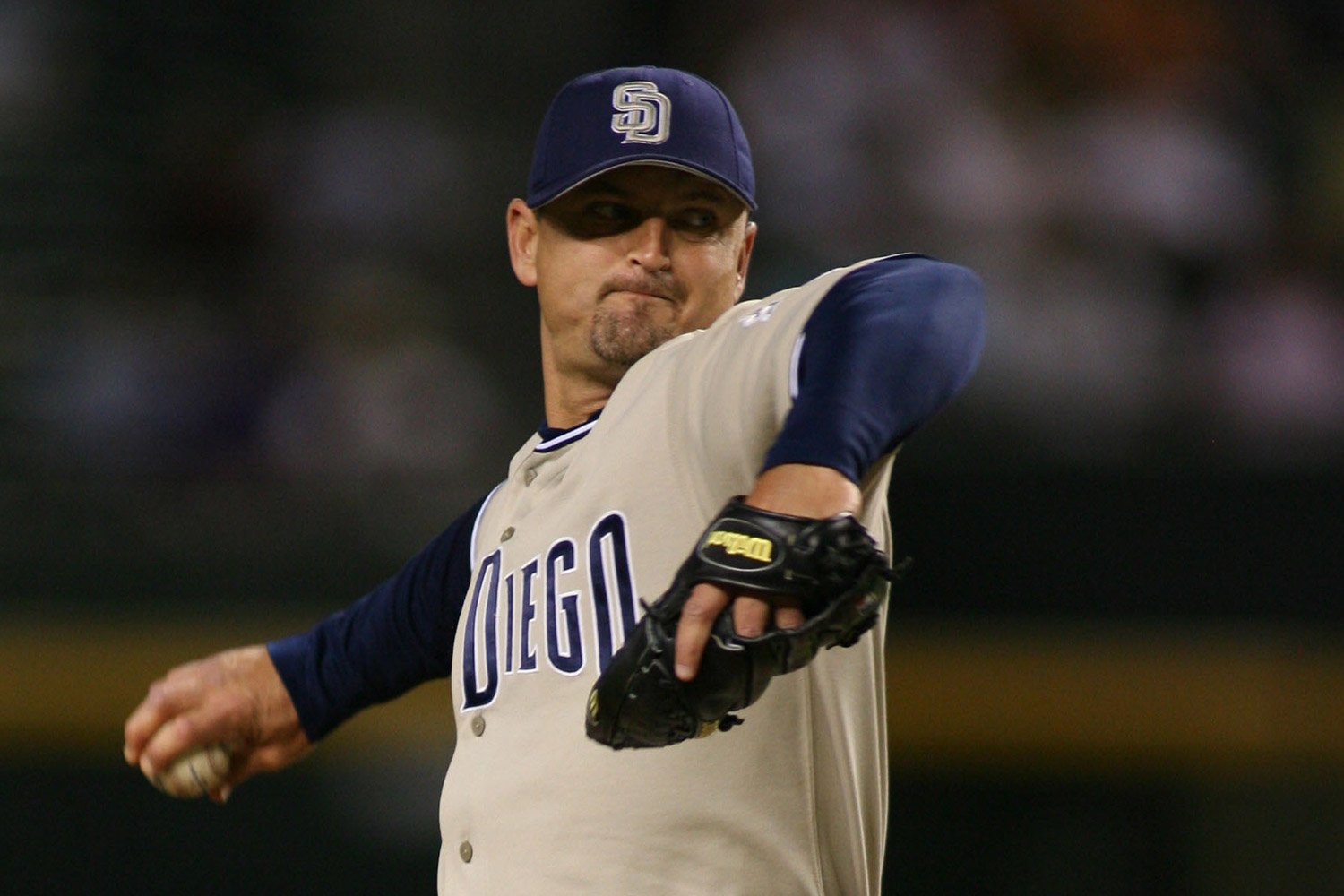
Iconic Look: During the 1998 season, Hoffman rotated between the Padres' classic navy blue pinstripes, the road greys, and the season’s signature navy alternate jerseys, all topped with the navy cap and its white and orange interlocking "SD." On the mound, his trademark goatee look and intense stare from beneath a low-pulled brim were as recognizable as his entrance music. His mechanics were anchored by a signature high leg kick that created a sense of tension before he broke toward the plate, allowing him to hide the ball behind his body until the last possible second. This made his devastating changeup appear identical to his fastball until it was too late. The sight of Trevor emerging from the bullpen as the Qualcomm Stadium lights flickered and the first toll of the bells rang out remains the definitive visual of San Diego’s most celebrated season.
The "Did You Know Factor": Hoffman was a trailblazer in the record books, becoming the first pitcher in MLB history to reach both the 500 and 600-save milestones—a feat so rare that only Mariano Rivera has ever joined him. Remarkably, his path to greatness began as a complete pivot; originally drafted as a shortstop, he possessed a rare 80-grade arm—the highest rating a scout can give—which convinced the Reds to move him to the mound after he struggled as a light-hitting infielder. This transition to a first-ballot Hall of Famer is even more impressive considering he had a kidney removed as an infant, a condition that once made many teams hesitant to recruit him. His dominance was so defining that Major League Baseball eventually renamed the National League Reliever of the Year Award in his honor: The Trevor Hoffman Award.
RP Rollie Fingers "Rollie" "The Handlebar" "The 'Stash Man" 1978 (3.9 WAR) The Baron of the Bullpen
W-L: 6-13 | ERA: 2.93 | SV: 37 | G: 67 | IRS%: 69.2% | WHIP: 1.15 | IP: 107.1 | SO: 82 | K/BB: 2.41 | ERA+: 120 | WPA: 2.1 | aLI: 1.85
2x NL Saves Leader ('77, '78) | NL Rolaids Relief Man | NL All-Star | Sporting News NL Fireman of the Year
The Five Pillars of The Handlebar
Innovation: Fingers was a master of the "sinker-slider" combination. At a time when many relievers just threw as hard as they could, Rollie used precision and late movement to induce weak contact. He was often called upon to pitch two or three innings at a time, redefining what it meant to "close" a game by being the ultimate high-leverage weapon. His innovation relied on a unique finger-pressure technique on his sinker that created a "heavy" ball, resulting in an elite groundball rate that allowed him to navigate the inherited jams that defined the "Fireman" era. While modern closers specialize in the clean 9th inning, Rollie innovated by "pitching to the floor," using a low three-quarters arm slot to make his slider "tilt" late. This created a devastating tunneling effect; by the time a hitter realized the pitch wasn't a sinker at the knees, it had already slid off the plate, forcing the weak, rollover contact that allowed him to pitch 107.1 innings of high-stress relief.
Impact: His presence gave the 1970s Padres immediate credibility. He was a professional who knew how to finish games, and he helped a young franchise learn how to win close contests. He remains a rare Hall of Fame icon who cemented his legend by dominating for the Padres during his prime years in San Diego. Beyond the box score, Rollie was the essential "safety net" for a roster that had never experienced a winning season, providing the veteran stability required for the franchise to finally break through with 84 wins in 1978. His impact was felt most by appearing in 67 games and throwing 107.1 innings; he acted as a bridge for the entire staff, often entering in the 7th or 8th inning to protect a lead for hours. By posting an elite 2.1 WPA (Win Probability Added), he proved that a dominant reliever could single-handedly change the entire win-loss trajectory.
Legend: Rollie Fingers brought an immediate championship pedigree to San Diego, arriving as a cornerstone free-agent signing with three World Series rings from his tenure with the Oakland A's. In 1978, he was an absolute workhorse, leading the National League with 37 saves while pitching a staggering 107.1 innings entirely out of the bullpen. Unlike modern closers, Fingers averaged nearly 1.2 innings per appearance, often entering in the 7th or 8th inning to extinguish threats. He served as the high-leverage anchor of a staff that featured Gaylord Perry’s Cy Young-winning campaign, creating a legendary veteran duo that finally propelled the Padres to an 84-78 finish—the first winning season in franchise history. His 1978 performance earned him his second consecutive Rolaids Relief Man of the Year Award and a top-10 finish in the Cy Young voting.
Iconic Look: You cannot talk about Rollie Fingers without mentioning the most famous mustache in sports history. His impeccably waxed handlebar mustache, kept in place with Hungarian Mustache Wax, became a symbol of his icy composure on the mound. During the 1978 season, this look was perfectly framed by the Padres' vibrant yellow-and-brown "all-gold" uniforms—the iconic pullover jerseys that remain a fan favorite. Because San Diego hosted the 1978 All-Star Game, Fingers’ jersey was uniquely adorned with a commemorative "Swinging Padre" patch on the left sleeve. On the rubber, his look was defined by a classic, high-leg-kick delivery that added visual deception to a heavy 92-mph sinker and a sharp, biting slider that hitters simply could not square up.
The "Did You Know" Factor: During his 1978 season in San Diego, Rollie was the ultimate volume-shooter of the bullpen, appearing in 67 games and facing 434 total batters. Despite his deceptive 6-13 record that year, his 3.9 WAR (Baseball-Reference) proves just how dominant he was in keeping the Padres in games. Did you know? Most of those losses were the result of Rollie being pushed to his absolute physical limit in extra-inning marathons where he was forced to throw multiple innings to protect thin leads for a team that lacked deep bullpen depth. Additionally, his famous mustache was so vital to his identity that he eventually chose to retire from baseball in 1986 rather than comply with the Cincinnati Reds' strict "no facial hair" policy.
RP Rich Gossage "The Goose" 1984 (3.4 WAR) The Outlaw Fireman
W-L: 10-6 | ERA: 2.90 | SV: 25 | G: 62 | IRS% 74% | WHIP: 1.08 | IP: 102.1 | SO: 84 | K/BB: 2.33 | ERA+ 122 | WPA: 2.7 | aLI: 1.70
2x NL All-Star (1984, 1985) | 1984 NL Champion
The Five Pillars of The Goose
Innovation: Goose was the pioneer of the "power closer" role, a high-velocity "fireman" who redefined what it meant to anchor a bullpen. Unlike modern closers who are often limited to a single clean inning, Gossage was a multi-inning weapon who specialized in "extinguishing" rallies in the 7th or 8th inning. His approach was built on a raw, aggressive delivery that made his upper-90s fastball feel even more overwhelming to hitters at Jack Murphy Stadium. By utilizing a heavy, sinking heater and a sharp slurve, he didn't just aim for the strike zone—he attacked it with a "here it is, try to hit it" mentality. This style of relief pitching was an evolutionary step in the game, moving away from the finesse-based relievers of the 70s and toward the era of late-inning power dominance that he helped invent.
Impact: His arrival changed the culture of the San Diego Padres overnight. Signed as a high-profile free agent from the Yankees, Goose brought an intense, win-at-all-costs mentality that immediately rubbed off on younger players like Tony Gwynn and Kevin McReynolds. He acted as the "final piece" of the puzzle, transforming a franchise of perennial also-rans into an elite National League power. During the 1984 NLCS against the Chicago Cubs, his presence at the back end of the bullpen gave the city of San Diego the ultimate security blanket. In a season where he recorded 10 wins as a reliever, his impact was measured not just in saves, but in the psychological edge he provided; when Goose began his trot from the bullpen, the opposing dugout knew the game was effectively over.
Legend: When the Padres signed Rich "Goose" Gossage in January 1984, they weren't just getting a pitcher; they were getting a Hall of Fame force of nature. He was the final major acquisition by legendary owner Ray Kroc before his passing, and Goose played like a man possessed to honor that legacy. This "Outlaw" earned his reputation through cold-blooded efficiency in high-leverage situations, helping the franchise reach its first-ever World Series appearance. Perhaps the most legendary moment of his '84 campaign was his relentless refusal to back down from any challenge, most famously illustrated by his desire to pitch to Kirk Gibson in the World Series rather than walk him—a move that, while it resulted in a home run, perfectly encapsulated the fearless, old-school warrior spirit that made him a San Diego icon.
Iconic Look: With his legendary horseshoe mustache and a glare that could freeze a hitter in the box, Goose was the most feared man in baseball. Standing 6'3" with a hulking frame, he looked more like a Western outlaw than a ballplayer. During the 1984 season, he wore the classic "Taco Bell" brown and gold uniforms with the gold "RAK" patch on the sleeve in memory of Ray Kroc. Seeing him stomp off the mound after a three-inning save, sweat-soaked and snarling from beneath his navy and orange cap, remains one of the definitive images of the 80s era. His mechanics were as violent as his look, featuring a high-effort follow-through that saw him practically fall toward the first-base line, adding to the sheer intimidation of facing 98 mph heat in an era before that was common.
The "Did You Know Factor": In 1984, Goose pitched over 100 innings entirely in relief—a workload that is almost unfathomable in the modern game. To put that in perspective, he pitched more innings that season than most modern "workhorse" relievers do in two full years combined. Despite this heavy usage and the constant pressure of entering games with runners on base, he maintained a sub-3.00 ERA and finished as an All-Star. He famously stated that the San Diego fans were the best he ever played for, noting that the electricity at "The Murph" during the '84 playoff run was the peak of his career. His 1984 performance remains the gold standard for veteran leadership, proving that a single elite reliever could truly shift the entire trajectory of a franchise.
RP Kirby Yates "Yatesy" 2019 (3.4 WAR) The Splitter Surgeon
W-L 0-5 | ERA 1.19 | SV 41 | G 60 | IRS% 80% | WHIP 0.89 | IP 60.2 | SO 101 | K/BB 8.42 | ERA+ 362 | WPA 3.7 | aLI 1.83
2019 All-MLB First Team | 2019 Baseball Digest Relief Pitcher of the Year | 2019 NL All-Star | 2019 MLB Saves Leader
The Five Pillars of Yatesy
Innovation Yates relied on a splitter that was statistically the most deceptive pitch in baseball during the 2019 season. Statcast data confirms he released the ball at a consistent 5.1-foot height, mirroring his 94 mph fastball perfectly before the splitter would plummet with 37.6 inches of vertical drop. By suppressing the spin rate to an average of 1,399 rpm—nearly 1,000 rpm lower than his four-seamer—he created a vertical break that was 3.5 inches greater than the league average. This mechanical "tunnelling" forced a 41.6% strikeout rate, as hitters routinely chased the pitch out of the zone thinking it was a belt-high heater. In 2019, his splitter accounted for the vast majority of his 101 strikeouts and held opposing batters to a .186 average, making it the premier "wipeout" pitch in the National League.
Impact Yates served as the ultimate high-leverage stabilizer for a Padres team in the midst of a roster transition, providing a guaranteed finish for any lead held after eight innings. He converted 41 of 44 save opportunities for a 93% success rate, leading the major leagues in saves and becoming the first Padre to do so since 1998. His 3.7 Win Probability Added (WPA) ranked fifth among all MLB pitchers that year, indicating he dominated in the most pressured moments of the season. He was particularly dominant during a historic first-half stretch where he posted a 1.15 ERA through 39 innings, earning him the role of the National League's designated closer for the All-Star Game. By stabilizing the 9th inning, Yates allowed a young, unproven bullpen to develop in lower-stress roles, providing a veteran identity to the pitching staff.
Legend The 2019 campaign was the culmination of a career reinvention that saw Yates go from being designated for assignment by three different teams to being the best reliever in baseball. His 1.19 ERA remains the lowest mark in franchise history for a pitcher with over 60 innings, and his 3.4 WAR is the second-highest ever for a Padres reliever in the divisional era, trailing only Mark Davis’s 1989 Cy Young season. He set a new franchise record by racking up 30 saves before the All-Star break, shattering the previous marks held by Heath Bell (26) and Trevor Hoffman (25). Though he was controversially bypassed for the NL Reliever of the Year Award, he was named the MLB-wide Relief Pitcher of the Year by Baseball Digest, proving that his surgical precision was the gold standard for the entire sport.
Iconic Look Yates was defined by a cold, clinical efficiency that earned him his nickname "The Surgeon." Standing 5'10", he utilized a high-effort, athletic delivery that saw him finish in a deep crouch, staring down hitters through the follow-through. Whether he was wearing the navy and white or the brown and gold "Friday" alternates, his demeanor never wavered regardless of the score or the pressure. He was known for his stoic professional walk off the mound following a save, rarely showing emotion or over-celebrating a strikeout. This imagery of a focused, unshakeable closer became the defining visual for the Padres' 9th inning, symbolizing a "guaranteed victory" for the San Diego faithful even during a rebuilding year.
The "Did You Know Factor" Kirby Yates was a 26th-round draft pick who didn't find a permanent home in the majors until his age-30 season. After being claimed off waivers by the Padres in 2017, he developed his elite splitter under the guidance of pitching coach Darren Balsley, transforming his entire career trajectory. In 2019, he became the first pitcher in MLB history to record 27 saves before the end of June, a blistering pace that set him apart from every other closer in the game. He also posted a 1.30 FIP (Fielding Independent Pitching), the lowest in the major leagues, confirming that his dominance was entirely the result of his own command rather than defensive luck. His 8.42 strikeout-to-walk ratio that year remains one of the most efficient marks for any closer in the modern era.
RP Brad Hand "Brotein Shake" "Brotato" "Handy" 2017 (3.0 WAR) The Hand of God
W-L: 3-4 | ERA: 2.16 | SV: 21 | G: 72 | IRS%: 74% | WHIP: 0.93 | IP: 79.1 | SO: 104 | K/BB: 5.47 | ERA+: 193 | WPA: 3.5 | aLI: 1.63
2x NL All-Star (2017, 2018) | 2x NL Reliever of the Month (July 2017, May 2018) | 2x Padres Darrel Akerfelds Bullpen Award Winner (2016, 2017)
The Five Pillars of Brotato
Innovation: Hand’s 2017 dominance was a clinical masterclass in pitch tunneling and the "primary-secondary" revolution. He leveraged an elite high-spin four-seam fastball (peaking at 2,629 rpm) to create an "induced vertical break" that perfectly mirrored the initial flight path of his primary weapon: a devastating 82 mph slider with elite vertical drop. By 2017, Hand had innovated his approach by increasing his slider usage to nearly 45%, defying the traditional "fastball-first" philosophy of the era. This mechanical deception forced hitters to respect a slider that looked identical to his 94-96 mph heater until the final 15 feet. This strategy effectively neutralized the platoon advantage, holding right-handed hitters to a meager .186 average and proving that a "wipeout" breaking ball could serve as a pitcher's true foundation.
Impact: Hand was the definition of a "High-Leverage Eraser" for the 2017 Padres, leading the club with 72 appearances and a massive 3.5 Win Probability Added (WPA). He was far more than a traditional closer; he was a bridge-hybrid who frequently entered in the 7th or 8th inning to kill an opponent's momentum, successfully stranding 74% of inherited runners. His value was best highlighted by a historic mid-summer stretch where he threw 24 consecutive scoreless innings, a run that stabilized a young roster and elevated him to the top of every contender’s trade wish list. With a 193 ERA+ and a microscopic 0.93 WHIP, Hand was performing 93% better than the league average, effectively shortening games to six innings for San Diego’s opponents.
Legend: The "Legend of Hand" is the ultimate story of a waiver-wire reclamation project becoming a franchise cornerstone. Originally a struggling starter in Miami, Hand arrived in San Diego and worked with Darren Balsley to refine a compact "short-arm" delivery that made his velocity play up. In 2017, he became the first Padres reliever since Trevor Hoffman to record over 100 strikeouts in a season, finishing with 104 punchouts in just 79.1 innings. His durability became a point of locker room pride, eventually fueling his journey to the prestigious 10-year Major League service time milestone. Teammates famously celebrated his blue-collar work ethic with "sleeveless and shades" days, cementing "Handy" as the respected veteran anchor of the Padres' bullpen during a critical era of transition.
Iconic Look: Hand’s look was synonymous with the Padres’ 2017 "Blue & White" era, a clean, professional aesthetic that removed the yellow accents and pinstripes of previous seasons. He was most recognizable in the team’s navy road alternate jersey with the crisp white interlocking "SD" on the left chest, or the solid home whites. On the mound, his mechanics were distinctive for their lack of "noise"—an athletic, repeatable delivery from a mid-three-quarters slot. Staring down hitters from beneath a low-pulled navy brim, he maintained an icy, robotic stoicism that never broke regardless of the leverage. The definitive visual of this era was Hand freezing elite hitters with a "back-door" slider that appeared to be a fastball off the plate before biting back to catch the corner.
The "Did You Know" Factor: Hand’s elite leg strength and durability were actually forged on the ice rather than the mound.Did you know? Brad Hand was a standout varsity hockey forward in Minnesota and credits his "ice-marrow" conditioning for his ability to lead the National League in games pitched (82) in 2016 without a single trip to the IL. This lower-body power allowed him to maintain his 96 mph peak velocity deep into the season. Additionally, Hand holds a rare piece of Marlins history: in his first MLB game in 2011, he not only earned the win but also recorded a line-drive base hit in his very first career at-bat—a "double-threat" debut that remains a rare feat for modern pitchers.
RP Heath Bell "Heater" 2010 (2.4 WAR) The Running Man
W-L 6-1 | ERA 1.93 | SV 47 | G 67 | IRS% 100% | WHIP 1.20 | IP 70.0 | SO 86 | K/BB 3.07 | ERA+ 186 | WPA 4.1 | aLI 1.98
2010 NL Rolaids Relief Man Award | 2010 MLB Delivery Man of the Year | 2010 NL All-Star | 2010 Sporting News NL Reliever of the Year
The Five Pillars of Heater
Innovation Unlike the finesse-based changeup of Trevor Hoffman, "Heater" was a power closer whose dominance was built on sheer explosive force and vertical deception. His 2010 repertoire centered on a heavy, mid-90s four-seam fastball that he lived with in the upper third of the zone, which he paired with a devastating 12-to-6 curveball. The effectiveness of this duo was driven by a massive 18 mph velocity gap, as his 76 mph breaking ball featured extreme vertical drop that induced a high groundball rate. By maintaining a high-effort delivery that masked his release point, Bell created a tunneling effect where both pitches looked identical out of the hand. This forced hitters to commit early to high heat, only to realize too late that the pitch was actually a floor-dropping curve, resulting in a career-high swinging strike rate.
Impact Bell successfully stabilized the Padres' 9th inning during one of the most competitive seasons in franchise history, proving a lead was safe the moment he touched the rubber. His career-best 1.93 ERA was backed by an elite 11.1 K/9 rate and a stifling .221 opponent batting average, proving he could miss bats at will in high-leverage situations. His reliability was further defined by his "Shutdown" consistency; in 67 appearances, he recorded 44 Shutdowns (games where he increased his team's win probability by at least 6%) against just 5 Meltdowns, a ratio that ranked among the league's elite. Most notably, his 100% Inherited Runners Stranded (IRS%) rate underscored his role as the ultimate fireman, shutting down all nine runners he inherited that season and ensuring that late-inning rallies were extinguished before they could begin.
Legend After serving a two-year apprenticeship in the setup role, Bell’s 2010 campaign solidified his place as one of the most prolific closers in franchise history. His 47 saves that season remain the second-highest single-season total in Padres history, and he currently sits second only to Hoffman on the club's all-time saves list. He was particularly dominant within the confines of Petco Park, where he posted a microscopic 1.11 ERA and converted 24 of 25 opportunities in front of the home crowd. During this stretch, Bell embarked on a historic run of 41 consecutive successful save conversions (spanning 2010–2011), tying a club record and cementing his legacy as a premier lockdown specialist. His 2010 performance ensured that the transition from the Hoffman era was seamless, maintaining San Diego's reputation as a "closer's paradise."
Iconic Look Heath Bell was defined by his trademark sprint from the bullpen, a ritual that began the moment "We Are One" by 12 Stones hit the Petco Park speakers. While other closers maintained a slow, focused jog, Bell would charge toward the mound at a full-speed gallop—once clocked by team staff at nearly 18 mph—often leaping the foul line and finishing with a characteristic slide into the dirt at the back of the mound to fire up the crowd. Standing a sturdy 6'3" and 235 lbs, he was a ball of pure kinetic energy in the navy blue and sand pinstripes of the era. This high-octane entrance, combined with his tendency to scream in celebration after a game-ending strikeout, made him the emotional heartbeat of the roster and a showman who transformed the 9th inning into a high-intensity event.
The "Did You Know" Factor Heath Bell’s path to stardom was one of the unlikeliest in baseball history; he was originally selected by the Tampa Bay Devil Rays in the 69th round of the 1997 draft (1,583rd overall) but did not sign, eventually signing with the Mets as an undrafted free agent. His 2010 season was a rare display of durability for a closer, as he became one of only three Padres relievers to ever record 45+ saves while pitching at least 70 innings in a single season, a workload that is virtually unheard of in the modern specialized era. He is perhaps most famously remembered for his 2011 All-Star Game entrance where he famously sprinted in and performed a full-body belly flop slide into the pitcher's mound. This moment, which occurred during a streak where he converted 34 consecutive saves to end a season, perfectly encapsulated Bell's philosophy: that baseball, even in its most pressured moments, should be played with unbridled joy.
We’ve reached the end of this first volume, but the echoes of these legends never truly fade. They are stitched into the very fabric of this city. From the grass at Petco to the saltwater breeze off the bay, we remember that their legacy isn’t just found in the Cooperstown plaques or the retired numbers swaying in the breeze. You can find it at the coolest intersection in the world: the corner of Tony Gwynn Drive and Trevor Hoffman Way. That’s where the past meets the present, and where the roar of the crowd never quite stops.
In the immortal words of the legendary Jerry Coleman, whenever a player did something truly spectacular, he would exclaim, "You can hang a star on that baby!" For these 26 icons, their stars are permanently hung in something sacred. They played with a "soul" that box scores can't fully capture, defining what it means to wear the brown and gold.
"Oh, Doctor! You can hang a star on that one!"





Recommended Comments
There are no comments to display.
Create an account or sign in to comment
You need to be a member in order to leave a comment
Create an account
Sign up for a new account in our community. It's easy!
Register a new accountSign in
Already have an account? Sign in here.
Sign In Now