


Padres Video
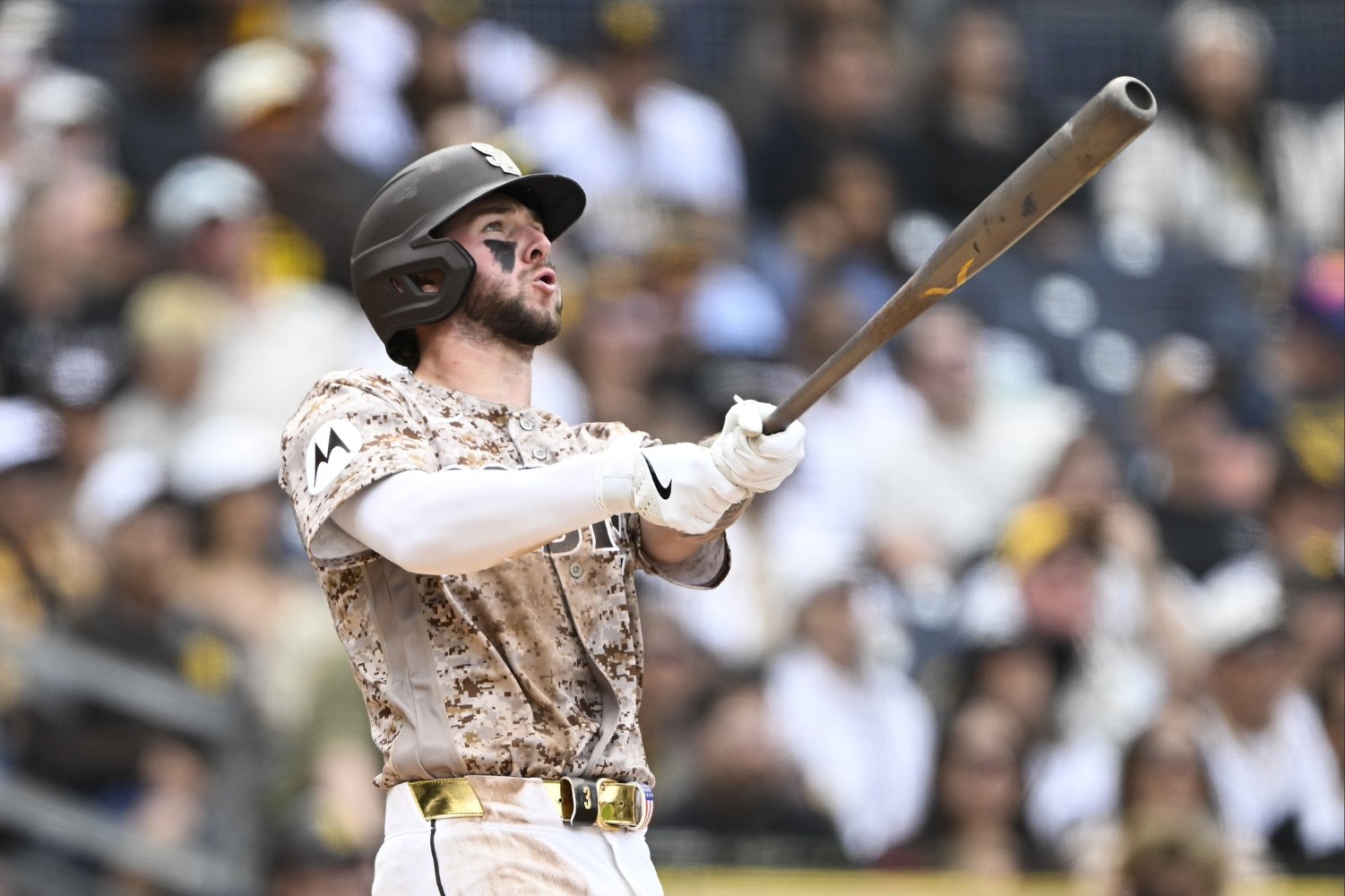
The San Diego Padres are on something of a roll. After starting the season 1-4, they’ve won 10 of their past 12 and own the second-best record in the National League. Usually, when a team is racking up wins with such ferocity, there is a bit of good fortune at play, but the Padres have gotten off to a 11-6 start despite possessing the least lucky bats in the league.
Based on Statcast’s expected statistics, the Padres, as a team, should have a wOBA of .346. That’s the third-best figure in the league, which suggests that this is one of the league’s elite offenses. Well, here’s the thing: Baseball isn’t played in a simulation, and the Padres' actual wOBA is .314, which ranks 17th, and is sandwiched between the Guardians and Angels. While a guardian angel is usually nice company to keep, that’s not the case when it comes to hitting a baseball. So, what the heck is going on here?
When Statcast debuted in 2015, the tired excuse of explaining away everything with BABIP finally eased. Make no mistake, hitting them where they ain’t is still a great idea, but exit velocities and launch angles made analyzing hitting as granular as it had ever been. We suddenly knew, with increased precision, the likelihood that any batted ball would be a hit, if it would clear the fence, who was getting hosed by bad luck, and who was really struggling at the plate.
However, expected stats are just probabilities based on launch angle and exit velocity. In the real world, you can’t hit 50% of a double; you either get to second and get 100% of it, or you don’t and get 0%. Now, stacking a bunch of probabilities based on real events usually gets you very good results, and it’s why expected stats have steadily grown to almost become the actual stats, which is weird, because one is imaginary, and the other is very, very real, which brings us back to the Padres.
The Padres are underperforming their Statcast data by a massive margin. To put human faces to their agony, Francisco Lindor produced a wOBA of .350 last season (right around the Padres' current mark), while Miguel Vargas managed a wOBA of .314. Ask yourself this: would you rather have Lindor come up nine times in a row or Vargas?
The simple explanation for this divergence between the expected and the actual is that the Padres are getting unlucky, and their statistics will slowly converge with their expected statistics. While I agree directionally with that notion, it also misses a crucial component. Expected stats are based on all batted balls hit throughout the year, but Petco Park loves to suppress offense, and especially so in April.
The Padres have played 11 out of 17 games at Petco, with their other six coming at Fenway and PNC Park. Petco is one of the toughest places to hit, PNC is also a bottom-third hitters' park, and while Fenway is a hitters' park, it is in a very unique way. Fenway suppresses triples and home runs tremendously, but it is the best park in the league to hit doubles. Depending on how you hit the ball, it is feast or famine.
Using Baseball Savant’s three-year rolling park factor as our baseline, Petco has a park factor of 97, PNC 99, and Fenway 105. Just on that alone, you’d expect the Padres to underperform their expected stats a tad, but according to research by Kiri Oler of Fangraphs, each of Petco, PNC, and Fenway are 4% less hitter-friendly in April than their overall figure. And on top of that, the time of day can make a dramatic difference in how a park plays. For instance, Petco has a park factor of 99 during the day, nearly league average, but falls to 96 at night, while PNC has a park factor of 97 during the day and 101 at night. Considering the Padres have played seven of their 16 games at Petco at night in April, it shouldn’t be a surprise to see their batted ball results lagging behind their exit velocities and launch angles.
With this cocktail of information, we can do back-of-the-envelope math to see what type of park factor the Padres have opened the season with. Using the time of day park factors and inputting the -4% April park factor tax, the Padres, on average, have played in a ballpark with a 94.56 park factor. That’d be the worst park outside of T-Mobile in Seattle (91), which is in a tier of its own.
Does this mean the Padres haven’t gotten a little unlucky with their batted balls? Almost certainly not, but the combination of bad luck and a rough-hitting environment is the reason they’re underperforming their expected stats more than any other team. As the weather warms up, so should the Padres’ bats, but in the meantime, maybe try scheduling a few more day games in April.





Recommended Comments
There are no comments to display.
Create an account or sign in to comment
You need to be a member in order to leave a comment
Create an account
Sign up for a new account in our community. It's easy!
Register a new accountSign in
Already have an account? Sign in here.
Sign In Now