


Padres Video
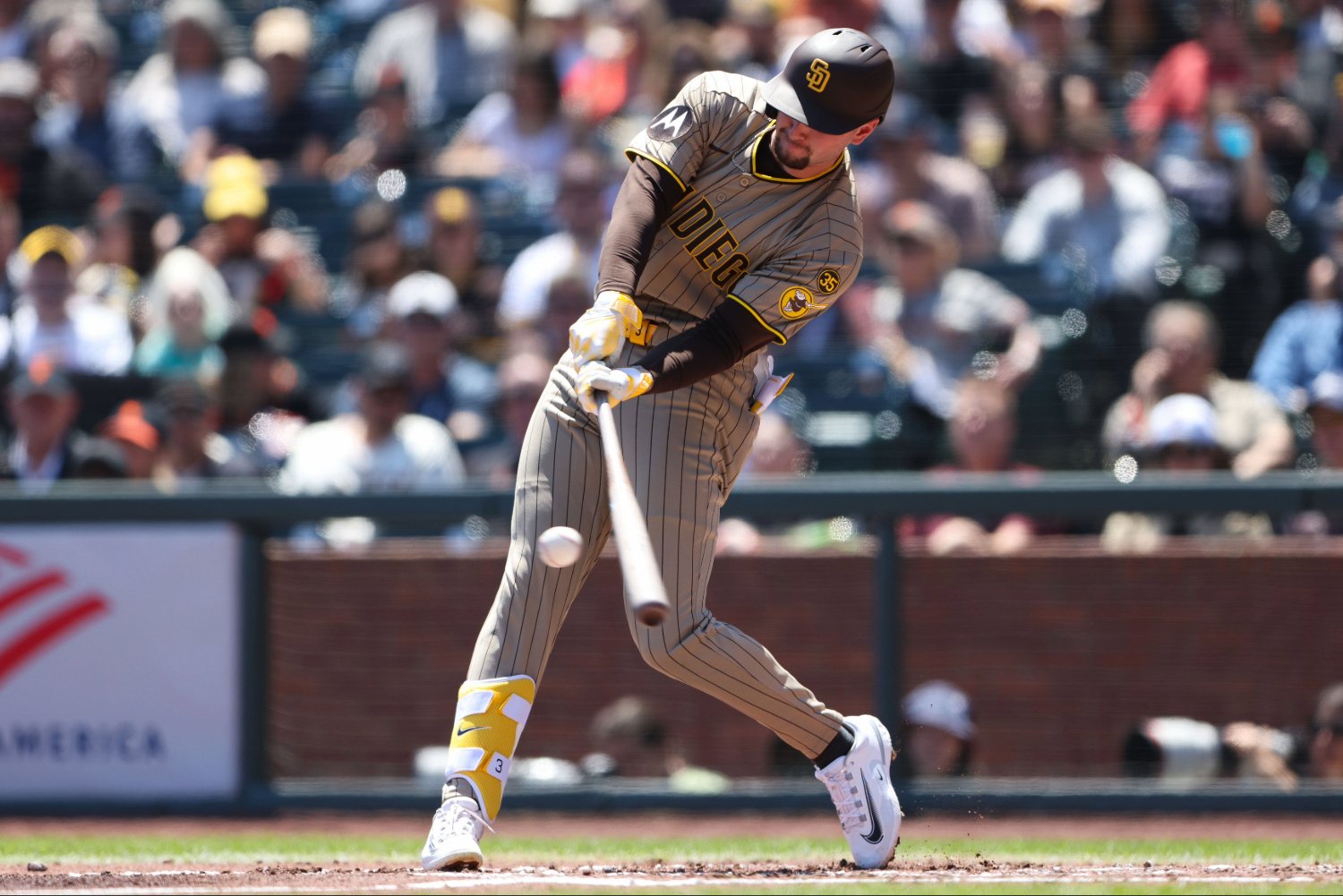
You could forgive Jackson Merrill for a sophomore slump in 2025. It would even be tough to label it such. The San Diego Padres' young star dealt with a variety of injuries seemingly from the jump, facing a hamstring strain, a concussion, and an ankle injury before the season reached its end, to say nothing of the lingering effects in between. As a result, he experienced a decline just about everywhere on the stat sheet. Yet even clear of such health woes, things have only gotten worse thus far in 2026.
As he approaches 200 plate appearances for the year, Merrill is bogged down in a .206/.274/.329 line. He's striking out at a 26.1 percent clip and has a wRC+ of 72. His power has waned, with a .124 isolated power number that represents a 69-point drop from even last year's 15-point decline in that regard. Just about the only positives to emerge to this point in the year are an increased walk rate (8.0 percent) and eight steals that put him halfway to his career-high. As the Padres struggle to find sustained production on offense, Merrill's early struggles have been right at the forefront with no such injury excuses on which to fall back.
The issue with Merrill's early performance this year isn't even in the performance itself. It's the absence of an obvious explanation for why he's underperforming. Generally, one can look at a player's underlying trends and find a catalyst that speaks to the origins of the struggle. Matters of the approach are a particularly notable factor in performance variance. Merrill's case isn't so apparent, however. For example, here are his swing trends over the course of his three years in the league:
- 2024: 34.3 O-Swing%, 79.8 Z-Swing%, 56.7 Swing%
- 2025: 37.8 O-Swing%, 79.1 Z-Swing%, 58.3 Swing%
- 2026: 36.3 O-Swing%, 80.6 Z-Swing%, 56.1 Swing%
There isn't anything remarkably different in the approach there. Even his swing distribution against different pitch types has remained within three percent over that stretch of time.
Instead of the issue being in the approach, Merrill's problem lies in the execution. He's just not making enough contact. Here are those trends over three years:
- 2024: 66.0 O-Contact%, 87.6 Z-Contact%, 81.0 Contact%, 10.8 SwStr%
- 2025: 58.6 O-Contact%, 83.7 Z-Contact%, 75.5 Contact%, 14.1 SwStr%
- 2026: 60.3 O-Contact%, 83.4 Z-Contact%, 75.1 Contact%, 14.0 SwStr%
That's a pretty cut-and-dry case right there. Even though his swing rate is at the lowest point of his career, he's not managing to translate that into anything meaningful. This is especially true against off-speed pitches. The rate of swings against that pitch type has only increased by a single percentage point, but his whiff rate against off-speed offerings has jumped from 26.0 percent in 2024 to 34.8 percent in 2026.
It's possible that some of this, especially the off-speed element, is due to an increased swing speed. At 73.3 MPH, Merrill's swing is harder than ever. Conventional baseball wisdom, however, indicates that you don't need to swing hard to make meaningful contact. Is it possible that Merrill is simply swinging too hard in a way that's stifling his ability to make contact? It would represent an obvious connection between an approach that has stayed the same despite contact metrics that have dropped off since his rookie season.
He's also been coming in with a steeper swing in the last two years than in the first. His attack angle in 2024 was just six degrees against a 10-degree angle in 2025 and a nine-degree angle thus far in 2026. A faster, steeper swing occurring alongside wilting contact numbers seems to be where we may find the root of the issue for Merrill. Especially with a hard contact rate that sits up in the 84th percentile (48.3 percent).
That's our intersection. The approach has been steady, but the swing has become more aggressive and, at the same time, steeper. That means when contact is there, it's of a harder variety, but we also see less of it. That's also why the biggest issue in his contact has been with the off-speed, which feeds off a hitter's aggression. It's not that Merrill is swinging at the wrong pitches. He's swinging at them in the wrong manner.
Whether or not this is something fixable within the confines of a baseball season remains to be seen. It's not a pure mechanical tweak like footwork but something that manifests more out of mindset or instruction. That means an adjustment will have to come courtesy of Merrill's own fix or from hitting coach Steven Souza Jr. Doing so in the midst of a 162-game grind is far easier said than done.





Recommended Comments
There are no comments to display.
Create an account or sign in to comment
You need to be a member in order to leave a comment
Create an account
Sign up for a new account in our community. It's easy!
Register a new accountSign in
Already have an account? Sign in here.
Sign In Now