Randy Holt
-
Posts
486 -
Joined
-
Last visited
-
Days Won
6
Content Type
Profiles
San Diego Padres Videos
2026 San Diego Padres Top Prospects Ranking
San Diego Padres Free Agent & Trade Rumors, Notes, & Tidbits
Guides & Resources
2025 San Diego Padres Draft Pick Tracker
News
2026 San Diego Padres Draft Tracker: Picks & Bonuses
Forums
Blogs
Events
Store
Downloads
Gallery
Everything posted by Randy Holt
-
Jackson Merrill was on fire to start the season. Through 41 plate appearances in March & April, the sophomore outfielder was wRC+ing 202 courtesy of a .378/.415/.676 line that went along with a .297 ISO. Only a dozen players featured a better wRC+ through April 6th (the last game he played before his injury), and only eight carried more fWAR than Merrill's 0.6 mark in a minuscule sample. Merrill was out from April 6th to May 6th. He returned to rainy weather in the Bronx against the New York Yankees and recorded a pair of hits, one of which was a double. The next night, he notched another two, one of which was a home run off Max Fried (who, if you're unaware, has been one of the best starting pitchers in baseball this year): Merrill spent his weekend in Colorado continuing to hit. He recorded three hits on Friday and another four in the 21-0 win on Saturday. After an illness held him out of the lineup on Sunday, he was at it again with three hits. While it was a game the Padres ended up losing (courtesy of a Robert Suárez blown save), Merrill was a star in all facets: The May returns include a .607 average, a .625 OBP, and a 337 wRC+. He's struck out at a lower rate than he did in March & April while providing slightly more on the power side (.304 ISO). Obviously it's a smaller sample. But the fact that he didn't skip a beat even with a month between Major League games speaks to the talent level the Padres currently possess in center field. Even without enough time to qualify, his Baseball Savant percentile distribution is a sight to behold. If you're fan of the color red, at least. That the Padres were able to weather the storm without such a key component of their lineup is reflective of the contributions they've been able to get elsewhere (on both sides of the ball). But having Jackson Merrill back in the mix is perhaps the most important development in recent days for a Padres team with no shortage of them. Especially as they begin the march toward a contender-heavy June. View full article
-
Padres Bullets: Kolek vs. Seattle, Brito Done, and Darvish Close
Randy Holt posted an article in Padres
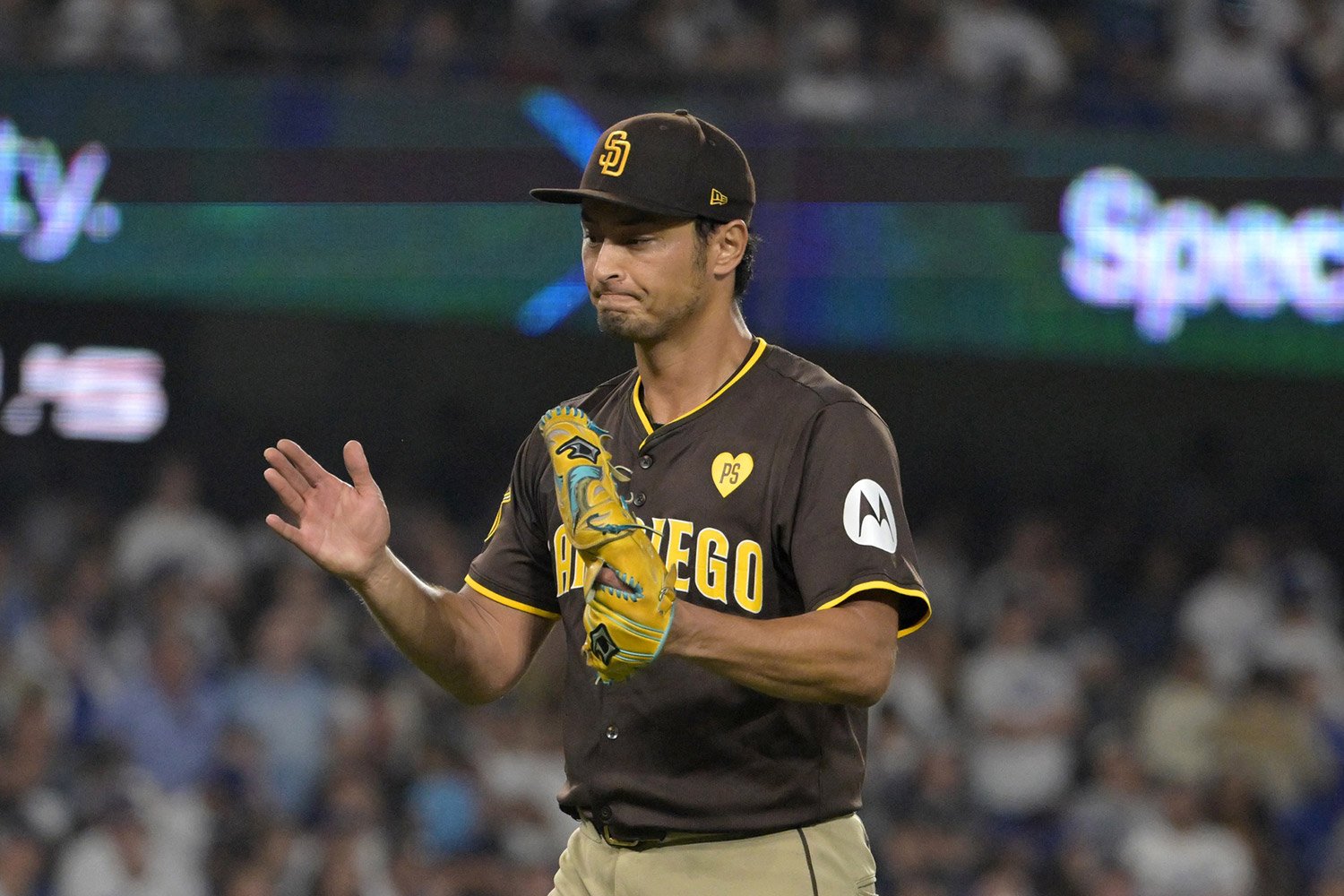 The San Diego Padres resume their homestand on Friday night, welcoming in the Seattle Mariners. Unlike their last pair of matchups, which saw them take on two last-place teams, the weekend tilt vs. the M's represents a series between two legitimate contenders. Seattle sits atop the American League West at present, courtesy of a 23-19 start. Here are the headlines heading into the weekend: Kolek vs. His Former Organization Stephen Kolek only has two big league starts under his belt, but he's been nothing short of terrific. He has yet to allow a run through 14.1 innings of work and is getting the ball on the ground almost 60 percent of the time. Friday's start will be his first at Petco Park, but it'll be marked by other significance. The Padres selected Kolek from the Mariners in the Rule-5 draft back in December of 2023. At that point, Kolek had been moved out of a starting role and into a bullpen given the crowded starting group in Seattle. With that, Friday offers Kolek an opportunity to make a couple of different statements. One is in the obvious shoving against his former club that brings a sense of satisfaction. The other is staking his claim to a rotation spot in the longer-term in San Diego. Brito Out Into 2026 The Padres have received no shortage of contributions from those that they received as part of the Juan Soto trade with the New York Yankees. Michael King has been excellent atop the rotation. Randy Vásquez has worked around backwards strikeout-to-walk splits. Even Drew Thorpe was used as part of a package to acquire Dylan Cease. But the team will have to wait a bit longer for Jhony Brito to showcase his value. With a torn flexor tendon in his throwing arm, Brito underwent UCL & tendon surgery that will cost him the remainder of 2025 and some of 2026. Darvish Nearing Return Off Short Rehab We've known for a while that Yu Darvish was nearing a rehab assignment given the ramping up of his bullpen sessions. The veteran threw four innings with El Paso on Wednesday night, allowing two runs on two hits. He threw 51 pitches. It's possible that Darvish heads out on one more rehab start, but the team may opt for a simulated game instead. Either way, it looks like one more outing is in the cards before Darvish makes his return. We'll talk more about the rotation implications, but it seems the Padres could merely add him to the starting group without ousting another arm; the team is set to play 26 games in 27 days starting on May 30th. De Vries' Timeline Considering the top-heavy nature of the Padres' lineup, we're likely going to hear a lot about Leo De Vries joining the roster at some point in 2025. The 18-year-old has mashed in High-A and moved up to the no. 3 spot on MLB Pipeline's Top 100 Prospects. The Athletic's Dennis Lin discussed as much in his mailbag this week. For his money, though, Lin doesn't see De Vries arriving at Petco this year as a realistic scenario. Using Ethan Salas' struggles (and injury) after a hot start as part of the basis, it's ultimately important to consider that the leap from High-A to the big leagues is absolutely massive. It's likely not a timeline the Padres are willing to push too much at this point.
 -
The San Diego Padres resume their homestand on Friday night, welcoming in the Seattle Mariners. Unlike their last pair of matchups, which saw them take on two last-place teams, the weekend tilt vs. the M's represents a series between two legitimate contenders. Seattle sits atop the American League West at present, courtesy of a 23-19 start. Here are the headlines heading into the weekend: Kolek vs. His Former Organization Stephen Kolek only has two big league starts under his belt, but he's been nothing short of terrific. He has yet to allow a run through 14.1 innings of work and is getting the ball on the ground almost 60 percent of the time. Friday's start will be his first at Petco Park, but it'll be marked by other significance. The Padres selected Kolek from the Mariners in the Rule-5 draft back in December of 2023. At that point, Kolek had been moved out of a starting role and into a bullpen given the crowded starting group in Seattle. With that, Friday offers Kolek an opportunity to make a couple of different statements. One is in the obvious shoving against his former club that brings a sense of satisfaction. The other is staking his claim to a rotation spot in the longer-term in San Diego. Brito Out Into 2026 The Padres have received no shortage of contributions from those that they received as part of the Juan Soto trade with the New York Yankees. Michael King has been excellent atop the rotation. Randy Vásquez has worked around backwards strikeout-to-walk splits. Even Drew Thorpe was used as part of a package to acquire Dylan Cease. But the team will have to wait a bit longer for Jhony Brito to showcase his value. With a torn flexor tendon in his throwing arm, Brito underwent UCL & tendon surgery that will cost him the remainder of 2025 and some of 2026. Darvish Nearing Return Off Short Rehab We've known for a while that Yu Darvish was nearing a rehab assignment given the ramping up of his bullpen sessions. The veteran threw four innings with El Paso on Wednesday night, allowing two runs on two hits. He threw 51 pitches. It's possible that Darvish heads out on one more rehab start, but the team may opt for a simulated game instead. Either way, it looks like one more outing is in the cards before Darvish makes his return. We'll talk more about the rotation implications, but it seems the Padres could merely add him to the starting group without ousting another arm; the team is set to play 26 games in 27 days starting on May 30th. De Vries' Timeline Considering the top-heavy nature of the Padres' lineup, we're likely going to hear a lot about Leo De Vries joining the roster at some point in 2025. The 18-year-old has mashed in High-A and moved up to the no. 3 spot on MLB Pipeline's Top 100 Prospects. The Athletic's Dennis Lin discussed as much in his mailbag this week. For his money, though, Lin doesn't see De Vries arriving at Petco this year as a realistic scenario. Using Ethan Salas' struggles (and injury) after a hot start as part of the basis, it's ultimately important to consider that the leap from High-A to the big leagues is absolutely massive. It's likely not a timeline the Padres are willing to push too much at this point. View full article
-
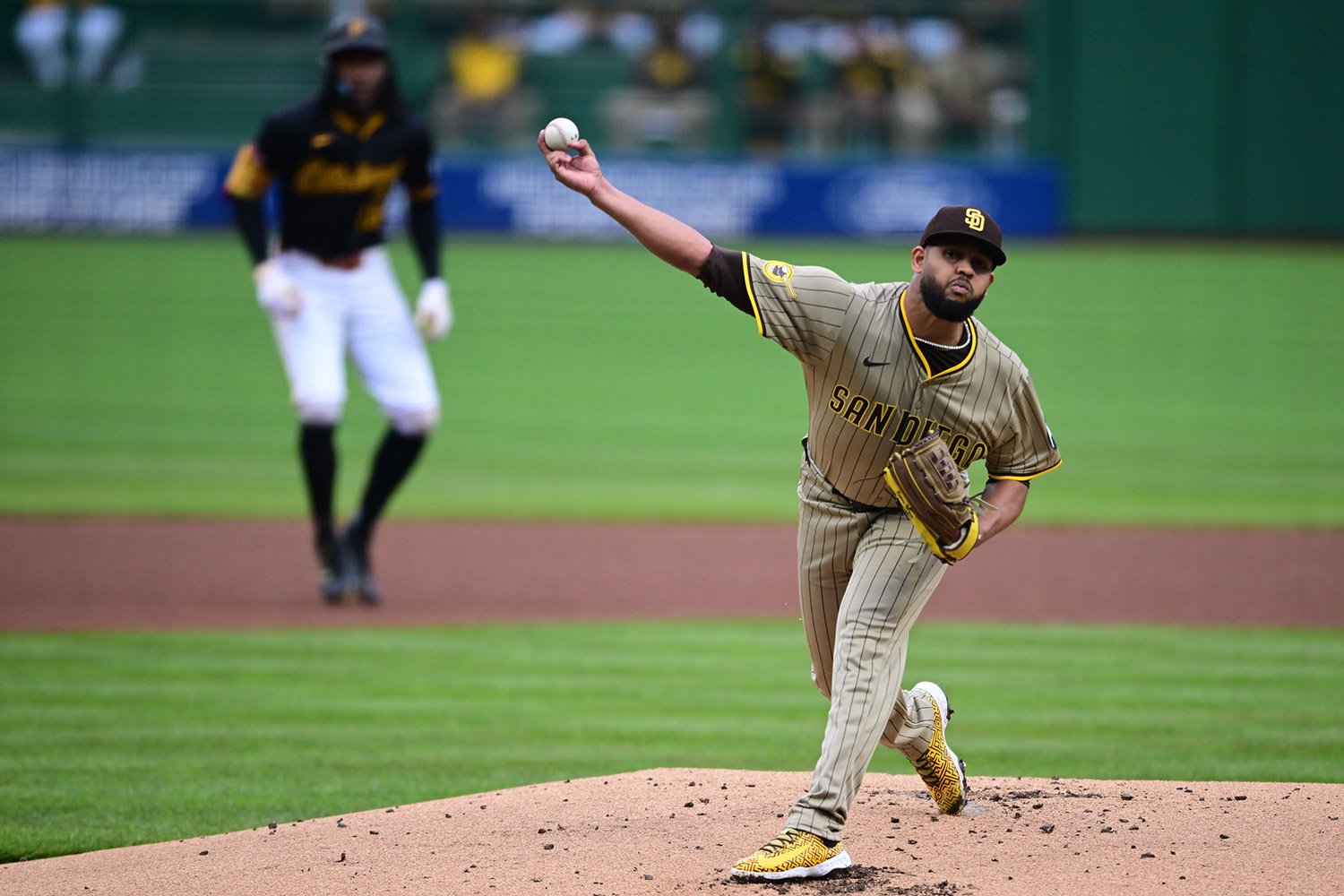 The strength of the 2025 San Diego Padres resides on the mound. Pitching is the reason they've been able to compensate for a lack of offensive depth, and it's also the reason they were able to stave off a slide in the wake of injuries that threatened to expose that lack of depth. Randy Vásquez has been an important part of that. Only six teams have a better ERA than the Padres' 3.46 mark from their starting pitchers. Only five are ahead in Hard-Hit% allowed (39.2). They're top 12 in BB% (9.4) and WHIP (1.24). Although there have been some inefficiencies, the group propped up by Michael King, Dylan Cease, and Nick Pivetta has been among the league's strongest. Even with Joe Musgrove out for the year, and Yu Darvish yet to appear in a game. And here is where we transition to the aforementioned Randy Vásquez. The pitcher acquired from the New York Yankees in the Juan Soto trade has taken the mound for eight starts. He's 2-3 in those starts with a 3.76 ERA. He's been among the league's best in avoiding hard contact, sitting in the 86th percentile in average exit velocity (86.8 MPH). Given the stability he's provided, you'll take it. However, it doesn't require any level of detective skills to identify the flaws. No starting pitcher with at least 30 innings has walked more hitters than Vásquez (14.5 percent). Only Colorado's Antonio Senzatela has a lower strikeout rate than his 10.3 percent. Again, it doesn't take Benoit Blanc to figure out the apprehension in thinking about Vásquez as a long-term option: It's an intensely strange combination. We've seen pitchers have success sans punchouts. Limiting quality contact and getting the ball on the ground is a proven recipe for success. But those pitchers aren't walking the kind of volume we're seeing from Vásquez thus far. Even weirder, though, is the fact that not a whole lot has changed in the peripherals for Vásquez, except in one very notable way. While each of his first strike, whiff, and contact rates hasn't changed in any real way, hitters simply are not swinging in the way that we've seen in the past. His overall swing rate has fallen more than six percent (43.0), and his chase rate has dropped nearly eight percent (19.7). Strikeouts may not be a prerequisite for success, but you have to induce some chase in order to keep hitters off balance via soft contact. Part of that may be in the usage. Vásquez has used a cutter far more than he has in the past; the increase in opposing Swing% has been marginal. Meanwhile, hitters are chasing his other offerings with far less frequency. He's also been inconsistent in working the zone. This, while throwing technically six different pitches as part of his repertoire thus far. There are very likely some things that need to be sorted in the usage. His avoidance of quality contact is allowing him to maintain success through an entirely backwards method of pitching, from the standpoint of the strikeout and walk rates. That isn't always going to work, though. We've seen it catch up with him in starts against Chicago and Detroit (read: good baseball teams). We'll conduct a deeper dive into the usage and explore potential solutions in the coming weeks. Still, it's extremely clear that you're currently operating on a very narrow margin for error. Perhaps more than anyone in baseball.
 -
The strength of the 2025 San Diego Padres resides on the mound. Pitching is the reason they've been able to compensate for a lack of offensive depth, and it's also the reason they were able to stave off a slide in the wake of injuries that threatened to expose that lack of depth. Randy Vásquez has been an important part of that. Only six teams have a better ERA than the Padres' 3.46 mark from their starting pitchers. Only five are ahead in Hard-Hit% allowed (39.2). They're top 12 in BB% (9.4) and WHIP (1.24). Although there have been some inefficiencies, the group propped up by Michael King, Dylan Cease, and Nick Pivetta has been among the league's strongest. Even with Joe Musgrove out for the year, and Yu Darvish yet to appear in a game. And here is where we transition to the aforementioned Randy Vásquez. The pitcher acquired from the New York Yankees in the Juan Soto trade has taken the mound for eight starts. He's 2-3 in those starts with a 3.76 ERA. He's been among the league's best in avoiding hard contact, sitting in the 86th percentile in average exit velocity (86.8 MPH). Given the stability he's provided, you'll take it. However, it doesn't require any level of detective skills to identify the flaws. No starting pitcher with at least 30 innings has walked more hitters than Vásquez (14.5 percent). Only Colorado's Antonio Senzatela has a lower strikeout rate than his 10.3 percent. Again, it doesn't take Benoit Blanc to figure out the apprehension in thinking about Vásquez as a long-term option: It's an intensely strange combination. We've seen pitchers have success sans punchouts. Limiting quality contact and getting the ball on the ground is a proven recipe for success. But those pitchers aren't walking the kind of volume we're seeing from Vásquez thus far. Even weirder, though, is the fact that not a whole lot has changed in the peripherals for Vásquez, except in one very notable way. While each of his first strike, whiff, and contact rates hasn't changed in any real way, hitters simply are not swinging in the way that we've seen in the past. His overall swing rate has fallen more than six percent (43.0), and his chase rate has dropped nearly eight percent (19.7). Strikeouts may not be a prerequisite for success, but you have to induce some chase in order to keep hitters off balance via soft contact. Part of that may be in the usage. Vásquez has used a cutter far more than he has in the past; the increase in opposing Swing% has been marginal. Meanwhile, hitters are chasing his other offerings with far less frequency. He's also been inconsistent in working the zone. This, while throwing technically six different pitches as part of his repertoire thus far. There are very likely some things that need to be sorted in the usage. His avoidance of quality contact is allowing him to maintain success through an entirely backwards method of pitching, from the standpoint of the strikeout and walk rates. That isn't always going to work, though. We've seen it catch up with him in starts against Chicago and Detroit (read: good baseball teams). We'll conduct a deeper dive into the usage and explore potential solutions in the coming weeks. Still, it's extremely clear that you're currently operating on a very narrow margin for error. Perhaps more than anyone in baseball. View full article
-
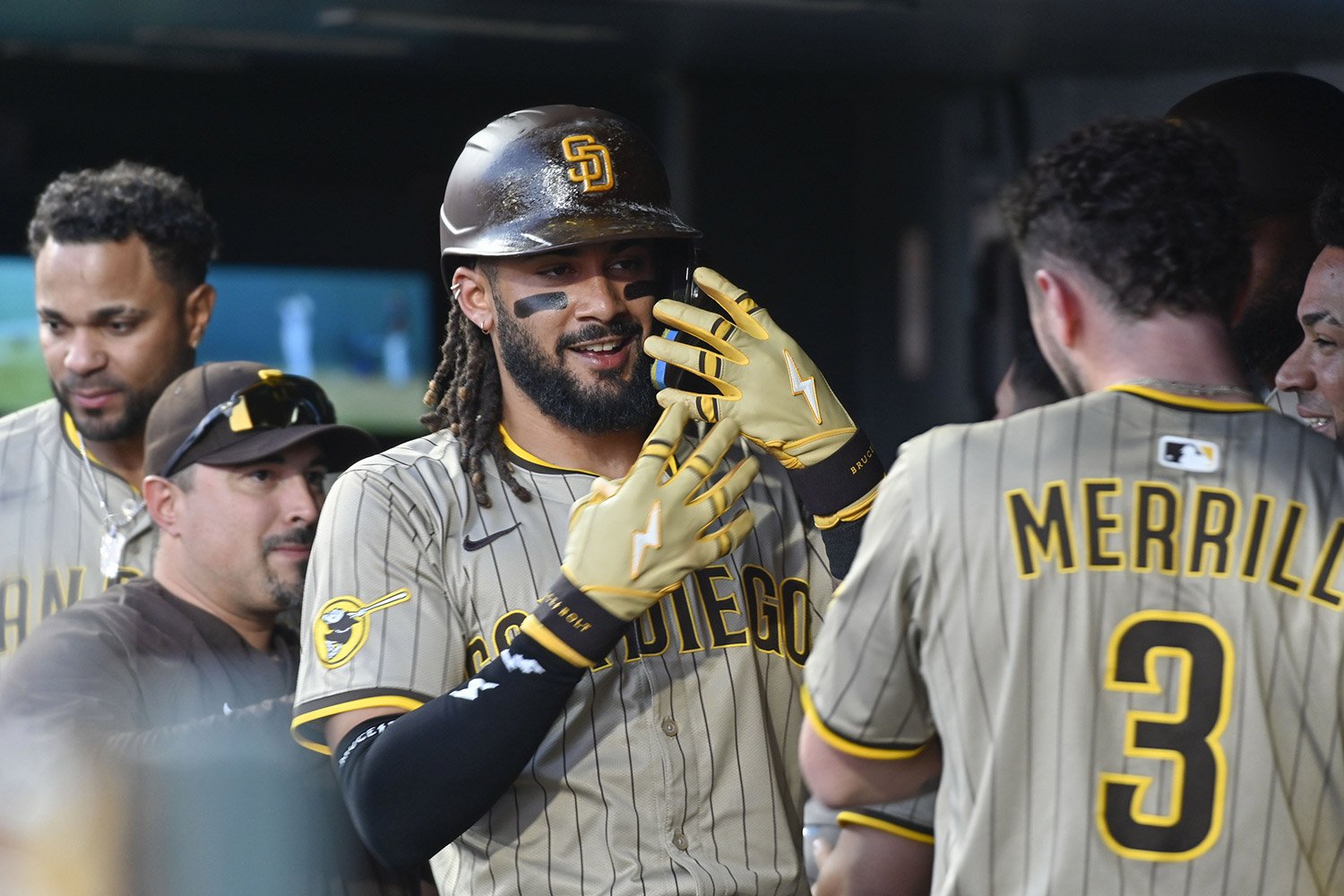 The Colorado Rockies are who they are. They're on pace to be one of the worst teams in the history of Major League Baseball. As such, you could make the case that a team like the San Diego Padres should do exactly what they did against them on Saturday night: a 21-0 win that set or tied multiple franchise records. Considering the struggles the Padres endured after getting ahead 13-2 on Friday night, it was a worthy outcome. Despite that massive early lead, the team was forced to deploy closer Robert Suárez in what became a very close game by night's end. They left no doubt in the follow-up, though. Here's some of the history made (courtesy of MLB.com): The 21-0 win was the largest margin of victory in franchise history. The team's previous record for a win was 16 runs, which they've done on multiple occasions (and as recently as 2021). However, it fell short of the largest margin of victory in modern history, as the Texas Rangers' 30-3 victory over Baltimore in '07 still reigns there. It was also one run short of the league record for the largest margin in a shutout. Eight members of the Padres recorded multiple hits. Fernando Tatis Jr, Manny Machado, Xander Bogaerts, and Jake Cronenworth each had two, Luis Arráez, Elías Díaz, and Gavin Sheets had three, and Jackson Merrill led the group with four. That hadn't been done in franchise history. The 24 hits merely tied a franchise record, though. With his home run in the fifth inning, Fernando Tatis Jr passed Tony Gwynn on the Padres' all-time leaderboard. While not a prolific home run hitter, anytime you're passing Mr. Padre in something, you're probably doing it correctly. Hilariously, Stephen Kolek made some history on the mound and went the distance. He was the first Padre since 1986 to throw a shutout within the first two starts of his career. Even better, he was the first Major League pitcher to throw a complete game shutout with this margin of victory since 1939. He also checked in as the first visiting starter to throw one at Coors Field since 2013 (Clayton Kershaw, somewhat obviously). Oh yeah, the Padres as an organization had never done it in Denver either. The Padres will get back to work on Sunday, having scored 34 runs in two games. With a completely healthy lineup, they'll look to continue to pour in runs with Nick Pivetta on the bump.
 -
The Colorado Rockies are who they are. They're on pace to be one of the worst teams in the history of Major League Baseball. As such, you could make the case that a team like the San Diego Padres should do exactly what they did against them on Saturday night: a 21-0 win that set or tied multiple franchise records. Considering the struggles the Padres endured after getting ahead 13-2 on Friday night, it was a worthy outcome. Despite that massive early lead, the team was forced to deploy closer Robert Suárez in what became a very close game by night's end. They left no doubt in the follow-up, though. Here's some of the history made (courtesy of MLB.com): The 21-0 win was the largest margin of victory in franchise history. The team's previous record for a win was 16 runs, which they've done on multiple occasions (and as recently as 2021). However, it fell short of the largest margin of victory in modern history, as the Texas Rangers' 30-3 victory over Baltimore in '07 still reigns there. It was also one run short of the league record for the largest margin in a shutout. Eight members of the Padres recorded multiple hits. Fernando Tatis Jr, Manny Machado, Xander Bogaerts, and Jake Cronenworth each had two, Luis Arráez, Elías Díaz, and Gavin Sheets had three, and Jackson Merrill led the group with four. That hadn't been done in franchise history. The 24 hits merely tied a franchise record, though. With his home run in the fifth inning, Fernando Tatis Jr passed Tony Gwynn on the Padres' all-time leaderboard. While not a prolific home run hitter, anytime you're passing Mr. Padre in something, you're probably doing it correctly. Hilariously, Stephen Kolek made some history on the mound and went the distance. He was the first Padre since 1986 to throw a shutout within the first two starts of his career. Even better, he was the first Major League pitcher to throw a complete game shutout with this margin of victory since 1939. He also checked in as the first visiting starter to throw one at Coors Field since 2013 (Clayton Kershaw, somewhat obviously). Oh yeah, the Padres as an organization had never done it in Denver either. The Padres will get back to work on Sunday, having scored 34 runs in two games. With a completely healthy lineup, they'll look to continue to pour in runs with Nick Pivetta on the bump. View full article
-
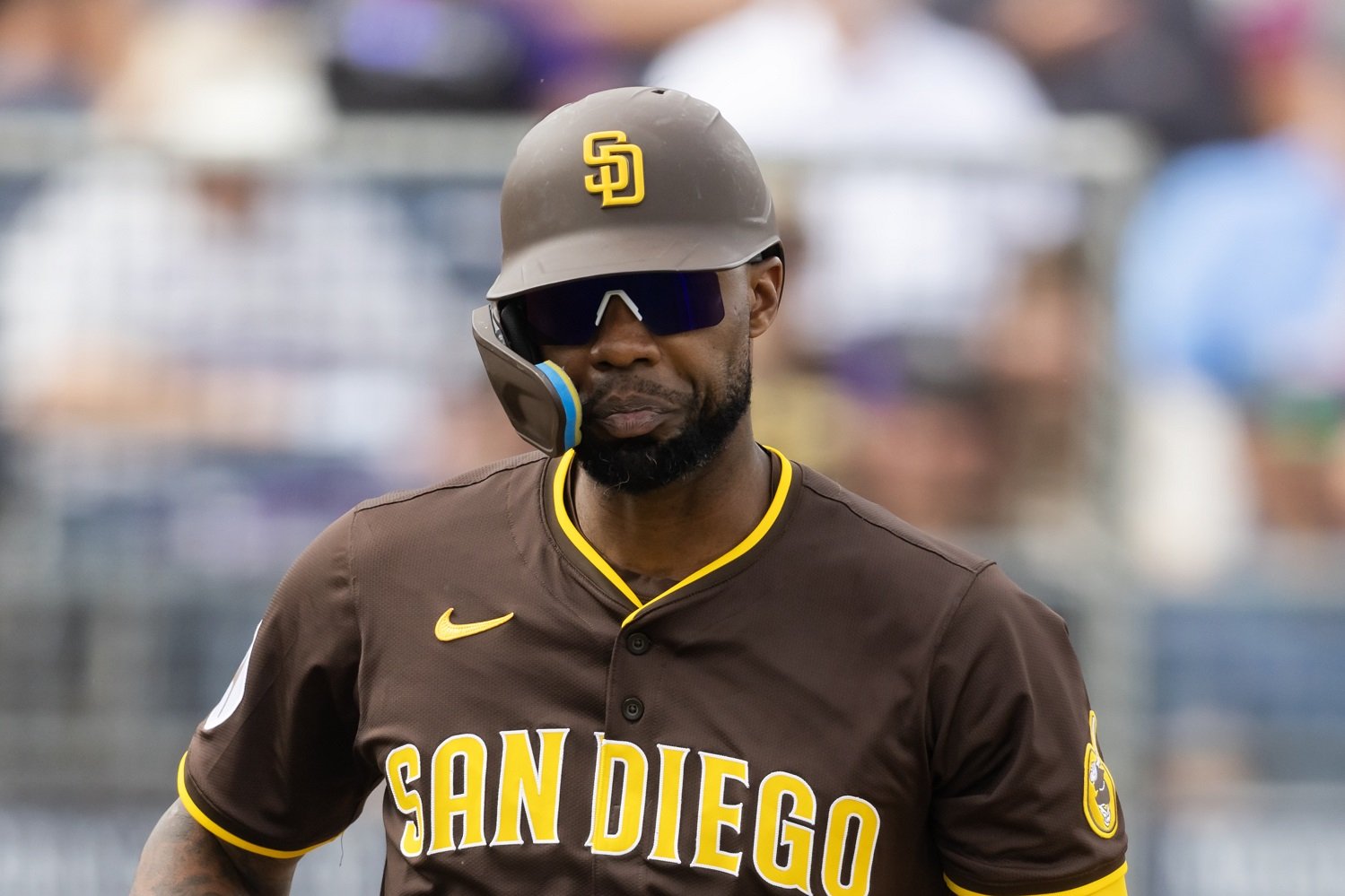 In spite of themselves, the San Diego Padres keep on winning. A top heavy lineup from the jump, ravaged by injuries and comprised of fringe Major League talent on the margins, keeps doing it. But while they've managed to survive with the strategy of loading up the bench with non-roster invites from back in spring training, they've also shown they have limits. Yuli Gurriel didn't hit. He was given 40 plate appearances to prove his meddle as a bench piece, with injuries ahead of him manifesting opportunities. He could only muster a wRC+ of 5, though, and was unceremoniously designated for assignment before later electing free agency. The team isn't quite at that point with Jason Heyward. But it's not that far off. Heyward missed his share of time last month with knee inflammation. But on either end of that short stay on the Injured List, it hasn't been terrific. His slash includes an average of just .196, an OBP of .250, and not a lot happening elsewhere to compensate. His walk rate is running under eight percent while his isolated slugging comes in at just .089. His wRC+ is just 51, indicative of a player 49 percent worse than league average. Of the 307 players with at least 60 PA this year, he's the 24th worst by wRC+. It's not like there's some saving grace in the underlying data, either. Heyward doesn't have enough playing time to qualify or register for percentile ranks on Baseball Savant, but pretty much everything would be lingering around the bottom if he did. His chase rate (35.0 percent) is at the highest point of his career while his contact rate sits as one of his worst (76.1). His Hard-Hit% is 28.3. Even for a hitter not known for impact outcomes at the plate, that latter figure is the lowest rate of his career. Considering that most of his work has come against right-handed pitching within a platoon, breaking down splits becomes irrelevant at that point. The bat speed is down, too. After declining slightly between 2023 & 2024, it's down even more (71.9 MPH average) in '25. His rate of fast swings, at 16.7 percent, has fallen by more than 10 percent. This, while his swing has gotten longer. Some of this you could survive if Heyward was the defender he once was. But he's been slightly below average by Fielding Run Value (-1). His outfield jump is also at a career-low. It's a small sample, but he's also never posted a below average figure in either regard. Brandon Lockridge, meanwhile, is posting above average defensive figures (3 FRV). Which brings us to sort of the central problem with Jason Heyward. The Heyward-Lockridge combination was deemed the platoon in left field at the season's outset. It wasn't an entirely encouraging situation on the offensive side, but given limited financing the team was willing to invest in their roster construction, it was the situation nonetheless. At this point, Lockridge is playing himself into more time while Heyward is playing himself out of it. Lockridge is offering better defense and, interestingly, faring better against righties than his platoon partner in Heyward (the former's shortcomings against left-handed pitching is a topic for another day). You're not squeezing a lot of offense out of either case, but that Lockridge is providing more value in Heyward's role than Heyward could spell some eventual doom as far as Heyward's roster status is concerned. There are unquantifiable elements here. Heyward is as respected a veteran as exists in baseball. Helping the team to stay the course in the clubhouse in the midst of such a high volume of injuries is likely a consideration on some level. But even that gets harder to ignore in the face of the quantifiable. Not that we have any reason to suspect Heyward's roster spot is in immediate danger. The lack of depth still exists. You can't get rid of a depth piece when depth wasn't a factor to begin with. In the interim, our more immediate point is that Heyward's bat is broken. His defense no longer compensates. With the Padres starting to get healthy, you can work a little more toward mitigating some of those negative effects. But the reality is that this is a player that cannot, and should not, be relied upon for a team with developing championship aspirations.
 -
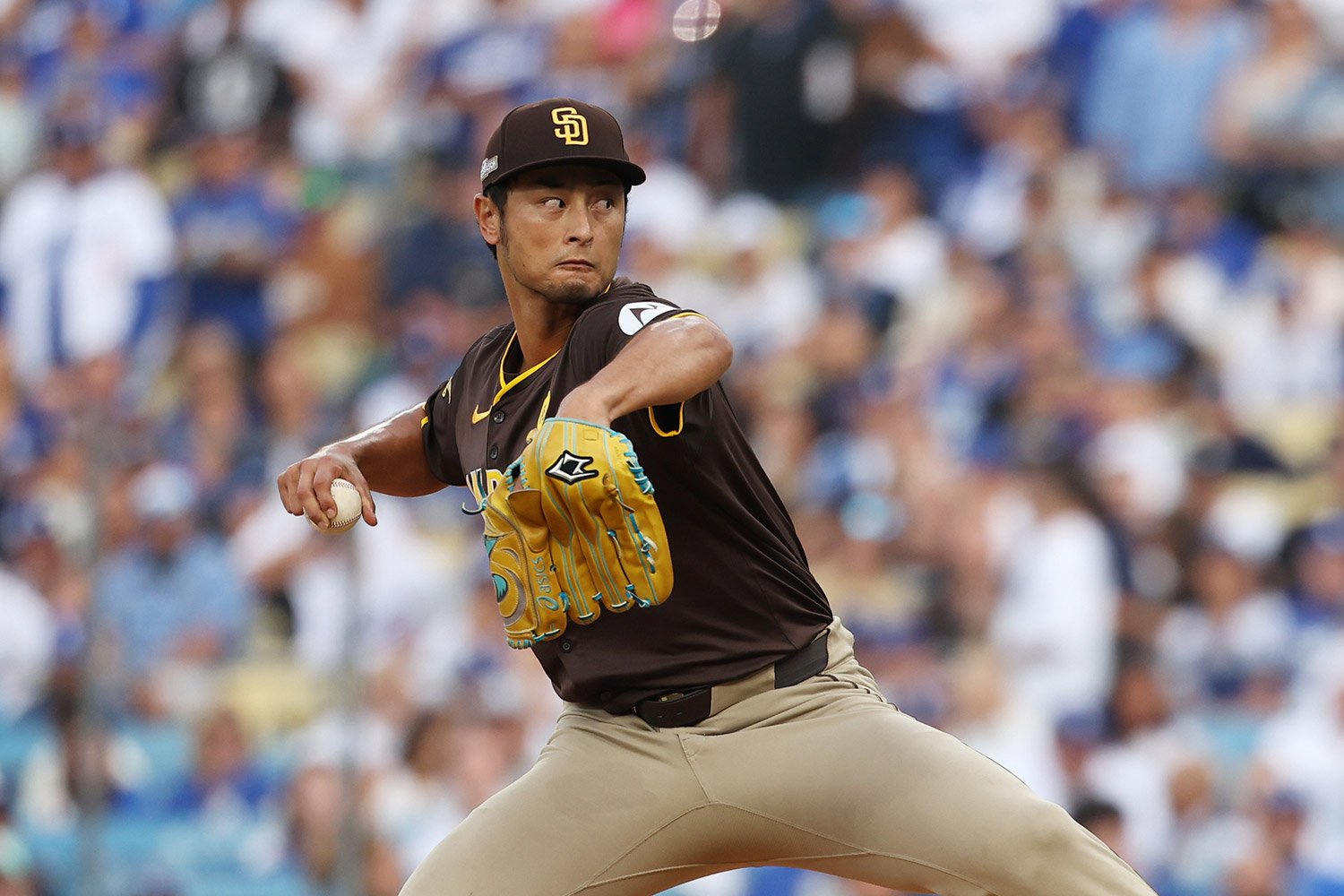 The San Diego Padres play baseball today. After a tough close to the series against the New York Yankees (in more ways than one), they'll get a bit of a reprieve when they head to Colorado for a three-game set against the Rockies. The Padres will send Randy Vásquez, Stephen Kolek, and Nick Pivetta across the trio of tilts in Denver. Here's everything you need to know about the organization (and the league) heading into the weekend. Cease, Merrill Apparently Fine Disappointing as Wednesday's extra innings loss in the Bronx was, the outcome could have been much worse. Especially with the injury luck the Padres have had thus far in 2025. With forearm cramping, Dylan Cease left his best start of the year (taking a no-hitter into the seventh). Jackson Merrill, who returned from his hamstring injury on Tuesday, caught a pitch from Devin Williams on his left forearm. But Cease passed the post-game tests, and Merrill remained in the game. We have no reason to think either will miss time at this point. It at least feels reassuring that not every potential injury results in an IL stint, as the broader picture of this year would have us believe. Darvish's Live Work On Thursday, Yu Darvish took another step forward in his recovery from elbow inflammation that has delayed his start to the year. He was set to throw at least one session to live hitters ahead of what could be a first rehab start on Tuesday. Given that Tuesday is four days away, we're likely at least a few weeks away from seeing Darvish take the mound for San Diego. But given that they're cobbling together a rotation that has, thus far, included the likes of Vásquez's no-strikeout, all-walk outcomes, Kolek's reliever-to-starter transition, and the struggling Kyle Hart, his impending return should bring some sorely needed stability to the group. Whenever that happens to be. Cronenworth Inching Closer That the Padres have been so successful without Merrill & Jake Cronenworth in the lineup for weeks is nothing short of a miracle. A top-heavy group to begin with, they've stayed the course courtesy of just enough offense and a dominant bullpen. But with Merrill returning to immediate success, they could get another key component of their lineup back as soon as Friday. After consecutive rehab starts in El Paso, Cronenworth could join his comrades in Colorado on Friday. He hasn't appeared in a game since April 9th, courtesy of a fractured rib. A fully healthy lineup against this Rox club in Denver? Oof. In a good way. Bellatti Released Andrew Bellatti signed with the Padres toward the end of spring training. After a strong 2022 in Philadelphia, he could not replicate that success the following season, largely due to injury setbacks. He spent all of 2024 in Lehigh Valley. A depth signing to begin with, Bellatti was always going to find it difficult to break into this bullpen picture, given the volume and early dominance. But after 4.2 innings of work, it leaned more toward impossible. He allowed 10 hits, five walks, and six runs. The Padres announced his release on Thursday. Rosario Makes El Paso History That Eguy Rosario was unable to crack a bench job out of spring training was wrought more from roster logistics than any of his own shortcomings. He's had a tough run of it in El Paso (his wRC+ is 7), but he made a little bit of positive history earlier this week, when he hit his 49th career home run for the Chihuahuas. The previous record of 48 was held by Cody Decker. Not bad for only being 25.
 -
The San Diego Padres play baseball today. After a tough close to the series against the New York Yankees (in more ways than one), they'll get a bit of a reprieve when they head to Colorado for a three-game set against the Rockies. The Padres will send Randy Vásquez, Stephen Kolek, and Nick Pivetta across the trio of tilts in Denver. Here's everything you need to know about the organization (and the league) heading into the weekend. Cease, Merrill Apparently Fine Disappointing as Wednesday's extra innings loss in the Bronx was, the outcome could have been much worse. Especially with the injury luck the Padres have had thus far in 2025. With forearm cramping, Dylan Cease left his best start of the year (taking a no-hitter into the seventh). Jackson Merrill, who returned from his hamstring injury on Tuesday, caught a pitch from Devin Williams on his left forearm. But Cease passed the post-game tests, and Merrill remained in the game. We have no reason to think either will miss time at this point. It at least feels reassuring that not every potential injury results in an IL stint, as the broader picture of this year would have us believe. Darvish's Live Work On Thursday, Yu Darvish took another step forward in his recovery from elbow inflammation that has delayed his start to the year. He was set to throw at least one session to live hitters ahead of what could be a first rehab start on Tuesday. Given that Tuesday is four days away, we're likely at least a few weeks away from seeing Darvish take the mound for San Diego. But given that they're cobbling together a rotation that has, thus far, included the likes of Vásquez's no-strikeout, all-walk outcomes, Kolek's reliever-to-starter transition, and the struggling Kyle Hart, his impending return should bring some sorely needed stability to the group. Whenever that happens to be. Cronenworth Inching Closer That the Padres have been so successful without Merrill & Jake Cronenworth in the lineup for weeks is nothing short of a miracle. A top-heavy group to begin with, they've stayed the course courtesy of just enough offense and a dominant bullpen. But with Merrill returning to immediate success, they could get another key component of their lineup back as soon as Friday. After consecutive rehab starts in El Paso, Cronenworth could join his comrades in Colorado on Friday. He hasn't appeared in a game since April 9th, courtesy of a fractured rib. A fully healthy lineup against this Rox club in Denver? Oof. In a good way. Bellatti Released Andrew Bellatti signed with the Padres toward the end of spring training. After a strong 2022 in Philadelphia, he could not replicate that success the following season, largely due to injury setbacks. He spent all of 2024 in Lehigh Valley. A depth signing to begin with, Bellatti was always going to find it difficult to break into this bullpen picture, given the volume and early dominance. But after 4.2 innings of work, it leaned more toward impossible. He allowed 10 hits, five walks, and six runs. The Padres announced his release on Thursday. Rosario Makes El Paso History That Eguy Rosario was unable to crack a bench job out of spring training was wrought more from roster logistics than any of his own shortcomings. He's had a tough run of it in El Paso (his wRC+ is 7), but he made a little bit of positive history earlier this week, when he hit his 49th career home run for the Chihuahuas. The previous record of 48 was held by Cody Decker. Not bad for only being 25. View full article
-
In spite of themselves, the San Diego Padres keep on winning. A top heavy lineup from the jump, ravaged by injuries and comprised of fringe Major League talent on the margins, keeps doing it. But while they've managed to survive with the strategy of loading up the bench with non-roster invites from back in spring training, they've also shown they have limits. Yuli Gurriel didn't hit. He was given 40 plate appearances to prove his meddle as a bench piece, with injuries ahead of him manifesting opportunities. He could only muster a wRC+ of 5, though, and was unceremoniously designated for assignment before later electing free agency. The team isn't quite at that point with Jason Heyward. But it's not that far off. Heyward missed his share of time last month with knee inflammation. But on either end of that short stay on the Injured List, it hasn't been terrific. His slash includes an average of just .196, an OBP of .250, and not a lot happening elsewhere to compensate. His walk rate is running under eight percent while his isolated slugging comes in at just .089. His wRC+ is just 51, indicative of a player 49 percent worse than league average. Of the 307 players with at least 60 PA this year, he's the 24th worst by wRC+. It's not like there's some saving grace in the underlying data, either. Heyward doesn't have enough playing time to qualify or register for percentile ranks on Baseball Savant, but pretty much everything would be lingering around the bottom if he did. His chase rate (35.0 percent) is at the highest point of his career while his contact rate sits as one of his worst (76.1). His Hard-Hit% is 28.3. Even for a hitter not known for impact outcomes at the plate, that latter figure is the lowest rate of his career. Considering that most of his work has come against right-handed pitching within a platoon, breaking down splits becomes irrelevant at that point. The bat speed is down, too. After declining slightly between 2023 & 2024, it's down even more (71.9 MPH average) in '25. His rate of fast swings, at 16.7 percent, has fallen by more than 10 percent. This, while his swing has gotten longer. Some of this you could survive if Heyward was the defender he once was. But he's been slightly below average by Fielding Run Value (-1). His outfield jump is also at a career-low. It's a small sample, but he's also never posted a below average figure in either regard. Brandon Lockridge, meanwhile, is posting above average defensive figures (3 FRV). Which brings us to sort of the central problem with Jason Heyward. The Heyward-Lockridge combination was deemed the platoon in left field at the season's outset. It wasn't an entirely encouraging situation on the offensive side, but given limited financing the team was willing to invest in their roster construction, it was the situation nonetheless. At this point, Lockridge is playing himself into more time while Heyward is playing himself out of it. Lockridge is offering better defense and, interestingly, faring better against righties than his platoon partner in Heyward (the former's shortcomings against left-handed pitching is a topic for another day). You're not squeezing a lot of offense out of either case, but that Lockridge is providing more value in Heyward's role than Heyward could spell some eventual doom as far as Heyward's roster status is concerned. There are unquantifiable elements here. Heyward is as respected a veteran as exists in baseball. Helping the team to stay the course in the clubhouse in the midst of such a high volume of injuries is likely a consideration on some level. But even that gets harder to ignore in the face of the quantifiable. Not that we have any reason to suspect Heyward's roster spot is in immediate danger. The lack of depth still exists. You can't get rid of a depth piece when depth wasn't a factor to begin with. In the interim, our more immediate point is that Heyward's bat is broken. His defense no longer compensates. With the Padres starting to get healthy, you can work a little more toward mitigating some of those negative effects. But the reality is that this is a player that cannot, and should not, be relied upon for a team with developing championship aspirations. View full article
-
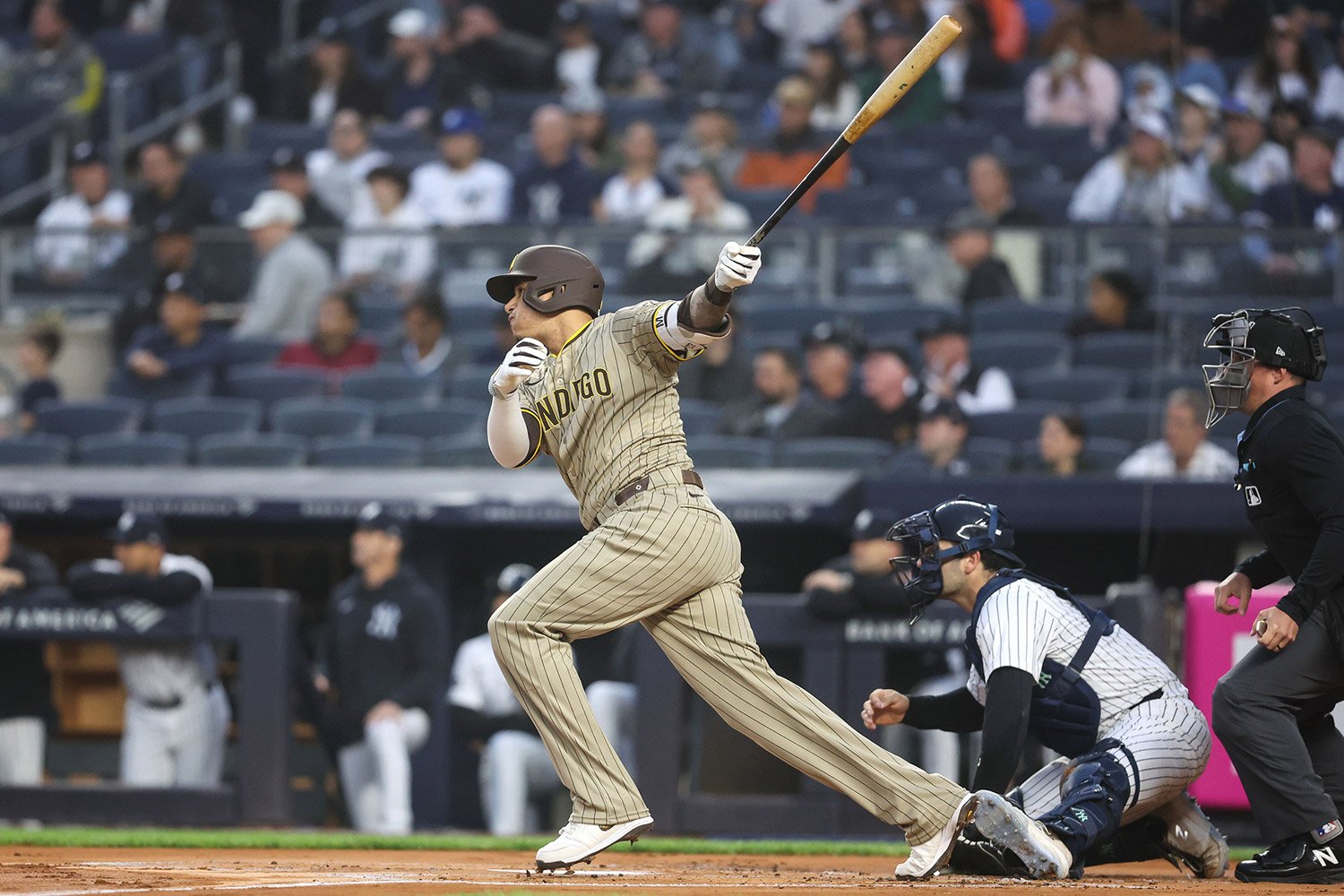 In a number of respects, Manny Machado is the best he's been in years. But the power side isn't one of them. The total body of work indicates an essential component of the San Diego Padres' lineup. Machado's line includes a .295 average, .360 on-base percentage, 16.9% strikeout rate, and a 9.6% walk rate. It all culminates in a 131 wRC+. The K% is his best since 2021, and everything else represents his best work since '22. But despite combining for 91 home runs over the three years prior to 2025, that element of his game has been almost entirely absent thus far. Machado has just three home runs to his credit this season and a .164 ISO. The latter figure represents a decline in each year since the aforementioned '22 campaign, but it also stands as his lowest since 2014, when he appeared in only 82 games and posted a .153 mark. What's weird, though, is that it doesn't entirely jive with what his outcomes should be, given batted ball data. As of this writing, Machado's hard hit rate sits in the 96th percentile (57.0 percent). His 12.0 Barrel% is in the 70th percentile and is a percentage point higher than last season. And it's not as if he's making different swing decisions. His swing rates and contact rates are within a point of last year's output. Pitch types haven't changed in any meaningful way as far as the power discussion goes, either. There's a notable change, but not one that we'd expect to impact him: That's a steep drop in the swing rate vs. off-speed pitches (41.1 percent). It's roughly a 10 percent drop off of what was roughly a six percent drop between '23 and '24. At no point has off-speed represented a source of launch angle. In only one season was it the pitch responsible for his highest fly ball rate. That was in 2014. So while it's the only notable change, it's also not responsible for the waning power output from Machado. His presence within the zone might give us some sense of where the power has gone, though. Here's Machado's fly ball distribution within the zone thus far in 2025: And here's his career: You could make an argument that there's some meat being left on the bone on the inner part of the plate. Especially up and in. It's a case. But much of his career ISO has come from middle-middle and middle-up. So while he might be able to derive more power from attacking that portion of the zone a bit more frequently, it's difficult to say with any certainty what such an increase would look like. If we're still looking for a case, could we blame bat speed? Machado's is on its third consecutive season of decline. He was at a 76.7 MPH average in 2023 and sits at 74.5 MPH this year. His rate of fast swings (over 75 MPH) is also significantly lower over that stretch, dropping from 66.3 percent two years ago to 43.5 percent now. Is it possible that even with solid plate discipline metrics and a steady rate of barrel contact that Machado's bat just doesn't have the same strength that it used to? That feels like an oversimplification. At the same time, it might not be too far off. He's only 32, but that body has been through plenty (including a surgery within the last two years). We'll keep an eye on both dynamics moving forward. Perhaps it's simply the portion of the zone where Machado is operating. Maybe it is age. Either way, it's a concerning development. While the team will get Jackson Merrill & Jake Cronenworth back in the coming days, additional pop from Machado would go a long way toward stabilizing the team's top-heavy offense.
 -
In a number of respects, Manny Machado is the best he's been in years. But the power side isn't one of them. The total body of work indicates an essential component of the San Diego Padres' lineup. Machado's line includes a .295 average, .360 on-base percentage, 16.9% strikeout rate, and a 9.6% walk rate. It all culminates in a 131 wRC+. The K% is his best since 2021, and everything else represents his best work since '22. But despite combining for 91 home runs over the three years prior to 2025, that element of his game has been almost entirely absent thus far. Machado has just three home runs to his credit this season and a .164 ISO. The latter figure represents a decline in each year since the aforementioned '22 campaign, but it also stands as his lowest since 2014, when he appeared in only 82 games and posted a .153 mark. What's weird, though, is that it doesn't entirely jive with what his outcomes should be, given batted ball data. As of this writing, Machado's hard hit rate sits in the 96th percentile (57.0 percent). His 12.0 Barrel% is in the 70th percentile and is a percentage point higher than last season. And it's not as if he's making different swing decisions. His swing rates and contact rates are within a point of last year's output. Pitch types haven't changed in any meaningful way as far as the power discussion goes, either. There's a notable change, but not one that we'd expect to impact him: That's a steep drop in the swing rate vs. off-speed pitches (41.1 percent). It's roughly a 10 percent drop off of what was roughly a six percent drop between '23 and '24. At no point has off-speed represented a source of launch angle. In only one season was it the pitch responsible for his highest fly ball rate. That was in 2014. So while it's the only notable change, it's also not responsible for the waning power output from Machado. His presence within the zone might give us some sense of where the power has gone, though. Here's Machado's fly ball distribution within the zone thus far in 2025: And here's his career: You could make an argument that there's some meat being left on the bone on the inner part of the plate. Especially up and in. It's a case. But much of his career ISO has come from middle-middle and middle-up. So while he might be able to derive more power from attacking that portion of the zone a bit more frequently, it's difficult to say with any certainty what such an increase would look like. If we're still looking for a case, could we blame bat speed? Machado's is on its third consecutive season of decline. He was at a 76.7 MPH average in 2023 and sits at 74.5 MPH this year. His rate of fast swings (over 75 MPH) is also significantly lower over that stretch, dropping from 66.3 percent two years ago to 43.5 percent now. Is it possible that even with solid plate discipline metrics and a steady rate of barrel contact that Machado's bat just doesn't have the same strength that it used to? That feels like an oversimplification. At the same time, it might not be too far off. He's only 32, but that body has been through plenty (including a surgery within the last two years). We'll keep an eye on both dynamics moving forward. Perhaps it's simply the portion of the zone where Machado is operating. Maybe it is age. Either way, it's a concerning development. While the team will get Jackson Merrill & Jake Cronenworth back in the coming days, additional pop from Machado would go a long way toward stabilizing the team's top-heavy offense. View full article
-
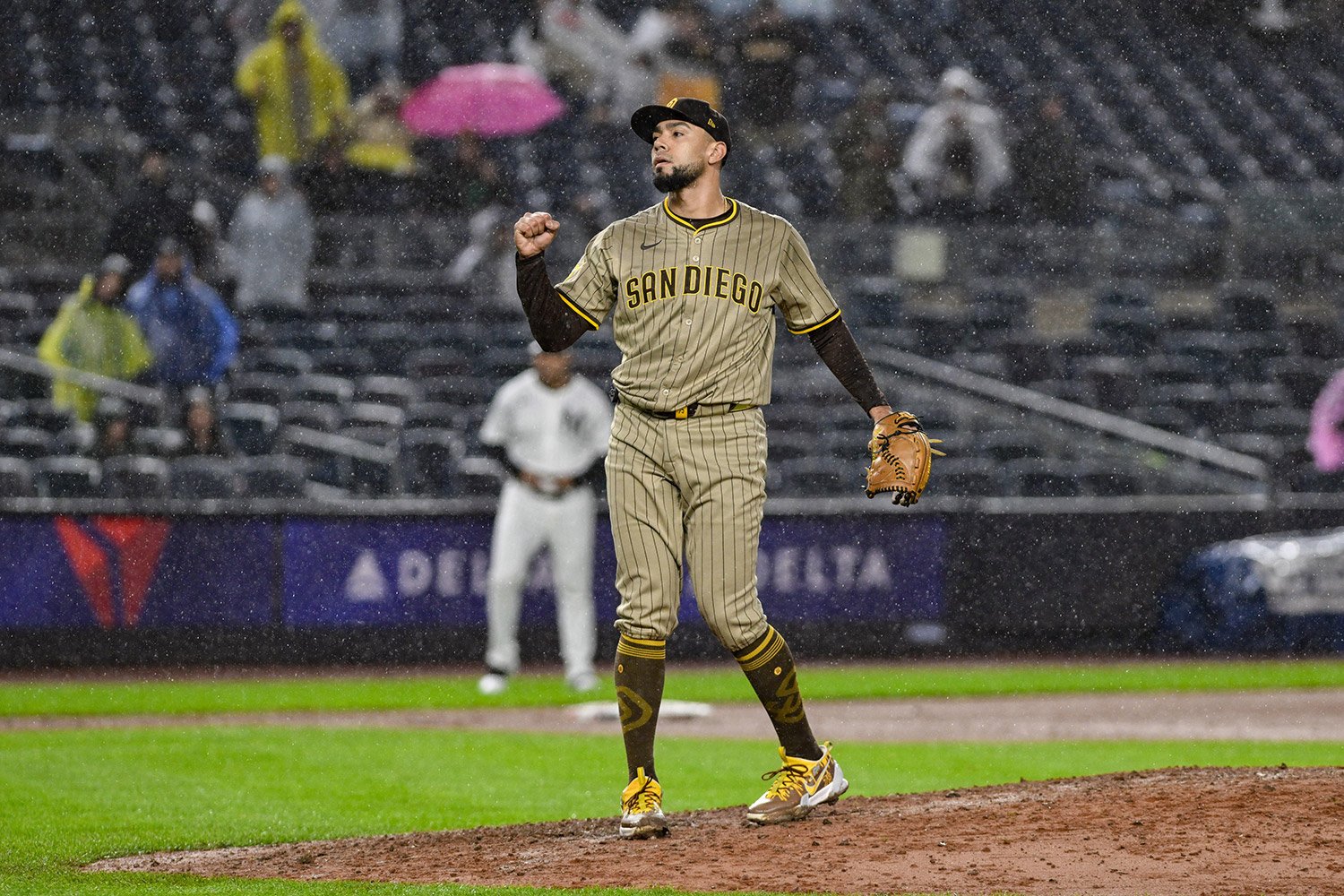 Almost nobody threw more fastballs in 2024 than Robert Suárez. The San Diego Padres' closer rode that pitch and its 99th percentile velocity to 36 saves and a 2.77 ERA. Fine outcomes at the back of the bullpen, to be sure. Ideally, you'd like at least a little variety out of your relief arms. Such variety has manifested in 2025 with the (re)introduction of a changeup. It's not a new pitch for Suárez in the traditional sense, though. As recently as 2023, he was a pitcher who demonstrated much more mix in his usage than we became accustomed to last year. Such mix included three pitches. The fastball was still his most utilized pitch that year (38.3 percent), but it was a narrow gap before we got to the change (33.6). The sinker came in at roughly 22 percent of the time. That Suárez became so fastball-heavy in '24 carries some logic. By Stuff+, it's represented his best offering since 2022 and checked in as one of the 10 best pitches of that variety last year. While that component remains (and is perhaps even better given a 120 Stuff+ thus far), Suárez has spent the early part of 2025 reintegrating the offspeed: That's a pretty tremendous narrowing of the gap in such a short time. The fastball and change account for over 85 percent of the pitches this year. The outcomes reflect the benefits of such variety. And don't. On the positive side, the massive increase in changeup usage has been a boon to Suárez thus far. It carries a 113 Stuff+. He's generating more chase on that pitch than anything else, which accounts for his highest Whiff% on any individual pitch by a wide margin (41.4 vs. 19.7 for the hard stuff). A primary goal of a reliever is to keep hitters off balance. A fastball bringing roughly 100 MPH cheddar combined with a change bringing a velo dip over 10 percent is enough to do just that. But it hasn't been perfect. Suárez allows more barrel contact (7.5 percent barrel rate) and a higher average exit velocity (93.7) than last year. Beyond that, the change isn't doing a whole lot for him overall. The overall whiff rate remains nearly identical to 2024. As does the contact rate. But to say such an evolution in usage is futile would also be an oversimplification. With the spike in changeup usage, Suárez has been able to drive up his strikeout rate (30.2 percent). The xBA on the change is only .133 against .255 with the fastball. While rising in a big picture sense, the exit velocity is a few MPH lower against the offspeed than with the fastball. The negative side is that hitters are able to key in on the fastball a little bit more. Instead of expecting it all the time and being overmatched, hitters can hunt fastball and strike for quality contact. They're not making a ton of it, but it's been a little bit more impactful compared to last year when they do. At least against last year, when they were looking at virtually one pitch type that had a bit more variety in location. Given the rise in punchouts and the limiting of overall baserunners, it at least appears to be a worthy change. Whether Suárez can continue to work through some of the negative components and peripherals associated with it, however, remains to be seen.
 -
Almost nobody threw more fastballs in 2024 than Robert Suárez. The San Diego Padres' closer rode that pitch and its 99th percentile velocity to 36 saves and a 2.77 ERA. Fine outcomes at the back of the bullpen, to be sure. Ideally, you'd like at least a little variety out of your relief arms. Such variety has manifested in 2025 with the (re)introduction of a changeup. It's not a new pitch for Suárez in the traditional sense, though. As recently as 2023, he was a pitcher who demonstrated much more mix in his usage than we became accustomed to last year. Such mix included three pitches. The fastball was still his most utilized pitch that year (38.3 percent), but it was a narrow gap before we got to the change (33.6). The sinker came in at roughly 22 percent of the time. That Suárez became so fastball-heavy in '24 carries some logic. By Stuff+, it's represented his best offering since 2022 and checked in as one of the 10 best pitches of that variety last year. While that component remains (and is perhaps even better given a 120 Stuff+ thus far), Suárez has spent the early part of 2025 reintegrating the offspeed: That's a pretty tremendous narrowing of the gap in such a short time. The fastball and change account for over 85 percent of the pitches this year. The outcomes reflect the benefits of such variety. And don't. On the positive side, the massive increase in changeup usage has been a boon to Suárez thus far. It carries a 113 Stuff+. He's generating more chase on that pitch than anything else, which accounts for his highest Whiff% on any individual pitch by a wide margin (41.4 vs. 19.7 for the hard stuff). A primary goal of a reliever is to keep hitters off balance. A fastball bringing roughly 100 MPH cheddar combined with a change bringing a velo dip over 10 percent is enough to do just that. But it hasn't been perfect. Suárez allows more barrel contact (7.5 percent barrel rate) and a higher average exit velocity (93.7) than last year. Beyond that, the change isn't doing a whole lot for him overall. The overall whiff rate remains nearly identical to 2024. As does the contact rate. But to say such an evolution in usage is futile would also be an oversimplification. With the spike in changeup usage, Suárez has been able to drive up his strikeout rate (30.2 percent). The xBA on the change is only .133 against .255 with the fastball. While rising in a big picture sense, the exit velocity is a few MPH lower against the offspeed than with the fastball. The negative side is that hitters are able to key in on the fastball a little bit more. Instead of expecting it all the time and being overmatched, hitters can hunt fastball and strike for quality contact. They're not making a ton of it, but it's been a little bit more impactful compared to last year when they do. At least against last year, when they were looking at virtually one pitch type that had a bit more variety in location. Given the rise in punchouts and the limiting of overall baserunners, it at least appears to be a worthy change. Whether Suárez can continue to work through some of the negative components and peripherals associated with it, however, remains to be seen. View full article
-
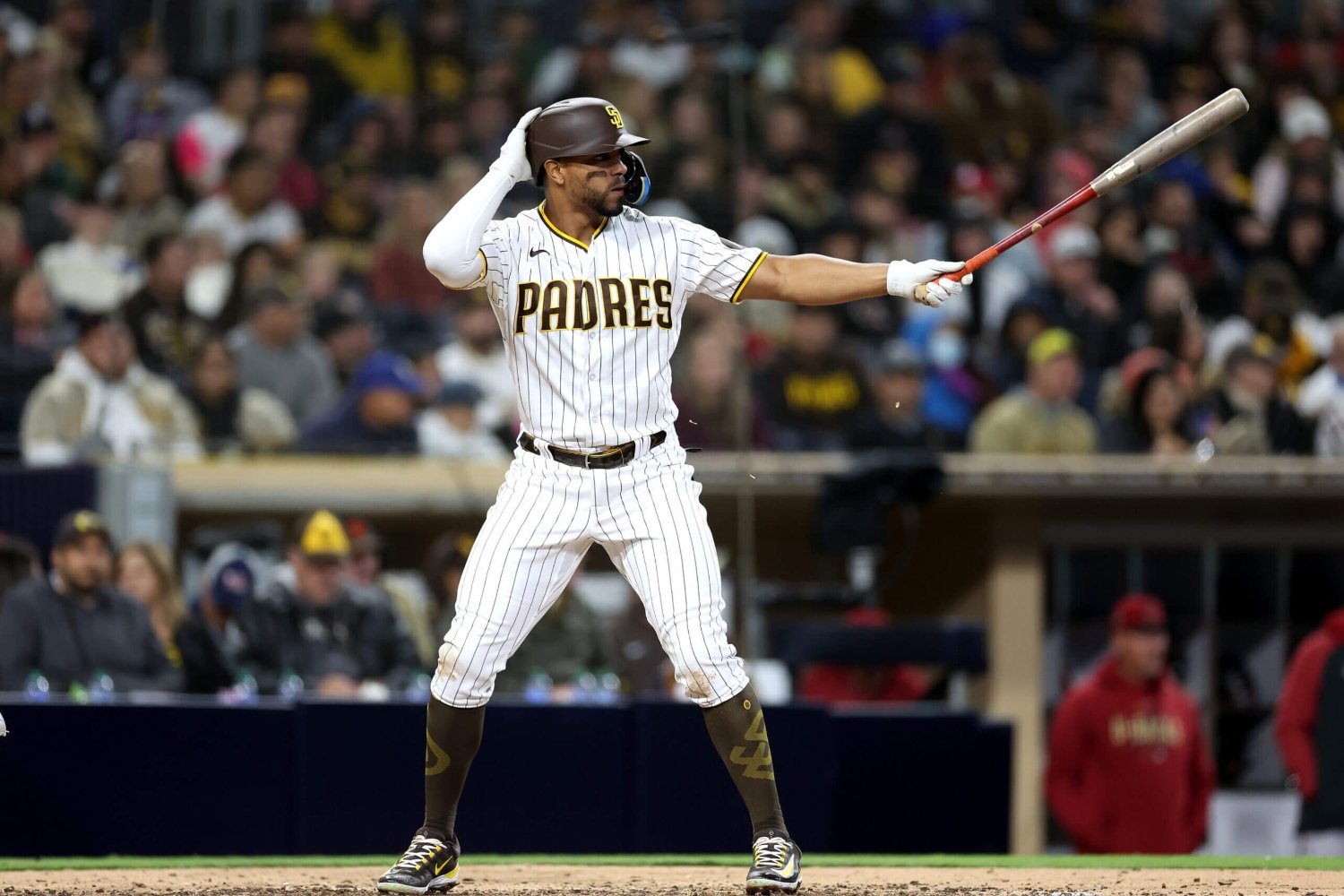 At present, the San Diego Padres are a team starved for offense. Even with the return of Luis Arráez, there's a level of impact that will remain absent from the lineup for the foreseeable future, given that they are still without Jackson Merrill and Jake Cronenworth indefinitely. That's left the team struggling to drum up any level of run production outside of what Fernando Tatis Jr. provides. Manny Machado isn't hitting for a lot of power; Gavin Sheets is striking out too much to be a consistent threat (despite his overall improvement). There simply aren't a lot of avenues for supplementary offense when you're missing key starters, especially when Xander Bogaerts is playing the way he is. Bogaerts' line includes an average of just .243 and a strikeout rate at its highest point since 2014. There are some positives mixed in (he's working a career-best 11.0 percent walk rate), but it's all culminated in a wRC+ of just 90. Coming off a season in which he produced a mark of 95, the last two seasons have seen below average production from a player with another eight years on his contract. The most concerning factor regarding Bogaerts' underwhelming production, though, lies in the lack of any real impact (read: power). While only occasionally a 20+ home run guy, Bogaerts has yet to get one ball over the fence as the calendar turns to May. [Note: This piece was written ahead of Bogaerts' first home run on Tuesday night. The homer came vs. a slider, which is notable considering the points made from here.] His isolated slugging checks in at a mere .084. So, while he's been able to get on base and swipe the occasional bag (four steals as of this writing), there isn't a lot of contribution to the run production game from a player who spends a good deal of time in the middle of the order. It's somewhat paradoxical, too. Bogaerts' bat speed is actually up. His average speed sits at 71.9 MPH and in the 53rd percentile. Last year, he was more than a mile per hour slower (and in the 28th percentile). When you combine a guy who's swinging a faster bat with a guy that has one of the better approaches in matters of chase and whiff, it would seem like a logical formula for success. Especially in the "driving the ball" department. That's not the case with Bogaerts, however. While he's maintaining a keen approach in not expanding the zone and not striking out a bunch with that faster bat, he's also making less overall contact — his overall Contact% is down three percent, at 80.3 for the year. It's become especially egregious outside the strike zone. Despite being more choose-y on such pitches, his contact rate on pitches outside of the zone has plummeted by more than 10 percent (50.0). The trend itself exists as a paradox. He's a patient hitter with quicker bat somehow can't generate quality contact. It then becomes much more real when looking at the type of pitch for which Bogaerts is most likely to expand the zone: That's a steep jump in the chase rate against off-speed pitches, in particular. At 53.3 percent, it also stands as the pitch type he's whiffing at the most on those out-of-zone swings. Unsurprisingly, the off-speed pitch is responsible for his lowest average exit velocity in six of his last seven seasons. There just aren't a lot of ways to win for Bogaerts when he's pursuing the off-speed pitch, especially when it's not within the strike zone. Which leaves us looking at these swing speed figures and making easy sense out of them. Yes, the swing is faster. But his squared-up rate on percentage of contact is down almost five percent (32.3). It presents a frustrating trend given the strides made in the speed itself and in the approach. There's clearly a re-evaluation of said approach needed here in matters of pitch type. Even last year's iteration of Bogaerts didn't include much power. But he was able to derive some out of the fact that he put some separation between fastballs and off-speed pitches in the way he attacked each pitch type. Fastballs were the priority. And while he didn't entirely avoid the off-speed stuff, he was able to swing at a higher frequency against the hard stuff, out of which he was able to salvage some of the power that hasn't been super present since, like, 2021. That's not happening this year, and this is the result you find. Should Bogaerts find some discipline in matters of pitch types, the newfound bat speed should help him to generate a bit more impact for a Padres team that desperately needs it. In the interim, though, the Padres are getting a guy that they have no shortage of on this roster: someone who can get on base, but can't drive in the players already there.
 -
At present, the San Diego Padres are a team starved for offense. Even with the return of Luis Arráez, there's a level of impact that will remain absent from the lineup for the foreseeable future, given that they are still without Jackson Merrill and Jake Cronenworth indefinitely. That's left the team struggling to drum up any level of run production outside of what Fernando Tatis Jr. provides. Manny Machado isn't hitting for a lot of power; Gavin Sheets is striking out too much to be a consistent threat (despite his overall improvement). There simply aren't a lot of avenues for supplementary offense when you're missing key starters, especially when Xander Bogaerts is playing the way he is. Bogaerts' line includes an average of just .243 and a strikeout rate at its highest point since 2014. There are some positives mixed in (he's working a career-best 11.0 percent walk rate), but it's all culminated in a wRC+ of just 90. Coming off a season in which he produced a mark of 95, the last two seasons have seen below average production from a player with another eight years on his contract. The most concerning factor regarding Bogaerts' underwhelming production, though, lies in the lack of any real impact (read: power). While only occasionally a 20+ home run guy, Bogaerts has yet to get one ball over the fence as the calendar turns to May. [Note: This piece was written ahead of Bogaerts' first home run on Tuesday night. The homer came vs. a slider, which is notable considering the points made from here.] His isolated slugging checks in at a mere .084. So, while he's been able to get on base and swipe the occasional bag (four steals as of this writing), there isn't a lot of contribution to the run production game from a player who spends a good deal of time in the middle of the order. It's somewhat paradoxical, too. Bogaerts' bat speed is actually up. His average speed sits at 71.9 MPH and in the 53rd percentile. Last year, he was more than a mile per hour slower (and in the 28th percentile). When you combine a guy who's swinging a faster bat with a guy that has one of the better approaches in matters of chase and whiff, it would seem like a logical formula for success. Especially in the "driving the ball" department. That's not the case with Bogaerts, however. While he's maintaining a keen approach in not expanding the zone and not striking out a bunch with that faster bat, he's also making less overall contact — his overall Contact% is down three percent, at 80.3 for the year. It's become especially egregious outside the strike zone. Despite being more choose-y on such pitches, his contact rate on pitches outside of the zone has plummeted by more than 10 percent (50.0). The trend itself exists as a paradox. He's a patient hitter with quicker bat somehow can't generate quality contact. It then becomes much more real when looking at the type of pitch for which Bogaerts is most likely to expand the zone: That's a steep jump in the chase rate against off-speed pitches, in particular. At 53.3 percent, it also stands as the pitch type he's whiffing at the most on those out-of-zone swings. Unsurprisingly, the off-speed pitch is responsible for his lowest average exit velocity in six of his last seven seasons. There just aren't a lot of ways to win for Bogaerts when he's pursuing the off-speed pitch, especially when it's not within the strike zone. Which leaves us looking at these swing speed figures and making easy sense out of them. Yes, the swing is faster. But his squared-up rate on percentage of contact is down almost five percent (32.3). It presents a frustrating trend given the strides made in the speed itself and in the approach. There's clearly a re-evaluation of said approach needed here in matters of pitch type. Even last year's iteration of Bogaerts didn't include much power. But he was able to derive some out of the fact that he put some separation between fastballs and off-speed pitches in the way he attacked each pitch type. Fastballs were the priority. And while he didn't entirely avoid the off-speed stuff, he was able to swing at a higher frequency against the hard stuff, out of which he was able to salvage some of the power that hasn't been super present since, like, 2021. That's not happening this year, and this is the result you find. Should Bogaerts find some discipline in matters of pitch types, the newfound bat speed should help him to generate a bit more impact for a Padres team that desperately needs it. In the interim, though, the Padres are getting a guy that they have no shortage of on this roster: someone who can get on base, but can't drive in the players already there. View full article
-
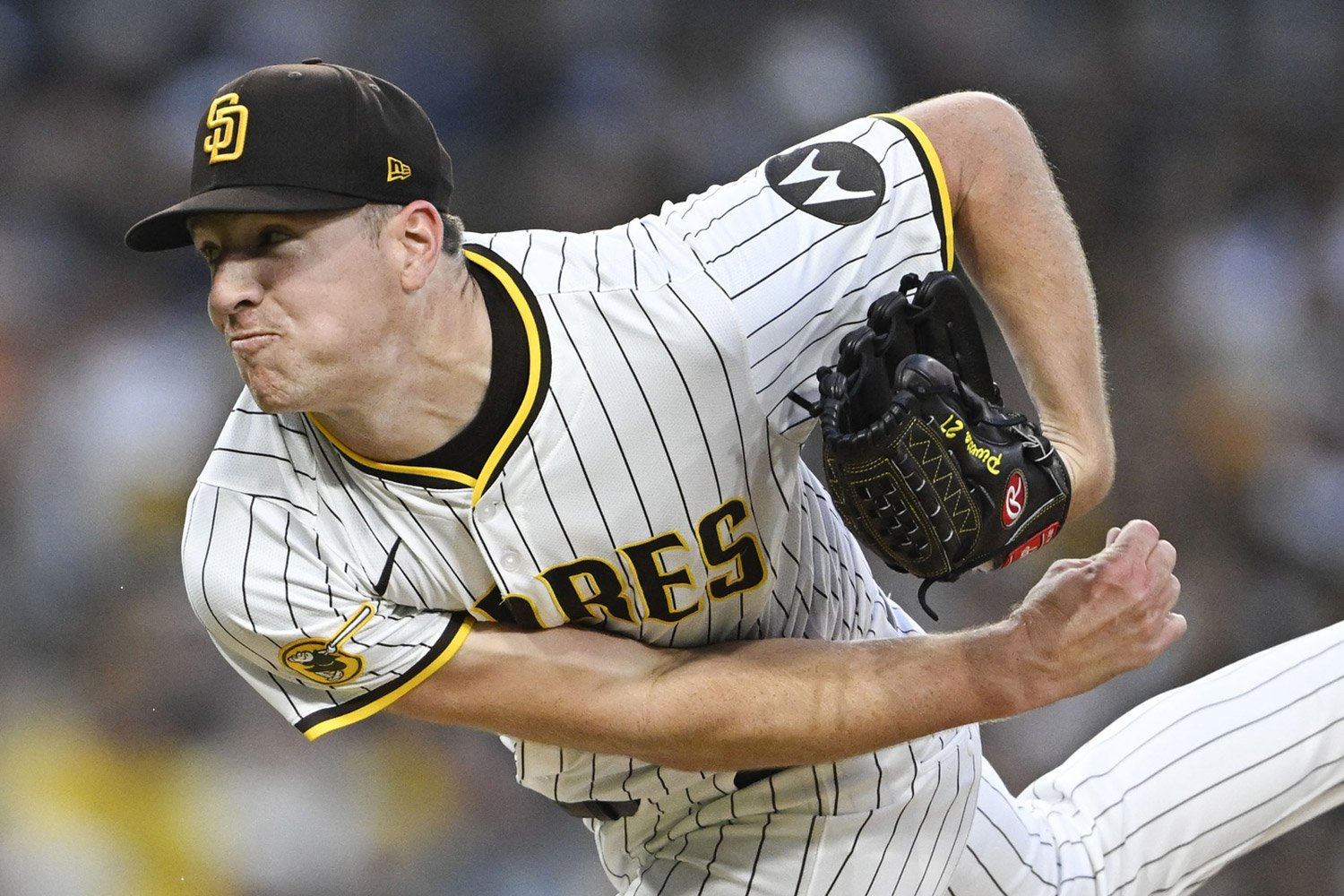 Unlike the hitting side of things, there's a number of arms we can acknowledge as the March/April Pitcher of the Month for the San Diego Padres. While the positional side has been decimated by injuries, the pitching staff has held it together. It hasn't been perfect (given some struggles in the rotation), but it's been a top 10 staff in all of baseball by most measures. With those aforementioned rotation issues in mind — the optioning of Kyle Hart, Michael King's efficiency, and Dylan Cease's start-to-start variance as examples — the key to the staff has been the Padres' late-inning combination of Jeremiah Estrada, Jason Adam, and Robert Suárez. Estrada is off to the best start of his career (1.32 ERA) largely thanks to the flip in his second offering from last year's slider to this year's "chitter." He's generating chase at a rate in the 95th percentile (37.0 percent) and getting punchouts in the 89th (31.4). Adam has been only slightly worse less excellent in the whiff game, but he's off to a 0.60 ERA start in which he hasn't allowed a single barrel. Suárez has been Suárez, incorporating the changeup quite a bit more in order to gain a rise in strikeout rate. They're hardly the only examples from the San Diego 'pen, however. Alek Jacob has been quite good across 15 innings of work. Adrian Morejón continues to look like one of the game's best middle relievers, with an arsenal that leaves him capable of being dropped into any given situation over the course of nine innings. The team not only has the chops to close out games efficiently, but a bridge to get them there. Our Pitcher of the Month for March & April, though, comes out of the rotation. And even though he signed on at the end of February, Nick Pivetta has been the team's most important pitcher through the first month-or-so of the 2025 season. Following a 2023 as a swingman and a 2024 that featured a 4.14 ERA as a full-time starter in Boston, Pivetta came in as one of the team's only Major League signings from this past winter. And while there are no shortage of reasons to believe that the regression monster could creep up behind him at any second, the efficiency and stability Pivetta has provided in the rotation thus far has been paramount for the Padres. The surface numbers are outstanding. Pivetta's pitched to a 1.20 ERA & 2.20 FIP through his first five starts, averaging six innings per start. He's gone seven innings in three of those five outings. The strikeout rate is down a touch (27.0 percent), but the walk rate has remained just about the same (the 6.3 percent rate is actually down on a per-inning basis). I mentioned regression. Pivetta has allowed a .205 BABIP and is stranding roughly 88 percent of runners. His barrel rate is living in just the 36th percentile (9.5 percent), and his groundball rate remains low (around 35 percent). His spike in sinker usage (and subsequent outcomes) should help him to remain largely efficient, but we have every reason to think that there's at least some level of regression on the horizon. Luckily, the team has the horses behind him to minimize the effects. That's a concern for another day, though. The Padres have needed every bit of the efficiency he's provided out of the rotation thus far. Dylan Cease has only worked past the fifth inning twice. Michael King has lacked a certain efficiency throughout his starts, despite the overall quality (which remains high). Dylan Cease has only worked past the fifth inning twice. Kyle Hart's already in El Paso. Yu Darvish and Matt Waldron remain on the IL. Regression — and the excellence of the relief corps — be damned, Nick Pivetta has been the team's most important pitcher through a month-and-change of 2025.
 -
Unlike the hitting side of things, there's a number of arms we can acknowledge as the March/April Pitcher of the Month for the San Diego Padres. While the positional side has been decimated by injuries, the pitching staff has held it together. It hasn't been perfect (given some struggles in the rotation), but it's been a top 10 staff in all of baseball by most measures. With those aforementioned rotation issues in mind — the optioning of Kyle Hart, Michael King's efficiency, and Dylan Cease's start-to-start variance as examples — the key to the staff has been the Padres' late-inning combination of Jeremiah Estrada, Jason Adam, and Robert Suárez. Estrada is off to the best start of his career (1.32 ERA) largely thanks to the flip in his second offering from last year's slider to this year's "chitter." He's generating chase at a rate in the 95th percentile (37.0 percent) and getting punchouts in the 89th (31.4). Adam has been only slightly worse less excellent in the whiff game, but he's off to a 0.60 ERA start in which he hasn't allowed a single barrel. Suárez has been Suárez, incorporating the changeup quite a bit more in order to gain a rise in strikeout rate. They're hardly the only examples from the San Diego 'pen, however. Alek Jacob has been quite good across 15 innings of work. Adrian Morejón continues to look like one of the game's best middle relievers, with an arsenal that leaves him capable of being dropped into any given situation over the course of nine innings. The team not only has the chops to close out games efficiently, but a bridge to get them there. Our Pitcher of the Month for March & April, though, comes out of the rotation. And even though he signed on at the end of February, Nick Pivetta has been the team's most important pitcher through the first month-or-so of the 2025 season. Following a 2023 as a swingman and a 2024 that featured a 4.14 ERA as a full-time starter in Boston, Pivetta came in as one of the team's only Major League signings from this past winter. And while there are no shortage of reasons to believe that the regression monster could creep up behind him at any second, the efficiency and stability Pivetta has provided in the rotation thus far has been paramount for the Padres. The surface numbers are outstanding. Pivetta's pitched to a 1.20 ERA & 2.20 FIP through his first five starts, averaging six innings per start. He's gone seven innings in three of those five outings. The strikeout rate is down a touch (27.0 percent), but the walk rate has remained just about the same (the 6.3 percent rate is actually down on a per-inning basis). I mentioned regression. Pivetta has allowed a .205 BABIP and is stranding roughly 88 percent of runners. His barrel rate is living in just the 36th percentile (9.5 percent), and his groundball rate remains low (around 35 percent). His spike in sinker usage (and subsequent outcomes) should help him to remain largely efficient, but we have every reason to think that there's at least some level of regression on the horizon. Luckily, the team has the horses behind him to minimize the effects. That's a concern for another day, though. The Padres have needed every bit of the efficiency he's provided out of the rotation thus far. Dylan Cease has only worked past the fifth inning twice. Michael King has lacked a certain efficiency throughout his starts, despite the overall quality (which remains high). Dylan Cease has only worked past the fifth inning twice. Kyle Hart's already in El Paso. Yu Darvish and Matt Waldron remain on the IL. Regression — and the excellence of the relief corps — be damned, Nick Pivetta has been the team's most important pitcher through a month-and-change of 2025. View full article
-
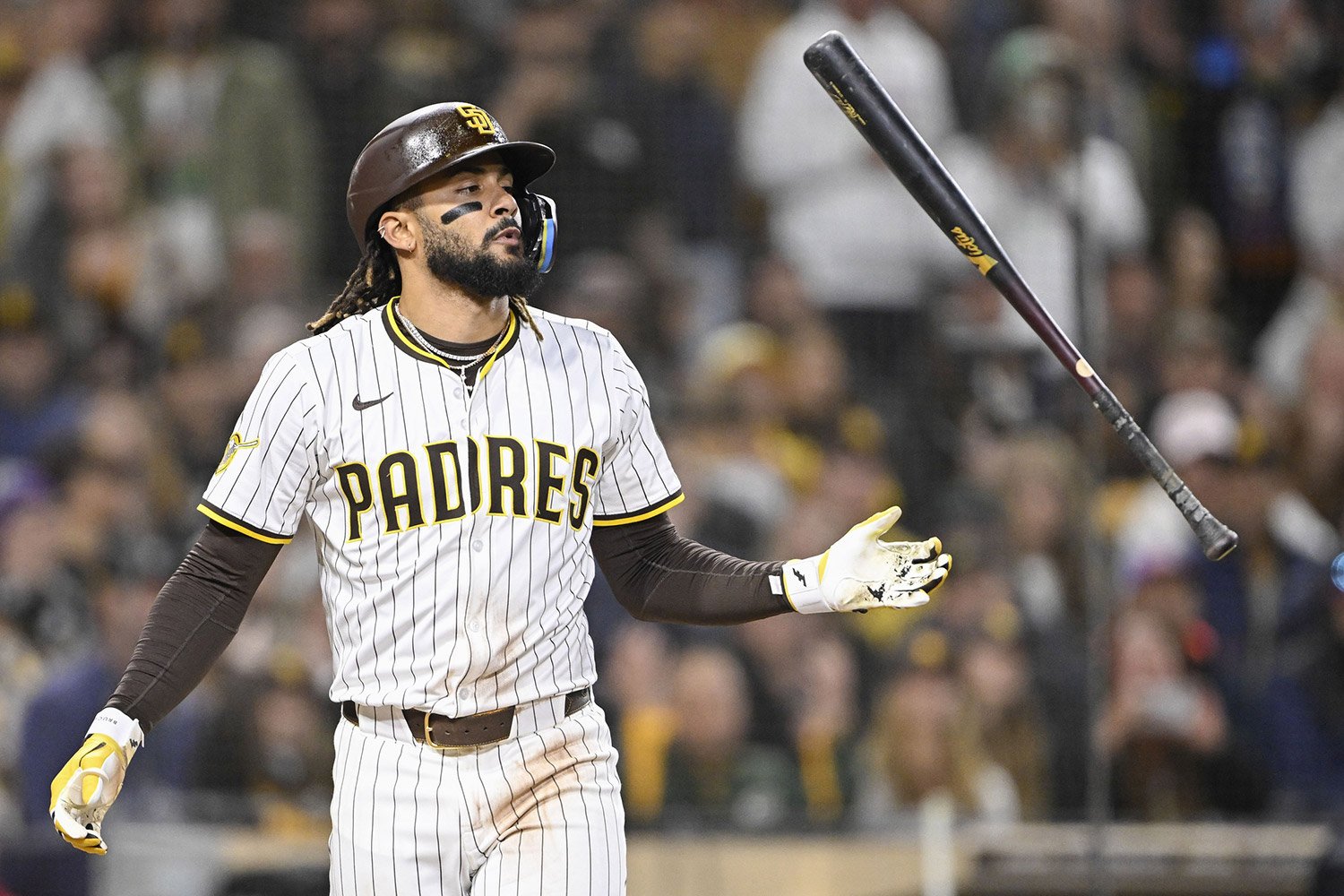 With the month of April coming to a close, it's time to examine the San Diego Padres' most impressive player on the positional side. Given the rash of injuries the team has experienced in recent weeks, however, it leaves us with fairly slim pickings. Jackson Merrill has been out for nearly three weeks. Jake Cronenworth for only slightly less. Luis Arráez missed a week. In between Injured List stints, the Padres are still waiting for Manny Machado to find a power stroke, hoping that Gavin Sheets will get his strikeout rate a little clearer of 30 percent, and praying that Xander Bogaerts will provide any offensive value that doesn't involve a walk. Which leaves us with only one option: Fernando Tatis Jr. Don't get it twisted, though. That Fernando Tatis Jr. is our March & April Hitter of the Month by default is hardly the result of the context permeating the rest of the roster. He's been legitimately excellent. Only two players have been more valuable this season than Tatis by fWAR: Aaron Judge & Corbin Carroll. And while Judge has the edge on the rest of the league by a wide margin, Carroll's 2.1 figure as of this writing only narrowly beats out Tatis' 2.0. Assuming his new role in the leadoff spot, he's thrived in virtually every aspect through the season's first month-plus. Some adjustments to the swing have allowed Tatis to lean into the pull side a bit more, resulting in more power, especially at home. His line thus far includes an average of .346, an on-base percentage of .415, and an OPS of 1.040. Each of those figures is in the league's top seven. He also carries an ISO of .279 and a wRC+ of 188. That latter figure has him as the league's fourth-best hitter. The rediscovery of the power stroke is an important component as Tatis reestablishes his status among the game's brightest stars. His average exit velocity (95.1) sits in the 97th percentile, and his 19.3 Barrel% checks in at the 95th. The approach hasn't changed, but he's making more contact (particularly inside the strike zone). When you combine those factors, the uptick in power output is hardly surprising. But he's also reclaiming some activity on the basepaths. Tatis' seven steals rank 12th in the league. His Baserunning Runs (BsR) from FanGraphs (0.9) has him in the league's top 30. While it's been a bit more in vain given the absence of consistent offense behind him (wrought by the team's injury woes), he's simply provided value in every possible area of offense. It's a crucial tone to set, both for Tatis Jr, the player, and the Padres at large. Coming off a season in which he was quite good, but held back by the stress fracture, there hadn't yet been a stretch since the 2022 debacle where we felt like he was on his way back to the player he was in the three years prior. It appears that's changed. For the San Diego Padres, nobody was better to start the year. And it's not particularly close.
 -
Is this even a question? With the month of April coming to a close, it's time to examine the San Diego Padres' most impressive player on the positional side. Given the rash of injuries the team has experienced in recent weeks, however, it leaves us with fairly slim pickings. Jackson Merrill has been out for nearly three weeks. Jake Cronenworth for only slightly less. Luis Arráez missed a week. In between Injured List stints, the Padres are still waiting for Manny Machado to find a power stroke, hoping that Gavin Sheets will get his strikeout rate a little clearer of 30 percent, and praying that Xander Bogaerts will provide any offensive value that doesn't involve a walk. Which leaves us with only one option: Fernando Tatis Jr. Don't get it twisted, though. That Fernando Tatis Jr. is our March & April Hitter of the Month by default is hardly the result of the context permeating the rest of the roster. He's been legitimately excellent. Only two players have been more valuable this season than Tatis by fWAR: Aaron Judge & Corbin Carroll. And while Judge has the edge on the rest of the league by a wide margin, Carroll's 2.1 figure as of this writing only narrowly beats out Tatis' 2.0. Assuming his new role in the leadoff spot, he's thrived in virtually every aspect through the season's first month-plus. Some adjustments to the swing have allowed Tatis to lean into the pull side a bit more, resulting in more power, especially at home. His line thus far includes an average of .346, an on-base percentage of .415, and an OPS of 1.040. Each of those figures is in the league's top seven. He also carries an ISO of .279 and a wRC+ of 188. That latter figure has him as the league's fourth-best hitter. The rediscovery of the power stroke is an important component as Tatis reestablishes his status among the game's brightest stars. His average exit velocity (95.1) sits in the 97th percentile, and his 19.3 Barrel% checks in at the 95th. The approach hasn't changed, but he's making more contact (particularly inside the strike zone). When you combine those factors, the uptick in power output is hardly surprising. But he's also reclaiming some activity on the basepaths. Tatis' seven steals rank 12th in the league. His Baserunning Runs (BsR) from FanGraphs (0.9) has him in the league's top 30. While it's been a bit more in vain given the absence of consistent offense behind him (wrought by the team's injury woes), he's simply provided value in every possible area of offense. It's a crucial tone to set, both for Tatis Jr, the player, and the Padres at large. Coming off a season in which he was quite good, but held back by the stress fracture, there hadn't yet been a stretch since the 2022 debacle where we felt like he was on his way back to the player he was in the three years prior. It appears that's changed. For the San Diego Padres, nobody was better to start the year. And it's not particularly close. View full article
-
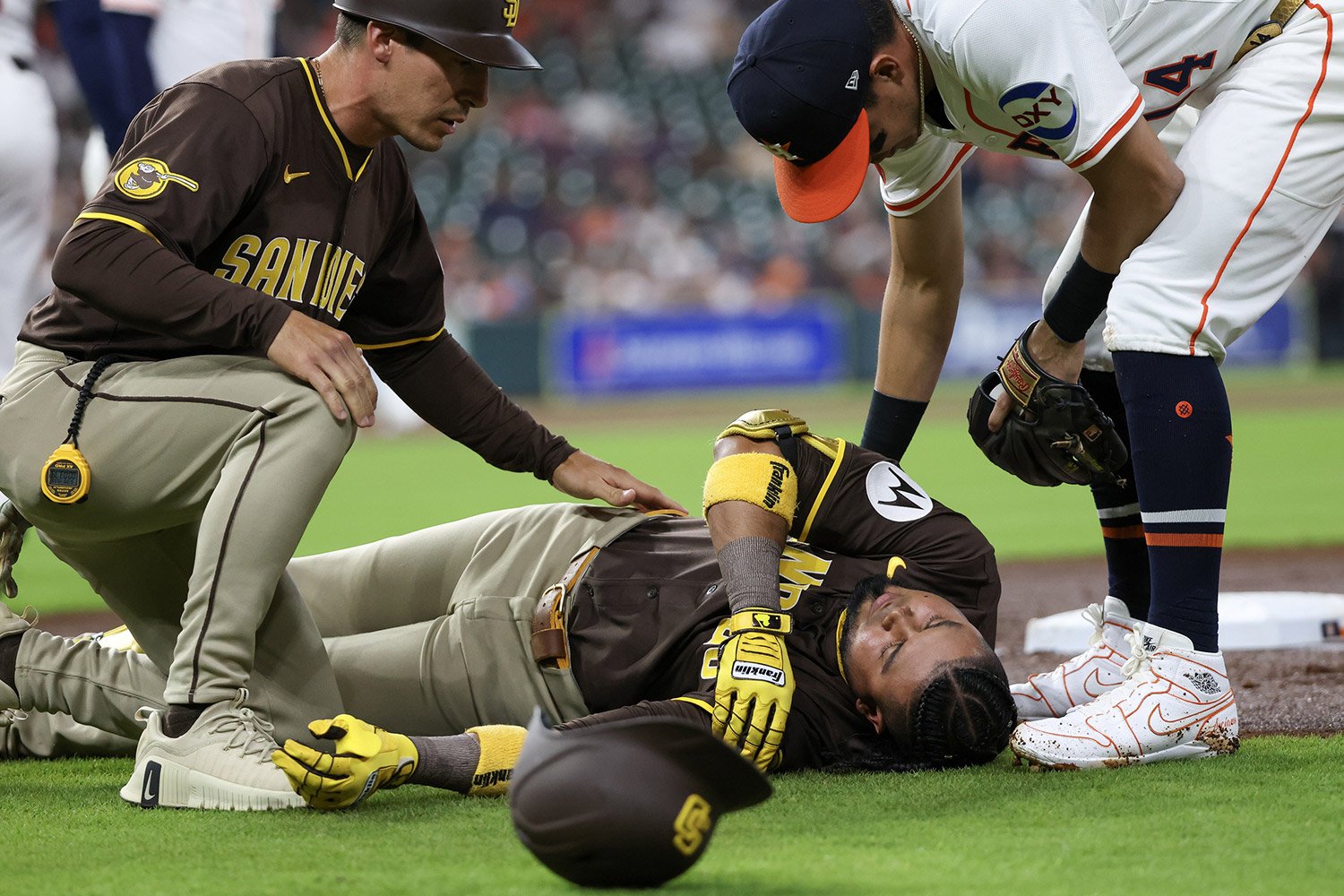 Even home cookin' isn't enough for the San Diego Padres these days. The team that started 12-1 at the friendly confines of Petco Park endured their first sweep of the season over the weekend, stinging even more because it came upon their return home from a six-game road swing. They scored just three runs across three games against the Tampa Bay Rays, giving way to larger concerns about the offense's ability to produce runs. At the same time, several key players remain out with various injuries. Jackson Merrill was placed on the IL on April 8th with a hamstring injury. Three days later, on April 11th, Jake Cronenworth followed with a rib injury. Luis Arráez went on the 7-day concussion IL exactly a week ago on Monday, following a scary collision in Houston. Those benchmarks are important in examining the Padres' offensive woes in recent games. Through April 7th, the Padres were a top 10 team in terms of run production. They'd scored 51 runs across 11 games, with a collective 120 wRC+ that ranked seventh among all teams in Major League Baseball. Even when Merrill went down, they stayed the course. Their wRC+ with an extra three days came in at 117 (sixth), and they were 10th in runs scored. Since that point, though, the injuries have started to wear on the Padres' offensive attack. They rank just 26th in runs (49) and 23rd in wRC+ (91). Their on-base percentage, a hallmark of early success, has also fallen to 23rd (.303). The last week without Arráez, in particular, has been a massive struggle. They've scored only nine runs in the past week (six games) and are 28th in OBP (.237). Their 41 collective wRC+ is just a single notch above last-place Toronto and Los Angeles (the Angels, obviously). There is, of course, a caveat to that in that they've gone against quality pitching. Houston (3.18) and Detroit (2.80) each rank in the top four staffs in cumulative ERA. Tampa Bay's just a little bit farther down the list in seventh (3.46). But it's not like things get easier this week. They'll welcome San Francisco's ninth-ranked (3.47) staff to town before heading to Pittsburgh & New York, each of which features staffs in the top half of the league in overall production. It's obviously very bad timing for a team just trying to scrape any offense they can find in the absence of several key players. Relying on the likes of Jose Iglesias, Tyler Wade, Yuli Gurriel, Tirso Ornelas, and Connor Joe likely isn't what the front office envisioned, even on a team starved for actual depth. And while, for their money, the likes of Iglesias and Wade have been fine, they're hardly impact bats in the lineup. At best, you're getting quality on-base skills for the rest of the lineup to knock in. Except most of the rest of the lineup is hanging out in IL city. But there is, at least, some reason for optimism on the horizon. Arráez appears set to be activated on Tuesday after spending the minimum on the concussion IL. Jason Heyward could join him. Jackson Merrill is taking live batting practice, and Jake Cronenworth is getting some fielding work in. While the latter has yet to begin diving as part of his on-field ramp-up, there are some encouraging signs that the health of the lineup is finally starting to tilt in the Padres' favor. They're not there yet, though. While a couple of off days this week will buy additional time, the lack of offense remains concerning. Difficult as it may be to pin recent losses on guys pressed into far more duty than expected, the team is going to have to find ways to generate at least some offense to support what has continued to be a high-quality pitching staff or risk falling behind quickly in the exceptionally competitive National League West.
 -
Injuries Taking Their Toll On The Padres' Offense
Randy Holt posted a topic in San Diego Padres Talk
Turns out, it's a lot harder to score runs when roughly half your lineup is on the injured list. Even home cookin' isn't enough for the San Diego Padres these days. The team that started 12-1 at the friendly confines of Petco Park endured their first sweep of the season over the weekend, stinging even more because it came upon their return home from a six-game road swing. They scored just three runs across three games against the Tampa Bay Rays, giving way to larger concerns about the offense's ability to produce runs. At the same time, several key players remain out with various injuries. Jackson Merrill was placed on the IL on April 8th with a hamstring injury. Three days later, on April 11th, Jake Cronenworth followed with a rib injury. Luis Arráez went on the 7-day concussion IL exactly a week ago on Monday, following a scary collision in Houston. Those benchmarks are important in examining the Padres' offensive woes in recent games. Through April 7th, the Padres were a top 10 team in terms of run production. They'd scored 51 runs across 11 games, with a collective 120 wRC+ that ranked seventh among all teams in Major League Baseball. Even when Merrill went down, they stayed the course. Their wRC+ with an extra three days came in at 117 (sixth), and they were 10th in runs scored. Since that point, though, the injuries have started to wear on the Padres' offensive attack. They rank just 26th in runs (49) and 23rd in wRC+ (91). Their on-base percentage, a hallmark of early success, has also fallen to 23rd (.303). The last week without Arráez, in particular, has been a massive struggle. They've scored only nine runs in the past week (six games) and are 28th in OBP (.237). Their 41 collective wRC+ is just a single notch above last-place Toronto and Los Angeles (the Angels, obviously). There is, of course, a caveat to that in that they've gone against quality pitching. Houston (3.18) and Detroit (2.80) each rank in the top four staffs in cumulative ERA. Tampa Bay's just a little bit farther down the list in seventh (3.46). But it's not like things get easier this week. They'll welcome San Francisco's ninth-ranked (3.47) staff to town before heading to Pittsburgh & New York, each of which features staffs in the top half of the league in overall production. It's obviously very bad timing for a team just trying to scrape any offense they can find in the absence of several key players. Relying on the likes of Jose Iglesias, Tyler Wade, Yuli Gurriel, Tirso Ornelas, and Connor Joe likely isn't what the front office envisioned, even on a team starved for actual depth. And while, for their money, the likes of Iglesias and Wade have been fine, they're hardly impact bats in the lineup. At best, you're getting quality on-base skills for the rest of the lineup to knock in. Except most of the rest of the lineup is hanging out in IL city. But there is, at least, some reason for optimism on the horizon. Arráez appears set to be activated on Tuesday after spending the minimum on the concussion IL. Jason Heyward could join him. Jackson Merrill is taking live batting practice, and Jake Cronenworth is getting some fielding work in. While the latter has yet to begin diving as part of his on-field ramp-up, there are some encouraging signs that the health of the lineup is finally starting to tilt in the Padres' favor. They're not there yet, though. While a couple of off days this week will buy additional time, the lack of offense remains concerning. Difficult as it may be to pin recent losses on guys pressed into far more duty than expected, the team is going to have to find ways to generate at least some offense to support what has continued to be a high-quality pitching staff or risk falling behind quickly in the exceptionally competitive National League West. View full article -
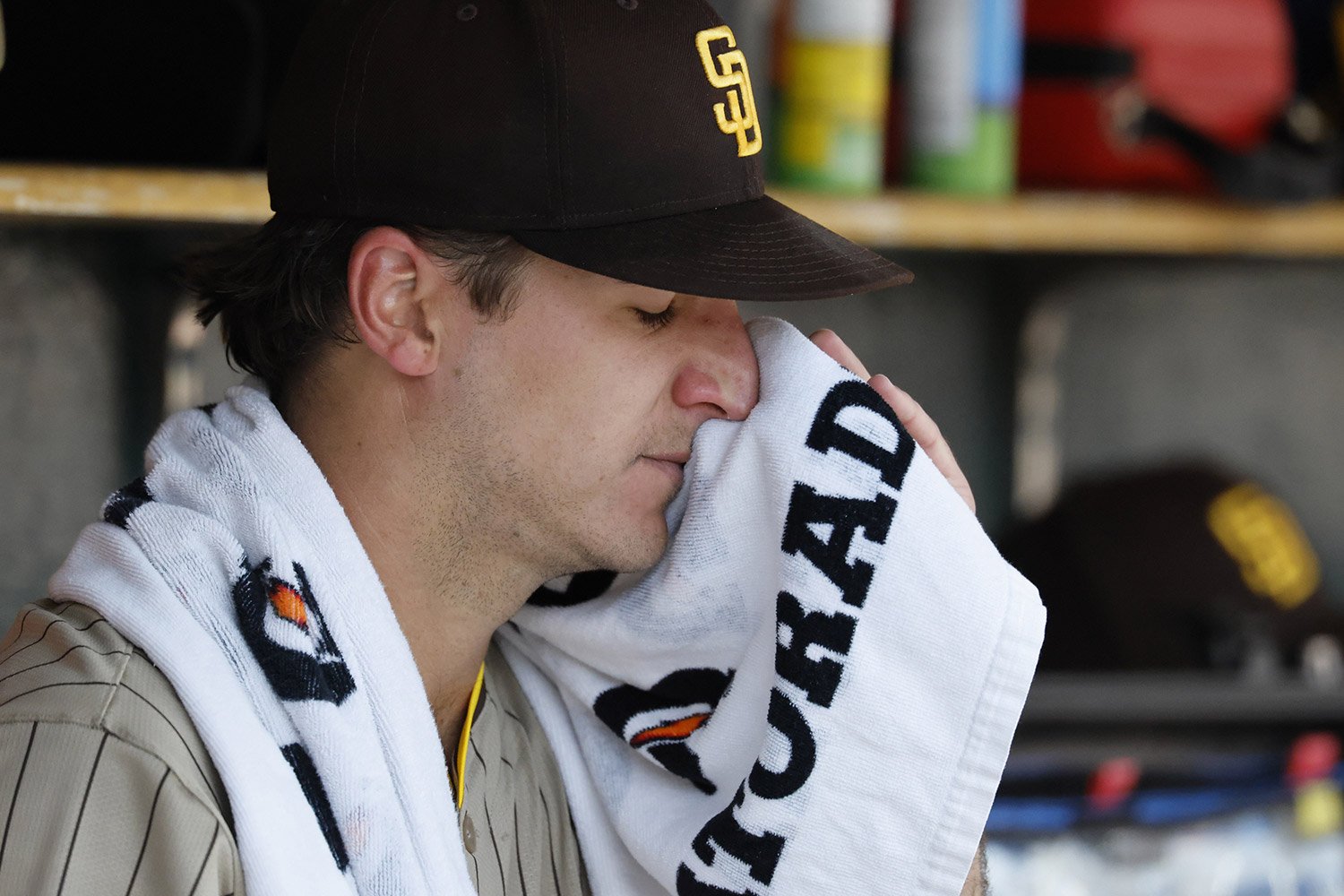 On Friday, the San Diego Padres announced that they've optioned starting pitcher Kyle Hart to Triple-A. Hart will ply his trade with the El Paso Chihuahuas for at least the next few weeks. With a rash of injuries limiting the team's ability to replace him directly from the 40-man, Hart will be replaced on the active roster by reliever Ryan Bergert. It's not an entirely unusual situation that the Padres optioned a player who is essentially their fifth starter—maybe their fourth. But the impact on the roster presents a couple of different layers of intrigue. First is just Hart's direct optioning. While he wasn't guaranteed a roster spot in his return from the KBO, Hart was able to grab the job largely due to Yu Darvish's elbow inflammation. His spring wasn't terrific (9.39 ERA), so there was a sort of "by default" factor given that he'd, ideally, be able to eat up some innings. Through his first five starts, though, Hart was leaving a lot on his plate. He went five innings in his first start but couldn't escape the first in his second. While he was able to turn in six shutout innings in the third start, it came against a brutal Colorado squad. His subsequent two starts saw him surrender five runs in five innings against Houston before working through just 4.1 innings of two-run ball in Detroit. It's left some pretty shoddy numbers on the books for him to date. Hart's line includes 21 innings, a 6.00 ERA (6.07 FIP), a 17.8 K%, and a 6.7 BB%. The walk rate looks pretty good. The issue is that virtually nothing else does: That's a lot of hard contact, a lot of barrels, and not much compensating for a relatively high overall contact rate (82.1 percent). He'll head to El Paso to work on some things. Ideally, he returns with a more stable foundation from which to work. His usage has been messy in terms of the usage itself and subsequent outcomes. With pressure already on the bullpen, given some injuries there, it was simply necessary. In a more pressing concern for the roster at large, though, you'll note the word "reliever" in the above regarding Ryan Bergert. The aforementioned slate of injuries — the team's Injured List currently features 11 different names — is problematic not only because of the direct impact of said injuries, but also the lack of flexibility wrought by them. Most of them are relatively short-term; almost none require a trip to the 60-day IL, which would provide a bit more flexibility on the 40-man roster. As such, the Padres are largely left to work with what they have. Moving out a position player or pitcher isn't going to happen with the team scraping the bottom of the barrel for personnel. While Bergert is not a starter, he can go multiple innings at a time if needed, so even a bullpen game should be manageable. That means, however, that with Hart's demotion, the team is set to roll with a four-man rotation for the time being. That could (?) be fine. The team has a day off on Monday and another on Thursday. The schedule could play out reasonably for them, permitting a short-handed starting group to remain roughly on time. There's also the possibility that Yu Darvish nears a return by the time a five-man rotation becomes a necessity again. He's begun ramping up more recently, with live BP appearing on the horizon. Such impeccable timing would be uncharacteristic of the massive bout of poor luck the Padres have experienced this year, but it does remain a possibility. Otherwise, you hope they get healthy elsewhere on the roster to open up more 40-man flexibility. It's a new situation for the Padres in 2025 to option out a player; their roster has performed so well to date, despite the injuries that have been the primary culprits of forcing players out. But subtracting Kyle Hart from the mix indefinitely is still an all-too-familiar problem for the team to confront as they move into the month of May.
 -
A four-man rotation it is, apparently. On Friday, the San Diego Padres announced that they've optioned starting pitcher Kyle Hart to Triple-A. Hart will ply his trade with the El Paso Chihuahuas for at least the next few weeks. With a rash of injuries limiting the team's ability to replace him directly from the 40-man, Hart will be replaced on the active roster by reliever Ryan Bergert. It's not an entirely unusual situation that the Padres optioned a player who is essentially their fifth starter—maybe their fourth. But the impact on the roster presents a couple of different layers of intrigue. First is just Hart's direct optioning. While he wasn't guaranteed a roster spot in his return from the KBO, Hart was able to grab the job largely due to Yu Darvish's elbow inflammation. His spring wasn't terrific (9.39 ERA), so there was a sort of "by default" factor given that he'd, ideally, be able to eat up some innings. Through his first five starts, though, Hart was leaving a lot on his plate. He went five innings in his first start but couldn't escape the first in his second. While he was able to turn in six shutout innings in the third start, it came against a brutal Colorado squad. His subsequent two starts saw him surrender five runs in five innings against Houston before working through just 4.1 innings of two-run ball in Detroit. It's left some pretty shoddy numbers on the books for him to date. Hart's line includes 21 innings, a 6.00 ERA (6.07 FIP), a 17.8 K%, and a 6.7 BB%. The walk rate looks pretty good. The issue is that virtually nothing else does: That's a lot of hard contact, a lot of barrels, and not much compensating for a relatively high overall contact rate (82.1 percent). He'll head to El Paso to work on some things. Ideally, he returns with a more stable foundation from which to work. His usage has been messy in terms of the usage itself and subsequent outcomes. With pressure already on the bullpen, given some injuries there, it was simply necessary. In a more pressing concern for the roster at large, though, you'll note the word "reliever" in the above regarding Ryan Bergert. The aforementioned slate of injuries — the team's Injured List currently features 11 different names — is problematic not only because of the direct impact of said injuries, but also the lack of flexibility wrought by them. Most of them are relatively short-term; almost none require a trip to the 60-day IL, which would provide a bit more flexibility on the 40-man roster. As such, the Padres are largely left to work with what they have. Moving out a position player or pitcher isn't going to happen with the team scraping the bottom of the barrel for personnel. While Bergert is not a starter, he can go multiple innings at a time if needed, so even a bullpen game should be manageable. That means, however, that with Hart's demotion, the team is set to roll with a four-man rotation for the time being. That could (?) be fine. The team has a day off on Monday and another on Thursday. The schedule could play out reasonably for them, permitting a short-handed starting group to remain roughly on time. There's also the possibility that Yu Darvish nears a return by the time a five-man rotation becomes a necessity again. He's begun ramping up more recently, with live BP appearing on the horizon. Such impeccable timing would be uncharacteristic of the massive bout of poor luck the Padres have experienced this year, but it does remain a possibility. Otherwise, you hope they get healthy elsewhere on the roster to open up more 40-man flexibility. It's a new situation for the Padres in 2025 to option out a player; their roster has performed so well to date, despite the injuries that have been the primary culprits of forcing players out. But subtracting Kyle Hart from the mix indefinitely is still an all-too-familiar problem for the team to confront as they move into the month of May. View full article